Page 1 of 2 Next >> In the second half of the 1970s Turbo charged engines made an explosive entrance into Formula 1. That can be taken very literally as the engines were very powerful, but usually went out with a big bang long before the races were over. It took a few years before the volatile forced induction engines were finally tamed and by then they had a 200 bhp power advantage over the Naturally Aspirated competition. Many of the smaller teams had neither the means nor the desire to race the very complex Turbo engines and had to rely on the latest version short-stroke of the Cosworth V8 engine. To bridge the 200 bhp gap the teams came up with several unconventional and often controversial solutions, but nevertheless they were steadily losing ground. One of the very last brand new cars built for a Naturally Aspirated engine was the Tyrrell 012, launched toward the end of the 1983 season.
With ground-effects banned at the start of the season, Tyrrell designer Maurice Phillippe no longer had to worry about elaborate side-pods. He came up with a very minimalistic design that bore quite some similarities with the Brabham BT52 penned by Gordon Murray. Much of the weight was moved towards the rear of the car, creating a distinct arrow shape. Breaking new ground for Tyrrell, the 012 used a considerable amount of carbon fibre to ensure the car was as light as possible. The composite material was used for the carbon fibre and aluminium honeycomb monocoque, the body and the wings. The parts were created for Tyrrell by expert Courtalds. Power came from the DFY variant of the Cosworth engine, which was bolted directly to the tub and sandwiched between the radiators. The short stroke engine produced a solid 500 bhp, but that was still around 200 bhp short of what the BMW, Ferrari and Renault engine produced in race trim.
Despite the power deficit Michele Alboreto had managed to score a victory earlier in 1983 with the two year old Tyrrell 011. As the 012 was an altogether more advanced car as its predecessor, the expectations were high when Michele Alboreto debuted the new racing car during the 1983 Dutch Grand Prix at Zandvoort. In race trim the Turbocharged machines already had a power advantage, but in qualifying they completely eclipsed the Naturally Aspirated runners with special engines running at a higher Turbo boost, producing in excess of 1000 bhp. Although Alboreto qualified the Tyrrell 012 well down the grid at its debut, his time was close to the fastest Cosworth runner. In the race the proven reliability of the V8 engine saw the Italian climb up the leaderbord to a point scoring sixth position. In the remaining races of the season teething problems, prevented Tyrrell from scoring any more points. Danny Sullivan came closest with a seventh place at the South African season finale. Page 1 of 2 Next >>

 Ultimatecarpage.com
> Cars by brand
> Great Britain
> Tyrrell
Ultimatecarpage.com
> Cars by brand
> Great Britain
> Tyrrell
 Racing cars
> Formula 1
Racing cars
> Formula 1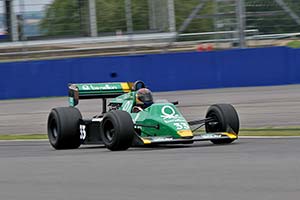
 In the second half of the 1970s Turbo charged engines made an explosive entrance into Formula 1. That can be taken very literally as the engines were very powerful, but usually went out with a big bang long before the races were over. It took a few years before the volatile forced induction engines were finally tamed and by then they had a 200 bhp power advantage over the Naturally Aspirated competition. Many of the smaller teams had neither the means nor the desire to race the very complex Turbo engines and had to rely on the latest version short-stroke of the Cosworth V8 engine. To bridge the 200 bhp gap the teams came up with several unconventional and often controversial solutions, but nevertheless they were steadily losing ground. One of the very last brand new cars built for a Naturally Aspirated engine was the Tyrrell 012, launched toward the end of the 1983 season.