Page 1 of 2 Next >> With the all-new flat 12 engine introduced at the start of the 1970 season, Ferrari briefly returned to the sharp end of the Formula 1 grid. The success did not last long enough to clinch either the constructor's or driver's championship. In a desperate attempt to turn the team's fortunes, chief engineer and the father of the flat 12 engine Mauro Forghieri was 'promoted' away from the Formula 1 team in 1973. Not surprisingly, this did not lead to immediate success and in an altogether wiser move, Enzo Ferrari appointed a young lawyer by the name of Luca de Montezemolo as the team manager at the start of the 1974 season.
One of the De Montezemolo's first decisions was to return Forghieri to his former post as chief engineer. Ferrari also abandoned the highly successful sports car program, which also used the flat 12 engine, to focus completely on Formula 1. He set about developing the existing 312 B3 design into a race winner, replacing the original's angular panels with a much more curvaceous body, which included an integrated air-intake. The driver line-up was also reshuffled with Clay Regazzoni and talented youngster Niki Lauda replacing Ferrari stalwarts Arturo Merzario and Jackie Ickx. All these drastic changes combined yielded success, as Lauda won two races in 1974 and Regazzoni one.
Encouraged by the renewed faith in his abilities, Forghieri created a new car for the 1975 season that was even better suited to the flat 12 engine. Dubbed the 312 T, for transversale, its secret was the transverse gearbox, which was mounted ahead of the rear axle. This meant that the Ferrari now not only had most of its weight mounted low in the car, due to the flat 12 engine but also between the front and rear axle. The near perfect weight distribution gave the 312 T superior handling. Lauda and Regazzoni were further aided by the abundance of power created by the latest evolution of Forghieri's flat 12. The bodywork fitted was clearly an evolution and the aluminium monocoque chassis featured in-board mounted front suspension actuated by rockers. Page 1 of 2 Next >>

 Ultimatecarpage.com
> Cars by brand
> Italy
> Ferrari
Ultimatecarpage.com
> Cars by brand
> Italy
> Ferrari
 Racing cars
> Formula 1
Racing cars
> Formula 1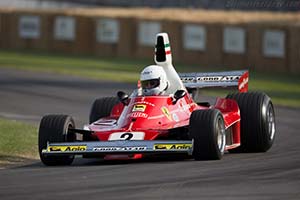
 With the all-new flat 12 engine introduced at the start of the 1970 season, Ferrari briefly returned to the sharp end of the Formula 1 grid. The success did not last long enough to clinch either the constructor's or driver's championship. In a desperate attempt to turn the team's fortunes, chief engineer and the father of the flat 12 engine Mauro Forghieri was 'promoted' away from the Formula 1 team in 1973. Not surprisingly, this did not lead to immediate success and in an altogether wiser move, Enzo Ferrari appointed a young lawyer by the name of Luca de Montezemolo as the team manager at the start of the 1974 season.