Page 1 of 2 Next >> Between 1974 and 1977, Ferrari and McLaren had been the dominant forces in Formula 1, however Lotus quickly became a force again. This was largely down to the 'ground effect' aerodynamics introduced in 1977 on the Lotus 78. Few of Lotus' rivals, Ferrari included, realised just how the new Lotus worked and continued much along the same lines for the 1978 season. Instead of developing a 'ground effect' car, Ferrari's Mauro Forghieri spent the winter adapting to the team's new Michelin radial tyres.
Although the 1978 Ferrari was dubbed the 312 T3, it was far more than an evolution of the 1977 World Championship winning 312 T2. The car sported a brand new chassis, which was required to make the most use of the Michelin radial tyres, which replaced the conventional Goodyear tyres used during the previous seasons. The switch was a daring move as although in theory the sophisticated radial tyres should provide a performance benefit, they had not been extensively used for racing yet.
The aluminium monocoque chassis itself was wholly conventional. Suspension was by lower wishbones and a top rocker arm at the front and a reversed lower wishbones, top links and radius arms at the rear. Ventilated Lockheed discs brakes were used on all four corners, mounted in-board at the rear. What was carried over from the 312 T2 was the very powerful 180° V12 engine. This was used as a fully stressed engine along with the transverse gearbox, from which the 'T' moniker was derived.
Whereas the Lotus relied on underbody tunnels to generate the now vital downforce, Forghieri used more old fashioned aerodynamic devices. At the front a full width, single piece wing was used while a two-piece rear wing was mounted on top of the gearbox. Compared to the earlier 312 T and T2, the new T3 sported a more angular body which itself was also shaped like a wing to generate downforce. The engine intakes were moved from the flanks to the very front of the body, running through the larger side-pods. Page 1 of 2 Next >>

 Ultimatecarpage.com
> Cars by brand
> Italy
> Ferrari
Ultimatecarpage.com
> Cars by brand
> Italy
> Ferrari
 Racing cars
> Formula 1
Racing cars
> Formula 1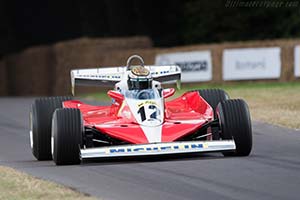
 Between 1974 and 1977, Ferrari and McLaren had been the dominant forces in Formula 1, however Lotus quickly became a force again. This was largely down to the 'ground effect' aerodynamics introduced in 1977 on the Lotus 78. Few of Lotus' rivals, Ferrari included, realised just how the new Lotus worked and continued much along the same lines for the 1978 season. Instead of developing a 'ground effect' car, Ferrari's Mauro Forghieri spent the winter adapting to the team's new Michelin radial tyres.