Go to Ultimatecarpage.com

Car search: Quick Advanced 
  Ultimatecarpage.com  > Cars by brand  > Italy  > Ferrari
Racing cars  > Other Sportscars
     340/375 MM Vignale Spyder
Cars statistics: 3256 cars, 325 makes, 21892 images; Events statistics: 123 reports, 20909 images; Forum statistics: 57,510 members, 34,448 topics; more...


Ferrari 340/375 MM Vignale Spyder

Ferrari 340/375 MM Vignale Spyder Ferrari 340/375 MM Vignale Spyder Ferrari 340/375 MM Vignale Spyder Ferrari 340/375 MM Vignale Spyder Ferrari 340/375 MM Vignale Spyder Ferrari 340/375 MM Vignale Spyder
Click here to save all images    Image credits: Rob Clements 


Click here to download printer friendly version When Enzo Ferrari started his own company in 1947, he hired Gioacchino Colombo as chief engineer. The two had previously worked together when Ferrari was team manager at Alfa Romeo. Colombo's task was to design a new engine that would outperform the 8-cylinder Grand Prix engine he had designed for Alfa Romeo before the War. The rules allowed for a supercharged engine with a maximum displacement of 1.5 litres or a naturally aspirated unit displacing up to 4.5 litres. Colombo's vast experience with supercharging made his choice for the former understandable.

Colombo's 1.5 litre V12 engine powered the very first Ferrari and with various displacements, it powered every Ferrari up to 1950. This was the first year of Formula One and the championship winner featured a Colombo designed engine. Unfortunately for him, it was the Alfa Romeo that won every single race of the championship; Colombo was quickly fired after this debacle. His replacement, Aurelio Lampredi, set out to design a completely new engine for 1951. Not making the same mistake as Colombo, Lampredi chose to design a naturally aspirated 4.5 litre V12 engine.

To save weight, both the cylinder block and heads were cast from light alloy. Each bank of cylinders featured a single overhead camshaft, operating 2 valves per cylinder. The engine was thoroughly tested in 1950 and ready to take on the Alfa Romeos in 1951. Fitted in the Ferrari 375 F1, the V12 produced around 350 bhp. Although this was no match for the Alfa Romeo's power, the 375's fuel efficiency still made it a serious contender, only losing the championship in the final race of the season.

Ferrari's performance and Alfa Romeo’s policy changes were the main reasons for the Milanese firm's withdrawal from Grand Prix racing. With Ferrari being the only team with a competitive F1 racer, the sport's governing body decided to run the 1952 and 1953 championship under Formula Two regulations. This left the Lampredi engine obsolete for Grand Prix racing, but its career was far from over. The large V12 found its way into a limited series of Ferrari sports racers, the 375 MMs constructed in 1953 and 1954.

The first cars constructed were equipped with engine Tipo 102 of the exact configuration as the Grand Prix engine. For reliability reasons, most cars featured engine Tipo 108 with a slightly different bore/stroke and displacement. Some of the large amount of torque available was sacrificed by the bigger bore, but the higher revving engine yielded a similar amount of horsepower. Pinin Farina supplied most of the bodies for the 26 375 MMs. Most common were the Spyder and Berlinetta bodies. The other five 375 MMs constructed were fitted with custom coachwork for some of Ferrari's wealthiest customers.

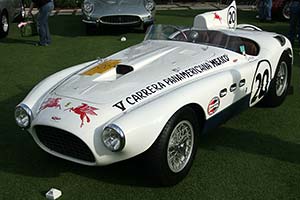
Featured is s/n 0286AM, which first left the factory in 1953 as a 340 MM equipped with a familiar Vignale Spyder body. It was retained by the Works team and served as a test bed for new developments and was the first MM to receive the large 375 engine. Before it was ever driven in anger, the engine was enlarged once again by increasing the bore. In this configuration the Lampredi V12 was later used in the Le Mans winning 375 Plus. Now the factory deemed the car ready for action and in the hands of Alberto Ascari and Giuseppe Farina the 375 MM Prototype took a win in the Nurburgring 1000 km.

After its Works service, the Vignale Spyder was sold to American importer Luigi Chinetti. He immediately entered it in the Carrera Panamericana together with Alfonso de Portago, but the powerful machine failed to reach the finish. After a short spell with a Mexican owner, the car was sold to Allen Guiberson who had the car equipped with a headrest and a fin and repainted white. He entered the car in the 1954 'Carrera' for Phill Hil and Richi Ginther, who finished a highly commendable 2nd overall. Caroll Shelby was the next racing legend to take to the wheel of this 'all-star' Ferrari and scored a win in the 1955 Torrey Pines sportscar race.

It was sold to Louis Berro later that year and he held on to it for many, many years. He did not take care of the unique machine very well and Marcel Massini listed it as 'buried in a hole in the ground' in his Ferraris by Vignale book. It was dug up in the 1990s and fully restored to its 1954 Carrera Panamericana livery by its new owner. He has since shown it on several occasions, winning prizes at Pebble Beach and in the Cavallino Classic. In March of 2007 it was awarded 'Best of Show' in the Amelia Island concours. The striking machine is pictured above at the 2007 Cavallino Classic where it won the 'Honorary Judges Cup'.

Article by Wouter Melissen, last updated on 03 / 15 / 2007

Add your comments on the Ferrari 340/375 MM Vignale Spyder


General specifications
Country of origin Italy
Chassis number 0268AM
Numbers built one-off
Produced from 1953 - 1954
Body design Vignale

Engine
Configuration Tipo 102 / 113 60º V 12
Location Front, longitudinally mounted
Construction alloy block and head
Displacement 4.954 liter / 302.3 cu in
Bore / Stroke 84.0 mm (3.3 in) / 74.5 mm (2.9 in)
Compression 9.0:1
Valvetrain 2 valves / cylinder, SOHC
Fuel feed 3 Weber Carburetors
Aspiration Naturally Aspirated

Drivetrain
Chassis/body alloy body on steel tubular chassis
Front suspension double wishbones, lower transverse leaf spring
Rear suspension live axle, semi-elliptic leaf springs, twin dampers
Steering worm-and-wheel
Brakes drums, all-round
Gearbox 4 speed Manual
Drive Rear wheel drive

Dimensions
Weight 900 kilo / 1984.2 lbs
Wheelbase / Track (fr/r) 2500 mm (98.4 in) / 1325 mm (52.2 in) / 1320 mm (52 in)

Performance figures
Power 330 bhp / 246 KW @ 7000 rpm
BHP/Liter 67 bhp / liter
Power to weight 0.37 bhp / kg

Resources
Suggested reading Ferrari by Vignale, by Marcel Massini
Related articles
Useful links


Ultimatecarpage.com - All Cars - Contact us - Privacy Statement - Top © 1998 - 2008 Ultimatecarpage.com