Go to Ultimatecarpage.com

Car search: Quick Advanced 
 sport Ultimatecarpage.com  > Cars by brand  > Italy  > Ferrari
Racing cars  > Other Sportscars
     860 Monza
Cars statistics: 5054 cars, 430 makes, 39392 images; Events statistics: 215 reports, 41349 images; Forum statistics: 85,356 members, 41,968 topics; more...


  Ferrari 860 Monza
 

Ferrari 860 Monza Ferrari 860 Monza Ferrari 860 Monza Ferrari 860 Monza Ferrari 860 Monza Ferrari 860 Monza
Click here to save all images    Image credits: Wouter Melissen 

Model history:
Click here to download printer friendly version Originally developed for the all-conquering Ferrari 500 F2 single seater, the Aurelio Lampredi designed straight four was briefly among Ferrari's most widely used sports car engines during the early 1950s. Following several prototypes raced by the works team in 1953, two production racers were launched in 1954; the 500 Mondial and 750 Monza, equipped with respectively a two- and three-litre version of the 'four'.

In a quest for even more power and torque, Ferrari's engineers continued the development of the four-cylinder engine. By 1955 its maximum displacement of just over 3.4 litre was achieved by boring and stroking the light alloy block to 102 mm and 105 mm respectively. That was almost twice the size of the two-litre original, which featured a more modest bore and stroke of 90 mm and 78 mm. The big 'four' a unitary displacement of 857.98 cc.

Known as the 'Tipo 129', the 1955 specification engine did follow the design of Lampredi's original, first raced back in 1952. Both the block and head were constructed from light alloy. The beautifully sculpted head featured twin overhead camshafts and could accommodate for two plugs per cylinder. The engine was fed by two massive twin-choke Weber carburettors. All this helped the Tipo 129 produce around 280 bhp and close to 400 Nm of torque.

Mated to a five-speed gearbox, the very tall engine was bolted in the Tipo 510 chassis that was virtually identical to the one used for the 750 Monza production cars. The frame was constructed from elliptical tubes and suspension was by double wishbones and coil springs at the front, while the rear used a DeDion axle with a transverse leaf spring. Unlike the British rivals, the Italian manufacturer opted to retain the tried and test hydraulic drums over the disc brakes pioneered by Jaguar.

In good Ferrari tradition, the new four cylinder racer was named after its unitary displacement, so the car was known as the 857 S or Sport. From the Ferrari factory, the rolling chassis were shipped to Sergio Scaglietti in Modena, who by then was responsible for clothing almost all of Ferrari's sports racers. The aluminium skin crafted by Scaglietti's skilled workers was similar to that of the rest of the range with the exception of two 'blisters' on the engine cover, needed to clear the tall engine's cam covers.

Especially for the Scuderia Ferrari works team, three examples were produced late in 1955, while a fourth 857 Sport was sold directly to the United States. The three works cars were raced only briefly by the factory with a victory in the Giro di Sicilia in 1956 as the best result. In private hands the four machines were campaigned for a lot longer and with considerable success, especially in the United States. Among the 857 Sport's noteworthy drivers were the likes of Phil Hill and Carroll Shelby.

One of the main reasons the 857 Sport was only briefly used by the Scuderia was that it was quickly followed by the 860 Monza. This used the same Tipo 129 engine but now in combination with the Tipo 520 chassis also used by the V12-engined 290 MM. Compared to the earlier design, the new chassis featured tubular reinforcements bringing it closer to a 'spaceframe' design. Another change was the adoption of a sturdier four-speed gearbox. Only three 860 Monzas were built, one of which was later converted to 290 MM specification.

Ready in time for the season opening Sebring 12 Hours, the new 860 Monza had a dream debut. Two cars were entered and Fangio and Castellotti led Musso and Schell home to score a one-two win. The winning car was sold but the other was campaigned alongside the 290 MMs for the rest of the year. Schell added another victory to the 860 Monza's tally by winning the GP de Rouen. The 1956 season would be the swansong for the works four cylinders but the engine would live on for another year in the customer 500 TR(C).

Used with great effect in period, the four-cylinder engines form but a side-note in the history of Ferrari where the V12 engine reigns supreme. When driven well, and most importantly carefully, the four-cylinder Ferraris were more than a match for most rivals. However, missing a gear and over-revving could have catastrophic results. It is perhaps not a coincidence then that the type's biggest win was scored by the ever delicate Juan Manuel Fangio.


Chassis: 0602M
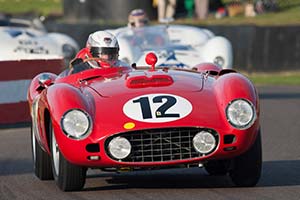
Chassis 0602M The first of three 860 Monzas built, chassis 0602M served throughout 1956 as one of the works cars. Piloted by the likes of Luigi Musso, Juan Manual Fangio and Eugenio Castelotti, the car's consistent finishes contributed greatly to Ferrari securing the World Championship. Before the end of the year, it was sold to Alfonso de Portago, who briefly raced it before selling it to Luigi Chinetti in the United States. Driven by Bruce Kessler and Bob Grossman, the car remained competitive until the fall of 1958 when it secured a class win at Watkins Glen.

The car eventually ended up in the fabulous collection of the late Pierre Bardinon. At the time, it had the wrong engine installed. During the 1980s Ferrari restorer David Cottingham reunited the car with its original engine. Following the restoration, Cottingham extensively campaigned the car before selling it in 1993. The current owner acquired the rare 860 Monza in August of 1994 and since then it has only rarely been seen in public. It is seen here during one of those rare outings; the 2011 Goodwood Revival where Juan Manual Fangio was celebrated.

Chassis: 0604M
Chassis 0604M Chassis 0604M was driven to a debut victory in the 1956 Sebring 12 Hours by Juan Manuel Fangio and Eugenio Castellotti. It was successfully raced until 1959 and has since been owned by some of the most prominent Ferrari collectors including Pierre Bardinon and Jean Sage. Today it is in British ownership and it was most recently raced at the Goodwood Revival by Indy 500 winner Danny Sullivan. It is also seen here during the 2007 Concorso d'Eleganza Villa d'Este where it was shown by former owner Norberto Ferretti.

Article by Wouter Melissen, last updated on September 24, 2012

Add your comments on the Ferrari 860 Monza

 bella205 Stories - A LABOUR OF PASSION & LOVE!  
Kiwieb
10-12-2007
Thanks so much for sharing your fascinating stories on your website bella205 and especially your experiences with your fabulous FERRARI 860 MONZA. I did read about your LOTUS 15 and your B FORD 1932 ROADSTER too.

Fascinating stuff.

You are obvously a talented and creative man who loves his cars and the way you solved many mechanical and restoration problems is also a real testament to your ingenuity and perserverance.

BTW bella205, in view of my post, how smooth to drive was the engine of your MONZA?

 Archetypical FERRARI is SUPERB!  
Kiwieb
10-12-2007
WOW! What a fabulously elegant and beautiful car. Hardly a wrong line or detail except for the ugly exposed fuel filler cap which only looks out of place as the rest of the car flows so seamlessly.

Another FERRARI which oozes "purpose with beauty" - the philosophy they have always passionately expressed and which has continued to delight not only FERRARI “Tifosi” but car lovers all over the globe. AVANTI FERRARI!

BTW, at 3.4 litres what a lump of an engine! The inherent vibration of this large inline four cylinder four stroke must have been a problem and I wonder how the FERRARI engineers solved it.

Rather than using a bigger flywheel with all the attendant extra weight problems perhaps FERRARI used a development of the English genius Professor Frederick Lanchester's 1904 invention of two eccentrically weighted counter rotating balance shafts driven either side of the crankshaft at twice engine speed to smooth things out?

MITSUBISHI refined the principle in the 1970's with balance shafts located diagonally and driven by chains from the oil pump. Their diagonal location also eliminated sideways vibrations at high RPM's and their "Silent Shaft" patents were subsequently licensed to Fiat, Saab and Porsche. Many world Marques now use balance shafts in their engines.

For a great article about balance shafts on WIKIPEDIA please paste the following into your browser:

http://en.wikipedia.org/wiki/Balance_shaft
 Ferrari 860 Monza  
bella205
10-11-2007
Welcome to read about my former 860/750 Monza s/n 0584M in my website concerning this car.
www.bjorns-story.se/private/minafordon/race/Ferrarihtm/ferrari-1_eng.htm
My car was sold long ago to England for 1000£ !!

View all the user comments on the Ferrari 860 Monza
     

General specifications
Country of origin Italy
Chassis number 0602M / 0604M
Numbers built 3 (One converted to 290 MM)
Produced in 1956
Predecessor
Body design Scaglietti

Major wins
1956 Sebring 12 Hours (Juan Manuel Fangio / Eugenio Castellotti in 0604M)

Engine
Configuration Tipo 129 Straight 4
Location Front, longitudinally mounted
Construction light alloy block and head
Displacement 3.432 liter / 209.4 cu in
Bore / Stroke 102.0 mm (4 in) / 105.0 mm (4.1 in)
Compression 8.5:1
Valvetrain 2 valves / cylinder, DOHC
Fuel feed 2 Weber 58 DCOA/3 Carburettors
Ignition Twin Spark
Lubrication Dry sump
Aspiration Naturally Aspirated
Power 280 bhp / 209 KW @ 6000 rpm
Torque 380 Nm / 280 ft lbs @ 4000 rpm
BHP/Liter 82 bhp / liter

Drivetrain
Body aluminium body
Chassis elliptical-section steel tube chassis
Front suspension double wishbones, coil springs, hydraulic shock absorbers
Rear suspension DeDion axle, twin radius arms, transverse leaf spring, hydraulic shock absorbers
Steering worm-and-sector
Brakes hydraulic drums, all-round
Gearbox 4 speed Manual
Drive Rear wheel drive

Dimensions
Weight 860 kilo / 1896 lbs
Wheelbase / Track (fr/r) 2350 mm (92.5 in) / 1246 mm (49.1 in) / 1310 mm (51.6 in)

Performance figures
Power to weight 0.33 bhp / kg

Resources
Related articles
Useful links