Page 1 of 1 In the second half of the 1950s Cooper took Formula 1 by storm and in the process revolutionized motor racing. The major asset of the Coopers was the mid-engined layout, which more than made up for the rudimentary chassis design and underpowered Climax engine. In 1959 and 1960 Jack Brabham won the World Driver's Championship, but drastic rule changes abrubtly ended the British manufacturer's reign. The maximum displacement of the engines was lowered from 2.5 to 1.5 litres. Most of the British teams and more important the engine manufacturers opposed the new regulations and were left hanging when the changes were confirmed at the last minute. The only team to be fully prepared was Ferrari, who used a high revving V6 engine to clinch the 1961 championship. Cooper relied on a slightly modified version of their 1960 cars, powered by a Coventry Climax four cylinder engine. Needless to say, the team had an abysmal season at the end of which team-leader Jack Brabham left to form his own team.
Towards the end of the 1961 season Coventry Climax introduced their first engine specifically built for the 1.5 litre regulations. Dubbed the FWMV, it was a start of the art V8 engine with twin overhead camshafts. Cooper modified one of the four cylinder chassis to fit the engine for the final races of the season, but Brabham could do no better than retire. The off season was used to design a chassis specifically for the new era and of course era. In good Cooper tradition the 'T60' was technically similar to its predecessors even though it looked quite a bit slimmer and lower. Under the elegant aluminium body the familiar steel tubular frame was found, which did not have enough cross braces to be considered a full spaceframe. Suspension was by double wishbones all-round, lacking the parallel radius arms found on the rear suspension of most of the competitors. The V8 engine was mated to Cooper's own six speed gearbox.
With long time team-leader Jack Brabham off to pursue his dreams, Cooper did not look long or far for a replacement. In Bruce McLaren they found a perfect substitute for both Brabham's driving ability and his technical insights. Although the T60 was more elegant than its predecessors, it could not compare with the exceptionally slim lines of the new Lotus 25 with its advanced monocoque chassis. Nevertheless McLaren was up at the top of the leaderbord in the opening races, scoring victory at Monaco in only the second Grand Prix of the season. Unfortunately this remained the only victory for Cooper in the five years Formula 1 was run under the 1.5 litre regulations. McLaren finished on the podium a further four times and his team mate Tony Maggs added a further two podiums to Cooper's tally. McLaren and Cooper ended the year in third in their respective championships.
Cooper used the lessons learned in 1962 and McLaren's input to slightly redesign the T60 for the 1963 season. By relocating various parts and redesigning the fuel tanks, the new T66 clearly was a slimmed down version of the T60. The chassis was reinforced at places by welded on sheet steel sections. The most important changes were made to the suspension geometry after McLaren complained about the T60's tendency to nose-dive under braking. Four cars were built. Three were used by Maggs and McLaren while the fourth Rob Walker, who entered it for Joakim Bonnier. The T66 was clearly a step forward, not big enough however to keep with the faster pace of the competition. The Works drivers and Bonnier managed to frequently place the T66 in the top six and even the odd podium finishes were scored, but the Coopers were never really in contention for wins. Cooper slipped to fifth in the constructor's championship. In the following seasons more drastic evolutions of the basic Cooper design were raced, with further modified and reinforced suspension, but these was painfully off the pace. Page 1 of 1

 Ultimatecarpage.com
> Cars by brand
> Great Britain
> Cooper
Ultimatecarpage.com
> Cars by brand
> Great Britain
> Cooper
 Racing cars
> Formula 1
Racing cars
> Formula 1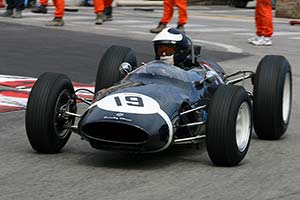
 In the second half of the 1950s Cooper took Formula 1 by storm and in the process revolutionized motor racing. The major asset of the Coopers was the mid-engined layout, which more than made up for the rudimentary chassis design and underpowered Climax engine. In 1959 and 1960 Jack Brabham won the World Driver's Championship, but drastic rule changes abrubtly ended the British manufacturer's reign. The maximum displacement of the engines was lowered from 2.5 to 1.5 litres. Most of the British teams and more important the engine manufacturers opposed the new regulations and were left hanging when the changes were confirmed at the last minute. The only team to be fully prepared was Ferrari, who used a high revving V6 engine to clinch the 1961 championship. Cooper relied on a slightly modified version of their 1960 cars, powered by a Coventry Climax four cylinder engine. Needless to say, the team had an abysmal season at the end of which team-leader Jack Brabham left to form his own team.