Go to Ultimatecarpage.com

Car search: Quick Advanced 
  Ultimatecarpage.com  > Cars by brand  > France  > Bugatti
Type 57 SC Atlantic Coupe
Cars statistics: 4674 cars, 413 makes, 34492 images; Events statistics: 196 reports, 36409 images; Forum statistics: 83,467 members, 40,991 topics; more...


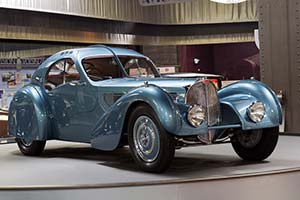
  Bugatti Type 57 SC Atlantic Coupe
 

Bugatti Type 57 SC Atlantic Coupe Bugatti Type 57 SC Atlantic Coupe Bugatti Type 57 SC Atlantic Coupe Bugatti Type 57 SC Atlantic Coupe Bugatti Type 57 SC Atlantic Coupe Bugatti Type 57 SC Atlantic Coupe
Click here to save all images    Image credits: Wouter Melissen / Bugatti Automobiles SAS / Paul Russell 

Model history:
Click here to download printer friendly version Bugatti struck gold with the introduction of the Type 57 early in 1934. In one big sweep, it replaced all existing road going models in the Bugatti line-up. The eight-cylinder engined machine was available with a choice of standard coach-work, ranging from a formal four-door sedan to a sporty roadster. The most exclusive of these Jean Bugatti designed bodies was the 'Atlantic' two-door coupe. Only four were built and the two that have survived in largely original condition are today among the most sought after and valuable cars in the world.

The story of the Atlantic begins with the even more elusive 'Aerolithe' prototype shown at the Paris Motor Show in 1935. Named after the Greek word for 'meteor', the car sported a beautiful aerodynamic body with a highly unusual construction. This was needed because of the extensive use of the magnesium alloy 'Electron'. Developed in the aeronautical industry, this material was as light as it was strong but had one major drawback; it was also very volatile. As a result welding the panels was not an option. Instead they were riveted together, giving the body a very distinct look with a 'spine' running front to back and over the front and rear fenders.

Some historians doubt Electron was really used for the Aerolithe but what is certain is that the subsequent Atlantics all featured aluminium bodies. They nevertheless featured riveted panels, presumably for aesthetic reasons. A more noticeable change was the switch to the latest evolution of the Type 57 chassis. This featured an underslung rear axle and deeper mounted radiator and was appropriately known as the Type 57 S for 'sousbaissé' or lowered. It shared the same short wheelbase as found on the special chassis used for the Aerolithe. Especially the drop in radiator height and the resulting smaller front-end improved Jean Bugatti's design.

With the chassis and running gear considerably closer to the ground, the Type 57 S also required a lower version of the original cast-iron straight eight. This was achieved by fitting a competition derived dry-sump oil system. The twin-cam head and engine block were left largely untouched. What did change was the compression ratio, which helped raise the power of the 3.3 litre engine from 135 to 170 bhp. Shortly after the first Atlantic was produced, Bugatti introduced an optional Roots-type supercharger. This added a further 40 bhp to the engine's output. Only one of the four Atlantics were originally fitted with the Type 57 SC engine but all surviving cars were upgraded soon after.

All three Atlantics that were sold to customers survived the War largely undamaged. The same could not be said for the Aerolithe and the factory show car, which was the only one fitted from new with a supercharged engine. The Aerolithe was most likely cannibalised for parts for production cars in the late 1930s. The missing Atlantic was on a list of cars that were due to be hidden away from the Germans in Bordeaux but it has never surfaced again. In 1955 one of the remaining three Atlantics was involved in a horrific collision with a train, leaving just two complete cars. The crashed car was, however, rebuilt in the early 1970s and more thoroughly in 2010.

Today the Atlantic is generally considered Bugatti's ultimate creation, which, by default, makes it one of the finest cars ever constructed. The futuristic lines with its beautiful details also make it a true icon. During the last decades the two original cars have been in long-term ownership and only the death of one of the owners resulted in one coming to the market. It sold in the spring of 2010 for well over $30 million; the highest known price ever paid for a car. Both of the complete survivors have won the prestigious 'Best of Show' award at the Pebble Beach Concours d'Elegance, further underlining their significance.


Chassis: 57374
Chassis 57374 This is the first of the four Atlantic Coupes built by Bugatti. Originally fitted with a naturally aspirated engine, it was delivered new to one of Bugatti's finest clients, Victor, Lord Rothschild in London. In 1939 it was upgraded by the factory to Type 57 SC specification by adding a supercharger to the straight eight engine. Lord Rothschild sold the car in 1941 and it changed hands several times before it ended up in American hands in 1945.

In 1971 chassis 57374 was offered at a Sotheby's auction in Los Angeles. It was acquired by noted Bugatti collector and President of the American Bugatti Club Dr Peter Williamson for a record amount of $59,000. He cherished the prized possession but also drove it on the road for many years before he had it completely restored to its original condition between 2001 and 2003. Upon completion, he entered the Atlantic Coupe in the Pebble Beach Concours d'Elegance where it was awarded 'Best of Show' just over a decade after a sister car won the same prestigious award.

Dr Williamson owned the car and continued to drive it enthusiastically until his untimely death in 2008. His widow Susan entrusted the sale of all the fabulous Bugattis in the collection to David Gooding. All were auctioned off, mostly for charity, with the exception of the Atlantic Coupe. Gooding brokered a private deal in April 2010, which saw the car pass into new ownership for an undisclosed amount between $30 - $40 million. This makes chassis 57374 the most expensive car ever sold. The best news is that the new owner has agreed to make the car available to the recently opened Mullin Automotive Museum and the Atlantic is on display for all to see.

Chassis: 57453
Chassis 57453 It is believed that the second of four Atlantic bodies built by Bugatti was fitted on chassis 57453. Never delivered to a customer, the supercharged Atlantic was shown during the 1937 Auto Salon in Nice where it is pictured here. Bugatti apparently made the show car available to the great privateer racer William Grover or 'Williams', who won the very first Monaco Grand Prix in a Bugatti back in 1929. What subsequently happened to this oft-forgotten Atlantic is not known. It could very well be hidden away in the one shed in south of France not yet visited by car historians.

Chassis: 57473
Chassis 57473 The third Atlantic was ordered from the factory by Jacques Holzschuch. He took delivery of the car in December of 1936 and promptly drove it back home to Paris. In the spring of the next, he drove the car to the French Riviera and showed it at a concours d'elegance in Nice. At some point, most likely in 1939, the Atlantic's body was modified, almost certainly by none other than Figoni & Falaschi. A supercharger was also fitted.

In 1952 the Bugatti was acquired by Marguerite Schneider for her lover Rene Chatard. Three years later Chatard and one of his mistresses were tragically killed when a train hit the Atlantic on an unguarded railway crossing. The shattered remains were finally released to Schneider after a decade and she immediately sold them to a scrap dealer in Gien. They were retrieved soon after by young Bugatti enthusiast Paul-Andre Berson.

By this time the Atlantic was already a valuable collectible, so it was not surprising that Berson set about resurrecting chassis 57473. It has long been uncertain just how much of the wreck was salvageable but eventually it became clear that Berson used very little for his 'new' Atlantic. Taken over ten years to complete the car sold almost immediately to French collector Nicolas Seydoux, while Berson held on to the remains with the idea of building another Atlantic at one point in the future.

Seydoux owned the resurrected Atlantic for several decades and regularly showed it at events around Europe. He eventually sold it to the current owner through Swiss broker Lukas Hüni in around 2006. Paul-Andre Berson was also tracked and all the remains of 57473, which were actually slowly becoming a second Atlantic, were also acquired. The two were reunited in the workshop of Paul Russell with the request of putting as many original parts from 57473 into the car built by Berson.

The Seydoux car was stripped and on a new wooden frame all of the surviving original body panels were mounted, which included much of the left hand side of the car, parts of the roof, the dashboard and the engine cover, which still bears marks of an earlier repair. The original crankcase was used to rebuild the engine. The aim was to restore the car to its 1955 configuration, complete with the modifications carried out by Figoni & Falaschi. The car was painted the correct grey that was discovered on the surviving panels and the interior colours were picked based on a piece of leather on the original dashboard.

The finished article was first shown to the world during the 2010 Pebble Beach Tour d'Elegance and again a few days later on the lawn for the Concours d'Elegance. Considering its coloured past, it was understandably not entered for judging. Some purists nevertheless questioned if a 'replica' should even be allowed onto the show field. That certainly does the car and Russell's formidable work no justice.

Chassis: 57591
Chassis 57591 Nearly two years after the first three, the fourth and final Atlantic was constructed. Chassis 57591 differs from its predecessors in detail. The biggest distinguishing features are the separate headlights, which are mounted flush with the fenders on the other three. It was ordered by British enthusiast Richard Pope in 1938. This decision was made a little easier due to devaluation of the French Franc compared to the Pound. It was painted a sapphire blue and also featured painted wire wheels.

Pope cherished his Atlantic and owned it for nearly three decades. In the subsequent 20 years, the car passed to various hands including noted British collector Anthony Bamford and Californian broker/collector Tom Price. In 1988 chassis 57591 was acquired by fashion designer Ralph Lauren. He had the mostly original car meticulously restored by Paul Russell. Two years later the car made its post-restoration debut and immediately won the coveted 'Best of Show' award. It has since been shown sporadically at events around the world. In 2005 the car was proudly displayed in the Boston Museum of Fine Art alongside the rest of the Ralph Lauren collection.

Article by Wouter Melissen, last updated on December 23, 2010

Add your comments on the Bugatti Type 57 SC Atlantic Coupe

 Which Atlantic Coupe?  
enor101
12-24-2010
I grew up in Union City New Jersey during the 1950's. During that time there was a black Atlantic coupe frequently parked on the street around the corner from my house! Always wondered whose it was and what became of it.
 A Type 57 in Milwaukee ??  
Washbush
12-23-2010
Gents ...

A friend and I are probing our foggy memories regarding a car in the collection of Brook Stevens in Mequon, Wisconsin. We remember two Bugattis, and are trying to sort out the temptation to say that one was a Type 57. Could it be?

John M
     
General specifications
Country of origin France
Chassis number 57374 / 57453 / 57473 / 57591
Numbers built 4
Produced from 1936 - 1938
Body design Jean Bugatti

Engine
Configuration Type 57 C Straight 8
Location Front, longitudinally mounted
Construction cast iron block and head
Displacement 3.257 liter / 198.8 cu in
Bore / Stroke 72.0 mm (2.8 in) / 100.0 mm (3.9 in)
Compression 8.5:1
Valvetrain 2 valves / cylinder, DOHC
Fuel feed Stromberg UUR2 Carburettor
Aspiration Roots-Type Supercharger
Power 210 bhp / 157 KW @ 5500 rpm
BHP/Liter 64 bhp / liter

Drivetrain
Chassis body on cross-braced frame
Front suspension beam axle, semi-elliptic springs, telescopic shock absorbers
Rear suspension live axle, quarter-elliptic springs, telescopic shock absorbers
Brakes hydraulic drums, all-round
Gearbox 4 speed Manual
Drive Rear wheel drive

Dimensions
Weight 1550 kilo / 3417.2 lbs
Wheelbase / Track (fr/r) 2980 mm (117.3 in) / 1350 mm (53.1 in) / 1350 mm (53.1 in)

Performance figures
Power to weight 0.14 bhp / kg
Top Speed 210 km/h (130 mph)

Resources
Suggested reading
  • Bugatti Magnum, by Hugh Conway with Maurice Sauzay
  • Bugatti - le Pur Sang des Automobiles, by Hugh Conway
  • Grand Marques Bugatti, by Hugh Conway
Related articles
Useful links