
| sport |
 Ultimatecarpage.com
> Cars by brand
> Great Britain
> Nash-Healey
Ultimatecarpage.com
> Cars by brand
> Great Britain
> Nash-Healey
 Racing cars
> Other Sportscars Competition Roadster Racing cars
> Other Sportscars Competition Roadster
|
| Nash-Healey Competition Roadster |
| Article | Image gallery (11) | X6 | Specifications |
|
|
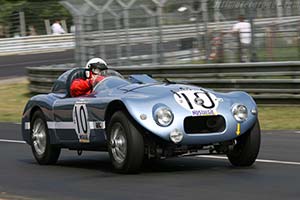
Page 1 of 1  Donald Healey had made quite a name for himself as a rally and development driver during the 1930s. He scored wins for Invicta and Triumph and also helped the latter develop the formidable Dolomite sports car. After the War, Healey decided he no longer wanted to offer his services for the benefit of others and formed his own company. Donald Healey had made quite a name for himself as a rally and development driver during the 1930s. He scored wins for Invicta and Triumph and also helped the latter develop the formidable Dolomite sports car. After the War, Healey decided he no longer wanted to offer his services for the benefit of others and formed his own company.Launched as early as 1946, the first 'Healeys' were a combination of a bespoke box-section chassis, a Riley engine and custom coachwork. The range was very diverse and included the Elliott family saloon as well as the cycle-fender Silverstone sports car. Despite their modest Riley engine, both cars were raced quite competitively. Healey nevertheless ventured out to the United States in 1949, in search for a more powerful engine. He had set his sights on the Cadillac V8 but General Motors was not very interested. Fortunately he had met Nash-Kelvinator President George Mason on his way to the USA. Mason had warned him that GM would turn him down and instead invited Healey to take a look at Nash' latest six cylinder engine. It seemed a match made in heaven; Healey would get a more powerful engine, while Nash would have an entry into the popular sports car market. A Silverstone chassis was used as a basis for the new Nash-Healey. The box-section frame had to be widened and reinforced to accommodate the larger and heavier American 'six'. This very reliable engine displaced 3.8 liter and equipped with a Healey aluminium head produced 125 bhp. It was mated to a Nash three-speed gearbox and Borg-Warner overdrive unit. The front suspension was by trailing arms, while at the rear a live axle was fitted. Each corner featured coil springs and telescopic shock absorbers. Still closely resembling the Healey Silverstone, the prototype Nash-Healey was entered in the 1950 Mille Miglia. With Donald Healey at the wheel, the car proved to be far from competitive and it was retired after it had 'conveniently' scraped a wall. To comply with the latest regulations, an all-enveloping body was fitted for the 24 Hours of Le Mans. Here the Nash-Healey did considerably better in the hands of future Le Mans winners Tony Rolt and Duncan Hamilton. They ran as high as third and eventually finished fourth overall. With the mechanicals proven in competition, the focus was now turned on the proposed road car. Funded by Nash, Len Hodges penned an understated two-seater Roadster. The all-aluminium body was built by Abbey Panels in England. The first completed example was launched at the Paris Motor Show in September of 1950. Following the successful 24 Hours race, the new road car was dubbed the Le Mans Roadster. With some minor tweaks to the original, the Nash-Healey entered production later in the year. Just over 100 of the original Le Mans Roadsters were produced before Italian coach-builder Pinin Farina was commissioned to completely redesign the body for the 1952 model year. The result was a combination of elegant lines and unusual features like the headlights, which were set in the grille. Steel was used instead of the original aluminium but the bodies were nevertheless lighter. A slightly larger version of the engine was introduced together with the Pinin Farina body. In 1953 a Coupe version was also added to the line-up. Encouraged by the 1950 Le Mans result, Donald Healey returned to racing in 1951. This time he fielded a rather ugly fixed-head bodied Nash-Healey. Rolt and Hamilton ran as high as fourth and eventually slipped to sixth. The Nash-Healey's best year when open cars were driven to seventh overall in the Mille Miglia and third overall at Le Mans. The Leslie Johnson and Tommy Wisdom result in the 24 Hours race was sufficient to score a best in class. Further efforts in 1953 did not yield any notable results. With the introduction of the Pinin Farina Roadster body, sales had peaked in 1952. Interest in the rather expensive Anglo-Italian-American hybrid dropped soon after as cheaper alternatives became available. Production ceased altogether in 1954. In the final year Pinin Farina only built Coupes. Donald Healey had already joined forces with Austin to create the now legendary Austin Healey and Nash merged with Hudson to form American Motors. It was the end of a brief but fruitful cooperation that was instrumental for the survival of Donald Healey's small company. Page 1 of 1 |
| Article | Image gallery (11) | X6 | Specifications |
| All Cars - Contact us - Privacy Statement - Top | © 1998 - 2024 Ultimatecarpage.com |