Page 1 of 1 Up until 1953 Ferrari sports racers, despite all of their type names and numbers, shared the same basic ladder type chassis with independent front suspension and a live rear axle. The only significant difference was the use of the Colombo designed 'short block' or the Lampredi designed 'long block' V12 engine. All this changed in 1953 when a brand new four cylinder engine was introduced. Inspired by the British 'fours' the new Ferrari engine was used to great effect in the F1/F2 World Championship where Alberto Ascari won all the races in 1952. More single seater 'technology' was carried over to the sports car range a year later when the DeDion type rear suspension as introduced.
Both the four cylinder engine and the all-round independently sprung chassis were available in the two-litre 500 Mondial and the three-litre 750 Monza that were used both by the Works and were available for customers as well. Although the focus seemed to be on the four cylinder engines, Ferrari did not discard the V12 engine completely. The big fours might have had superior low end torque, they could not match the peak horsepower of the high revving V12s.
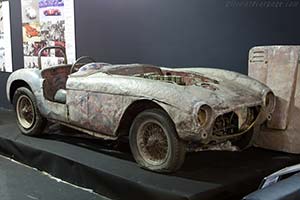
Using the latest, three-litre version of the Colombo engine and a slightly lengthened 750 Monza chassis, the Ferrari engineers created the '250 Monza' in 1954. The V12 was of a similar specification as used in the 250 MM constructed early in 1953. Breathing through three quad-choke Weber Carburetors, it was good for at least 240 bhp. A total of four of these 'hybrid' chassis were eventually constructed. Three of them were clothed by Pinin Farina with a design similar to that fitted on the 500 Mondial and the other received a Scaglietti body in the style of the 750 Monza.
The first chassis was retained to be used by the Works team, while the other three were sold to Italian customers. The privateer cars were quite successfully raced in local Italian events from March of 1954, taking victory in a variety of races. The first came on June second when Gerino Gerini drove one of the Scaglietti bodied cars to a victory in the Giro dell'Umbria. This same chassis was later that year raced to a commendable fifth overall and third in class in the gruelling Carrera PanAmericana. The Pinin Farina bodied Works car scored the type's biggest victory; the Hyeres 6 Hours on June 6th in the hands of Trintignant and Piotti.
After 1954 the days of the Colombo V12 as a competition engine really seemed over. Ferrari had expanded their line-up with two six cylinder models, which were blisteringly quick, but a little fragile. While Ferrari raced the four, six and long block V12 engined sports racers, the 'short block' engine had found a new home in the popular and very successful 250 GT model. Rule changes at the end of the 1956 season brought Ferrari's attention back on the three litre V12 engine and following the basic design of the 250 Monza, the Italians rolled out the 250 Testa Rossa for 1957 and the rest, so they say, is history. Page 1 of 1

 Ultimatecarpage.com
> Cars by brand
> Italy
> Ferrari
Ultimatecarpage.com
> Cars by brand
> Italy
> Ferrari
 250 Monza Pinin Farina Roadster
 Up until 1953 Ferrari sports racers, despite all of their type names and numbers, shared the same basic ladder type chassis with independent front suspension and a live rear axle. The only significant difference was the use of the Colombo designed 'short block' or the Lampredi designed 'long block' V12 engine. All this changed in 1953 when a brand new four cylinder engine was introduced. Inspired by the British 'fours' the new Ferrari engine was used to great effect in the F1/F2 World Championship where Alberto Ascari won all the races in 1952. More single seater 'technology' was carried over to the sports car range a year later when the DeDion type rear suspension as introduced.