Page 1 of 2 Next >> Although stories of a larger Aston Martin had been circulating for some time, the new model was only officially confirmed when the British manufacturer filed two entries for a two-litre car for the 1936 24 Hours of Le Mans. Information remained scarce, leading to wide speculation about just what type of engine would power the latest Aston Martin. Ultimately there were no resources for a clean-sheet design and instead the existing 1.5 litre engine that had served Aston Martin so well was enlarged and substantially modified.
In addition to the increased bore and stroke, the single biggest change to the familiar four cylinder engine was the reversal of the intake and exhaust ports. The reason for this was to eliminate the detonation, the 1.5 litre engine tended to suffer from at low speeds. What was retained was the patented wedge-shaped combustion chamber and single overhead camshaft. In competition trim, the 'new' engine was equipped with dry sump lubrication. Breathing through two SU carburettors, the two litre 'four' produced around 110 bhp.
Like the engine, the chassis was also based on an existing design. Again subtle changes were made both to improve the handling and to cope with the added power. An additional cross member was fitted because the engine was mounted on rubbers and unlike before added no rigidity to the frame. Hydraulic drum brakes were fitted on all four corners, which was a first for Aston Martin. To meet with the strict Le Mans production minimum, 25 chassis were constructed. The new Aston Martin was referred to as the '2 Litre' or 'Speed Model.'
First off the were the two examples destined for Le Mans, which were fitted with a simple cycle fender body, similar to those used for the 1.5 Litre team cars. Unfortunately, the race was called off at the last minute due to a massive strike. The same economic and political unrest also prompted Aston Martin to cease its racing activities. The Le Mans cars and a further two Speed Models were completed as racers and sold to privateers including Richard Seaman. Receiving considerable back-door support, these machines were campaigned with some success. Page 1 of 2 Next >>

 Ultimatecarpage.com
> Cars by brand
> Great Britain
> Aston Martin
Ultimatecarpage.com
> Cars by brand
> Great Britain
> Aston Martin
 Type C Speed Model
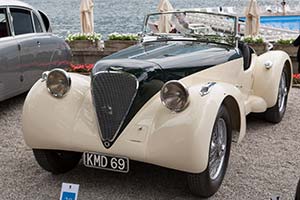
 Although stories of a larger Aston Martin had been circulating for some time, the new model was only officially confirmed when the British manufacturer filed two entries for a two-litre car for the 1936 24 Hours of Le Mans. Information remained scarce, leading to wide speculation about just what type of engine would power the latest Aston Martin. Ultimately there were no resources for a clean-sheet design and instead the existing 1.5 litre engine that had served Aston Martin so well was enlarged and substantially modified.