Go to Ultimatecarpage.com

Car search: Quick Advanced 
  Ultimatecarpage.com  > Cars by brand  > Italy  > OSCA
1600 GT Zagato Coupe
Cars statistics: 5054 cars, 430 makes, 39408 images; Events statistics: 215 reports, 41349 images; Forum statistics: 85,358 members, 41,971 topics; more...


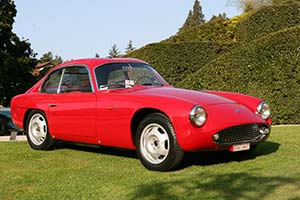
  OSCA 1600 GT Zagato Coupe
 

OSCA 1600 GT Zagato Coupe OSCA 1600 GT Zagato Coupe OSCA 1600 GT Zagato Coupe OSCA 1600 GT Zagato Coupe OSCA 1600 GT Zagato Coupe OSCA 1600 GT Zagato Coupe
Click here to save all images    Image credits: Wouter Melissen 

Model history:
Click here to download printer friendly version With sales of the once very successful OSCA sports racers dwindling, the Maserati brothers were forced to look for other sources of income towards the end of the 1950s. The first fundamental change was an engine partnership with Fiat, who were looking to expand their range with a new high performance model. In this arrangement, Fiat would manufacture a sophisticated twin-cam, four cylinder engine following an OSCA design.

In return, the Maserati brothers would also receive complete engines at but a fraction of the cost compared to one built in-house. It is unknown if OSCA received a substantial licensing fee but at least the arrangement opened new doors for the small company. The foremost was the possibility to produce a brand new production car that could be offered for a relatively competitive price. Known as the 1600 GT this duly appeared at the 1960 Turin Motor Show.

Aiming at the widest possible market, the new OSCA 1600 GT was available with two different chassis configuration and no fewer than four engine specifications. All versions used the same and relatively light steel tubular chassis. The double wishbone suspension at the front and the disc brakes built in Italy under Dunlop license were also common components. At the rear, the basic version featured a live axle, while the more expensive, competition oriented models used fully independent double wishbones.

The 1600 GT's four cylinder engine was a further development of the existing design that had been successfully used in OSCA's sports racers for a decade. It combined a cast-iron block with an aluminium, twin-cam cylinder head. In basic trim, fitted with a single Weber carburettor, it produced around 95 bhp. Three twin-carburettor versions were also available with power ranging from 105 bhp to 140 bhp for the twin-spark variant. The 1.6 litre engine was mated to a proprietary four-speed gearbox.

While the original show car was equipped with a Boneschi coupe body, OSCA would ultimately market the 1600 GT with a choice of Fissore or Zagato coachwork. Available with the 95 bhp and 105 bhp engines, the Fissore versions were less expensive than the competition oriented Zagatos. These featured a lightweight body with the signature double-bubble roofline. In the most potent 'GTS' trim, the Zagato Coupe also featured covered headlights and a much larger fuel tank for competition use.

Even though the 1600 GT was launched late in 1960, production did not start in earnest until 1962. Among the reasons for this lengthy delay were homologation issues of the competition cars. Still struggling to make ends meet, the Maserati brothers were forced to sell their company just over a year later to motorcycle and helicopter manufacturer Agusta. They were kept on for their engineering skills but OSCA clearly was not a priority and the 1600 GT was axed soon after.

A vast majority of the 1600 GTs were bodied by Zagato, while in addition to Fissore, other companies like Touring and Morelli also clothed the OSCA. Officially 128 examples were built but some suggest that as little as 56 rolled off the line. Regardless, the OSCA 1600 GT remains as the last production car developed and built by the Maserati brothers. Especially the Zagato bodied examples offer a combination of looks and handling that is highly regarded today.


Chassis: 0097
Chassis 0097 Sold new in April of 1963 to a customer in Rome, this Zagato bodied 1600 GT passed through several hands before it was eventually acquired by German Peter Kaus for his lovely Rosso Bianco Museum. He sold the car in the late 1990s when it was completely restored in Italy. Still in fabulous conditions, it passed into the collection of Belgian Jan de Reu early in 2006. He subsequently showed it at Villa d'Este where it won its class. The car was soon after part-exchanged for a Siata and will now be offered by RM Auctions in their October 31st London sale. The estimate for this lovely Italian gem is a reasonable GBP 140,000 - 190,000.

Article by Wouter Melissen, last updated on October 29, 2012

Add your comments on the OSCA 1600 GT Zagato Coupe


General specifications
Country of origin Italy
Chassis number 0097
Numbers built 98 (All Zagato Coupes)
Produced in 1963
Body design Zagato

Engine
Configuration Straight 4
Location Front, longitudinally mounted
Construction cast-iron block, light alloy head
Displacement 1.569 liter / 95.7 cu in
Bore / Stroke 80.0 mm (3.1 in) / 78.0 mm (3.1 in)
Valvetrain 2 valves / cylinder, DOHC
Fuel feed Weber 38DCOE Carburettors
Aspiration Naturally Aspirated
Power 105 bhp / 78 KW @ 6000 rpm
BHP/Liter 67 bhp / liter

Drivetrain
Body aluminium panels
Chassis steel tubular frame
Suspension (fr/r) double wishbones, coil springs
Brakes discs, all-round
Gearbox 4 speed Manual
Drive Rear wheel drive

Dimensions
Weight 850 kilo / 1873.9 lbs
Length / Width / Height 3860 mm (152 in) / 1473 mm (58 in) / 1200 mm (47.2 in)
Wheelbase / Track (fr/r) 2250 mm (88.6 in) / 1270 mm (50 in) / 1270 mm (50 in)

Performance figures
Power to weight 0.12 bhp / kg

Resources
Related cars
Related articles
Useful links