Page 1 of 2 Next >> Along with works driver and development engineer Ken Miles, Carroll Shelby looked at ways to further improve the performance of the Cobra racing car ahead of the 1965 season. In good American tradition, although Miles was actually British, the two found that shoe-horning an even bigger engine into the AC-supplied chassis to be best solution. This was, however, such a substantial change that for homologation purposes 100 examples had to be produced. Shelby had had no problems selling his Cobras before, so he believed this to be a relatively minor issue.
Miles and Shelby had set their sights on a very special '390' Ford V8 that was being developed for NASCAR. Cast from aluminium, it was exceptionally light but considerably more powerful than the small-block V8 previously used. One was used in an experimental Cobra developed and raced very successfully by Miles. Unfortunately, these high performance engines were in short supply and Ford's NASCAR teams objected to sharing them with the Cobra program. This forced Shelby and Miles to compromise and settle for the more readily available and far less exotic '427' big-block V8.
Displacing just under seven litres, it was heavier and bigger than the existing Cobra engines. The weight was kept down by using thin-wall casting but nevertheless substantial changes to the chassis were required to improve the handling characteristics. The single biggest improvement was the uprated suspension, which now used coil springs on all four corners instead of the transverse semi-elliptic leaf springs of the original design. With the help of Ford's sophisticated computers, the chassis design was revised, growing both in width and length to cope with the size and power of the engine. Page 1 of 2 Next >>

 Ultimatecarpage.com
> Cars by brand
> United States
> AC
Ultimatecarpage.com
> Cars by brand
> United States
> AC
 Shelby Cobra 427
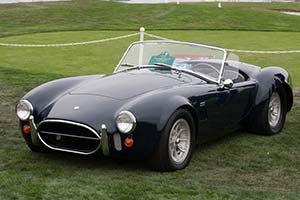
 Along with works driver and development engineer Ken Miles, Carroll Shelby looked at ways to further improve the performance of the Cobra racing car ahead of the 1965 season. In good American tradition, although Miles was actually British, the two found that shoe-horning an even bigger engine into the AC-supplied chassis to be best solution. This was, however, such a substantial change that for homologation purposes 100 examples had to be produced. Shelby had had no problems selling his Cobras before, so he believed this to be a relatively minor issue.