Page 1 of 1 At the end of the 1950s the three big American manufacturers signed a non racing pact, which effectively banned all works supported racing. General Motors worked around the pact somewhat with Corvette based prototypes, which were frequently raced. The official reading was that these racers were running test beds, which incorporated the latest technologies and design direction for the Corvette. Most famous of these 'specials' is the Sting Ray racer, which debuted in 1959. Its body design would find its way onto the second generation Corvette.
Ford was the first of the three to drop the pact with their open support for Carroll Shelby's Cobra racers in 1962. Although completely new, the 1963 C2 Corvette proved to be not a very suitable base for a GT racing car to compete with the Cobra. In a daring move Zora Arkus-Duntov, the father of the Corvette, convinced the other GM executives to produce a completely new car to compete with the Cobra. Dubbed the Grand Sport, it resembled the road going Corvette Coupe, but under the fiberglass body it was a completely new car. In order for the car to be eligible to run in the GT class, at least 100 examples were required to be produced.
One of the Corvette's biggest issues was the heavy chassis and the insufficient drum brakes, which both could not be rectified without having to homologate the racer as a new vehicle. For the Grand Sport a much lighter ladder frame with oval tubes was assembled. The suspension was similar to the road car, but the drums were replaced with Girling discs. For propulsion a twin plug, fuel injected V8 with hemispherical heads was proposed, but the complete program was axed by the executives before the engine could be installed. On the test bench the 377 ci engine was said to be good for at least 550 bhp.
The five completed chassis were equipped with a standard 327 ci road car engine, and supplied to various loyal GM privateers. All of these cars were equipped with coupe bodies. Sadly they were forced to race in the prototype class where they faced superior mid-engined specials. Although no direct competition for class honours, the 360 bhp Grand Sports proved to be superior to the Cobras. At the end of the 1963 season, the two rivals were finally able to race each other in the Nassau Speed Week, where the minimum production rules were not upheld very strictly. Equipped with an aluminium 485 bhp V8, the Grand Sports dominated the race, humiliating the Shelby team.
Encouraged by the Nassau success, Chevrolet prepared the Grand Sports for the 1964 Daytona and Sebring races. Two of the coupes were decapitated for better aerodynamics at the high speed tracks. For the second time the GM executives proved to be the racer's biggest adversary as they ground the project to a halt yet again and they ordered all cars to be destroyed. Fortunately, the engineers involved made sure that this did not happen and all five cars were quietly sold to privateers. Penske got his hands on one in time for the 1964 Nassau races where he faced a specifically prepared lightweight Cobra for Ken Miles. Roger Penske drove his Roadster bodied Grand Sport to an epic victory in the GT-class, beating the Cobras once more.
One can only wonder what would have happened if the Grand Sport was fully developed, but it would have most likely been able to challenge the coupe bodied Cobras, which took two class victories at Le Mans. Due to their exceptional rarity, the ill-fated Grand Sport racers are the most highly sought after of all Corvettes and the among the most valuable American cars in existence. This was underlined recently when one of the two Roadsters was offered for auction. A high bid of $4.9 million was not sufficient to meet the reserve set by the vendor. Page 1 of 1

 Ultimatecarpage.com
> Cars by brand
> United States
> Chevrolet
Ultimatecarpage.com
> Cars by brand
> United States
> Chevrolet
 Racing cars
> Other Sportscars
Racing cars
> Other Sportscars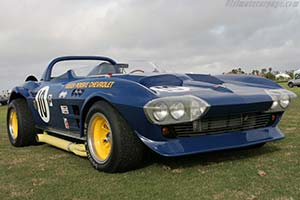
 At the end of the 1950s the three big American manufacturers signed a non racing pact, which effectively banned all works supported racing. General Motors worked around the pact somewhat with Corvette based prototypes, which were frequently raced. The official reading was that these racers were running test beds, which incorporated the latest technologies and design direction for the Corvette. Most famous of these 'specials' is the Sting Ray racer, which debuted in 1959. Its body design would find its way onto the second generation Corvette.