<< Prev Page 3 of 3 Only minor revisions were carried through on the TRs for 1960, mainly dictated by the slightly changed regulations. The only technical changes were seen on the gearbox of which various versions were tested and raced throughout the season. Three of the five TR59s were retained by the factory and updated to the new specification and are commonly referred to as TR59/60. At the Le Mans test day the fully independently sprung TRI60 was first campaigned. This highly advanced racer was considerably lighter than the regular TR59/60s and offered better cornering characteristics. The championship only consisted of five rounds this season and with the withdrawal of Aston Martin there was no factory opposition for Ferrari. The first championship victory by Ferrari in almost a year came in Buenos Aires. The Scuderia boycotted the Sebring 12 Hours race because they were forced to run the sponsor's fuel much like at the Nürburgring two years earlier. A privately entered TR59 scored four useful points behind the victorious Porsches. The Targa Florio and the Nürburgring 1000 km races again did not favour the TR and victories were scored by Porsche and Maserati respectively. At Le Mans the order was restored and with a one-two victory Ferrari regained the championship crown beating Porsche by four points.
Although the Ferraris were competitive in the last two seasons, the dominance of 1958 seemed so far in the past so more drastic alterations were required. Although still referred to as a Testa Rossa the TRI61 featured a completely new spaceframe chassis. The name is still somewhat justified as much of the suspension and drivetrain from the ill-fated independently sprung TRI60 was adapted. The spaceframe was not as elaborate as the one that gave the Maserati 'Birdcage' its nickname, but still offered superior weight and rigidity characteristics over its predecessors. The most obvious changes for the spectators was the new body style complete with a sharknose front and Kamm-tail for more stability. To more successfully take on Porsche on the tighter tracks the large TRI61 was joined by the nimbler, mid-engined 246 SP at the annual press conference. Ferrari's tactics paid off and with victories for the TRI61 in the Sebring 12 Hours and Le Mans 24 Hours and one for the 246 SP in the Targa Florio, the title came home with Enzo once again. The CSI stepped in once more and drastically changed the regulations again. For 1962 the world championship would be run for GT cars and although prototype racers like the Testa Rossa were still allowed to race for overall victory, they were no longer eligible to score points.
Following the rule changes, the prototype program was frozen in favour of the new GT car developed. Powered by the six carb TR engine, this 250 GTO owed much to its world championship predecessor. A new four litre 'experimental' class was created, but with much stricter regulations than the previous three litre prototype class. Many of these changes involved mandatory equipment such as full windscreens with wipers to resemble road cars more accurately. After many of the key personnel walked out in the winter of 1961, there was little time and desire to develop a new racer to suit this class. Work eventually began, but proved too late for the season opening Sebring 12 Hours. The chassis was derived from 250 TRI60 s/n 0780 TR, renamed 330 TRI/LM and renumbered 0808. It was stretched to house a four litre SuperAmerica engine that was tuned to develop a conservative 360 bhp. The car was ready for Le Mans where its only real opposition came from a fragile Aston Martin. With the TR's most successful drivers behind the wheel there was little doubt that a fourth Le Mans victory was on hand for the Testa Rossa. Phil Hill and Olivier Gendebien yet again showed their worth and promptly piloted the 330TRI/LM to Ferrari's sixth Le Mans triumph. It was the last major victory for the TR and also the last at Le Mans for a front engined racer.
In the 19 championship races the 250 TR variants were entered between 1958 and 1961, a remarkable 10 victories were scored. With the exception of the troublesome 1959 season there was no stopping V12 engined racers. It is debatable whether the successes were scored due to the lack of competition, or the TR's stellar pace turned the competition away from building a competitive racer of their own. Regardless, what matters most is the car's racing record; the hows and whys are quickly forgotten. Today the Testa Rossa name and the pontoon fendered shape of the early cars are highlights in Ferrari's long history. With only 34 examples of all versions constructed and even less remaining today, the TR is also one of the most valuable of all. In 2011 this was underlined by the sale of the 250 TR Prototipo for $16.4 million at Gooding's Pebble Beach auction, making it the most expensive car ever sold at auction. The previous record was also held by a 250 TR. << Prev Page 3 of 3

 Ultimatecarpage.com
> Cars by brand
> Italy
> Ferrari
Ultimatecarpage.com
> Cars by brand
> Italy
> Ferrari
 Racing cars
> Other Sportscars
Racing cars
> Other Sportscars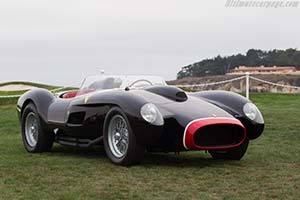
 Only minor revisions were carried through on the TRs for 1960, mainly dictated by the slightly changed regulations. The only technical changes were seen on the gearbox of which various versions were tested and raced throughout the season. Three of the five TR59s were retained by the factory and updated to the new specification and are commonly referred to as TR59/60. At the Le Mans test day the fully independently sprung TRI60 was first campaigned. This highly advanced racer was considerably lighter than the regular TR59/60s and offered better cornering characteristics. The championship only consisted of five rounds this season and with the withdrawal of Aston Martin there was no factory opposition for Ferrari. The first championship victory by Ferrari in almost a year came in Buenos Aires. The Scuderia boycotted the Sebring 12 Hours race because they were forced to run the sponsor's fuel much like at the Nürburgring two years earlier. A privately entered TR59 scored four useful points behind the victorious Porsches. The Targa Florio and the Nürburgring 1000 km races again did not favour the TR and victories were scored by Porsche and Maserati respectively. At Le Mans the order was restored and with a one-two victory Ferrari regained the championship crown beating Porsche by four points.