
 Ultimatecarpage.com
> Cars by brand
> Germany
> BMW
Ultimatecarpage.com
> Cars by brand
> Germany
> BMW
 3.0 CSL 3.0 CSL
|
| BMW 3.0 CSL |
| Article | Image gallery (58) | WBS81AZ090CM08044 | Specifications |
|
|
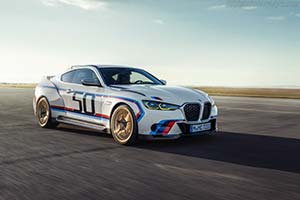
<< Prev Page 3 of 3  The BMW 3.0 CSL features the most powerful straight six-cylinder engine ever used in a road-legal BMW M automobile. This is also a tradition: in its final stage of development, the predecessor of the same name marked a new record with an engine output of 151 kW/206 hp – not only for six-cylinder models but for all BMW production vehicles produced up to that point. The BMW 3.0 CSL features the most powerful straight six-cylinder engine ever used in a road-legal BMW M automobile. This is also a tradition: in its final stage of development, the predecessor of the same name marked a new record with an engine output of 151 kW/206 hp – not only for six-cylinder models but for all BMW production vehicles produced up to that point.Since then, the straight six-cylinder engine with M Power has undergone impressive development. Engines of the same design mobilised an output of 204 kW/277 hp in the BMW M1 as early as 1978 and 250 kW/340 hp in the second-generation BMW M5 from 1991. The fifth-generation BMW M3 was launched in 2014 with a 317 kW/431 hp straight-six engine featuring M TwinPower Turbo technology. The straight six-cylinder engine of the BMW 3.0 CSL possesses the same technological roots as the power unit used in the current DTM winning car. The 3.0-litre power unit offers spontaneous high revving thanks to the typical M high-revving concept and comprises, among other things, an extremely rigid crankcase in a sleeveless closed-deck design, a forged lightweight crankshaft and a cylinder head core featuring 3D printing technology. The cooling system and oil supply are also designed for extremely dynamic driving situations. For its championship win in the DTM, the BMW M4 GT3 was powered by a version of the latest straight six-cylinder engine with around 600 hp which, in its version designed for large-scale production in the current models of the BMW M3/BMW M4 series, delivers up to 375 kW/510 hp. The version of the drive system with M TwinPower Turbo technology, which was further developed exclusively for the BMW 3.0 CSL, mobilises a maximum output of 412 kW/560 hp. The new record for straight six-cylinder models from BMW M GmbH with road approval underpins the special status of the vehicle. Its engine develops a maximum torque of 550 Nm with a linear power delivery up to a maximum speed of 7,200 min-1. To transfer the drive power to the road, the developers of the BMW 3.0 CSL used a concept that has been tried and tested for decades for maximum driving pleasure and intensive interaction between driver and vehicle. The straight six-cylinder engine is coupled with a 6-speed manual gearbox whose spread and transmission ratios are ideally matched to the performance characteristics. Precisely defined gear shift travel enables fast and precise gear changing. The gearshift knob made exclusively for the BMW 3.0 CSL protrudes from the centre console and is a luxurious accessory. It immediately arouses anticipation for the manual gearshift, lies snugly in the hand and, with its white surface, the engraved gearshift diagram and the number 50, is reminiscent of the beginnings of BMW M GmbH in the 1970s. A tribute to modern technology is the shift assistant, which uses a connection speed control to ensure slip-free clutch engagement after downshifting when braking for corners. Shift assistant can be activated or deactivated by the driver. The drive torque is transmitted to the road exclusively via the rear wheels of the BMW 3.0 CSL. For ambitious use on the racetrack, the driver can use the typical M linear build-up of lateral acceleration forces to steer the vehicle through bends with controlled drift manoeuvres. The Active M Differential in the rear-axle transmission also ensures superior dynamics. If necessary, it prevents torque compensation between the rear wheels and, at the same time, continuously and variably builds up a locking effect of up to 100 per cent. The Active M Differential is linked to the DSC (Dynamic Stability Control) and precisely adjusts its locking effect to the respective driving situation. For example, traction is optimised on roads with different friction values for the right and left rear wheels. When accelerating dynamically out of bends, the driver receives noticeable feedback on the grip potential on the rear wheels and can thus optimally dose the use of the accelerator pedal. In the configuration of the suspension technology as well, state-of-the-art technology has been combined with a methodology for the harmonisation of all components that has matured over five decades. The suspension components used in the BMW 3.0 CSL represent the spearhead of development for high-performance sports cars by BMW M GmbH: a double-joint spring strut front axle and a five-link rear axle in M-specific design, an Adaptive M suspension with electronically controlled shock absorbers, the electromechanical M Servotronic steering with variable ratio and the M carbon ceramic brake system with adjustable characteristic curves. The integrated application of all drive and chassis systems took place during intensive test drives on public roads as well as on race tracks, including the Nürburgring Nordschleife, which has been the ultimate testing ground for all BMW M automobiles for 50 years. Before testing, engineers at BMW M GmbH had designed and optimised the digital image of the BMW 3.0 CSL in every detail in a computer-aided design and development process. By incorporating virtual reality and other digital processes, it was possible to accelerate the series development process to the maximum extent. This detailed simulation and tuning process took into account the model-specific dimensions, vehicle weight and axle load distribution, the extremely high rigidity of the body and suspension connections as well as the aerodynamic balance of the BMW 3.0 CSL to ensure from the onset that typical M combination of agility, dynamics and handling precision. Powerful deceleration performance, optimised fading stability, outstanding thermal stability and extremely high wear resistance are offered by the M carbon ceramic brake system. It combines six-piston fixed-calliper brakes and ceramic brake discs measuring 400x38 millimetres on the front axle with single-piston fixed-calliper brakes and 380x28-millimetre ceramic brake discs at the rear and features red-painted brake callipers. The M-specific design of the integrated braking system allows two characteristic pedal-feel curves to be displayed, which can be selected in the M Setup menu. With the M Traction Control function, the driver can individually set the intervention thresholds of the wheel slip limitation. Ten levels are available for this purpose, and complete deactivation of the driving stability control is also possible via the M Dynamic Mode. The BMW 3.0 CSL is perfectly prepared for experiencing pure performance on the racetrack. In the BMW 3.0 CSL, the tradition of intelligent lightweight construction, which has been cultivated since the 1970s, is reformulated and reshaped using state-of-the-art technology. To reduce weight in the body and chassis areas, carbon fibre reinforced plastic (CFRP) is used to an exceptionally high extent alongside the minimised use of insulating material. BMW M GmbH is a pioneer in the use of CFRP in series-produced vehicles. As early as 2004, it equipped a large-series model with a carbon roof for the first time. The BMW 3.0 CSL features CFRP components on virtually all bodywork sections. In addition to the roof, bonnet and boot lid, the front and rear aprons are made entirely of carbon. The front and rear side panel attachments, the side sills, the rear diffuser, the rear wing and rear spoiler are also made of this high-tech material. All carbon components are manufactured in small series, mostly by hand and exclusively for the BMW 3.0 CSL. In addition, a targeted selection of materials and state-of-the-art design methods also lead to a significant reduction in the weight of other vehicle components. The roof spoiler of the BMW 3.0 CSL is made of glass fibre reinforced plastic. The titanium rear silencer of the BMW 3.0 CSL is around 4.3 kilograms lighter than a conventional steel component. The cast aluminium precision struts in the engine compartment, which connect the suspension strut domes and the front end, have a geometry that has been precisely matched to the forces acting in different driving situations. With the aid of mathematical models, agility and steering precision has been optimised with a minimum of material and weight. The use of carbon and other lightweight construction measures in the interior of the BMW 3.0 CSL emphasises its pure sports car characteristics. Instead of additional seats, the rear offers a storage compartment with two integrated helmet compartments. CFRP trim in the door panels and reduced acoustic insulation also contribute to the extremely sporty flair. The driver and front passenger sit in M Carbon full bucket seats, which convey a highly emotional and unique racing feeling every mile of the way. The diagonal connections between the seat surface and the backrest are reminiscent of the construction principle of the lightweight seats featured in the historic model. Seat height and inclination can be adjusted exclusively via a three-stage screw linkage in a workshop. The longitudinal position can be varied manually using a lever at the front edge of the seat. In addition, the M Carbon full bucket seats offer removable headrest inserts. Over and above that, the interior of the BMW 3.0 CSL presents itself as a sports car cockpit that is pure and exclusive. Black Alcantara seat surfaces and M seat belts are combined with an M Alcantara steering wheel, an anthracite roof liner, black Alcantara and matt carbon surfaces. Contrast stitching and other accents in white correspond with the exterior paintwork of the BMW 3.0 CSL, the model lettering of which is embossed into the door sill trims and the seat surfaces. The white gearshift knob symbolises the classic form of interaction between driver and vehicle when changing gear, while the start/stop button and the M buttons on the steering wheel are finished in red. The matt interior trims in a carbon fibre finish feature sequential numbering for each of the 50 units available. This marking, documented in the interior from #01/50 to #50/50, corresponds in each case to the final digits of the suspension number, thus representing a visible and authentic reference to the individual vehicle identity. << Prev Page 3 of 3 |
| Article | Image gallery (58) | WBS81AZ090CM08044 | Specifications |
| All Cars - Contact us - Privacy Statement - Top | © 1998 - 2026 Ultimatecarpage.com |