
 Ultimatecarpage.com
> Cars by brand
> Italy
> Ferrari
Ultimatecarpage.com
> Cars by brand
> Italy
> Ferrari
 SF90 XX Spider SF90 XX Spider
|
| Ferrari SF90 XX Spider |
| Article | Image gallery (9) | Specifications |
|
|
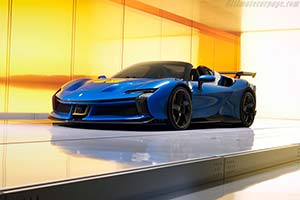
<< Prev Page 2 of 3 Next >>  The SF90 XX Stradale delivers the most efficient aerodynamic performance of any road-going car in Ferrari’s history, making it comparable only to that of the LaFerrari supercar. It delivers double the maximum downforce of the SF90 Stradale, improving grip and yielding a palpably faster lap time at Fiorano. The product of Maranello’s inestimable racing experience, this result was reached by redesigning the cooling flow management for the thermal and electric components as well the engine compartment to cope with the higher maximum power available. The SF90 XX Stradale delivers the most efficient aerodynamic performance of any road-going car in Ferrari’s history, making it comparable only to that of the LaFerrari supercar. It delivers double the maximum downforce of the SF90 Stradale, improving grip and yielding a palpably faster lap time at Fiorano. The product of Maranello’s inestimable racing experience, this result was reached by redesigning the cooling flow management for the thermal and electric components as well the engine compartment to cope with the higher maximum power available.From an aerodynamics perspective, the signature element is most definitely the rear fixed wing which was developed from experience with the XX Programme cars. This is an element with enormous aero potential that proved a natural fit for this particular application, thanks to close collaboration with the Ferrari Styling Centre. Its shape was dictated by the need to efficiently hone the way in which the pressure field created by the wing interacts with the complex pressure and backpressure systems that develop around the shut-off Gurney. The latter, which was also redesigned, efficiently manages the downforce/drag trade-off and has two configurations: LD (Low Drag) in which the mobile element is raised and is faired in with the fixed section, minimising drag to enhance longitudinal performance, while in HD (High Downforce), the mobile element is lowered, closing the blown area, thereby allowing the air to hit the fixed area. This generates an overpressure area which, aside from generating rear downforce, also deflects the incoming flow vertically to help deliver the absolute maximum rear downforce possible: 315 kg at 250 km/h. The ICE benefits from improved cooling thanks to the fact that the front radiators for the high temperature cooling circuit are more efficient. The new layout of the underbody was also optimised to guarantee improved extraction of the air coming off the radiators ahead of the front wheels. The side louvres on the lower part of the front bumper, already seen on the SF90 Stradale, were also redesigned and are now larger to reduce backpressure. The simultaneous increase in power and downforce posed a new challenge which Ferrari’s engineers tackled by reversing the layout of the medium temperature radiator, tasked with cooling the electrical components, increasing its efficiency and also enclosing a part of the car’s underbody, thereby increasing the effective surfaces that would help generate front downforce. It should come as no surprise that this very clearly race-derived architecture is shared by the brand-new 296 GT3. The different inclination of the front radiator improved the aerodynamic coefficients, simultaneously channelling hot air flows through and over the front bonnet. These flows are controlled and channelled over the car by two S-Ducts located one on either side of the vents in the centre of the bonnet. At the rear of the car, a scoop in front of the entry to the intercooler air intake cleans and slows the expansion of the flow arriving at the radiators. When the car is moving, cool air is drawn into the engine compartment through three apertures: the first located above the intercooler intake on the side and the second crossways on the engine cover, while the third is a pair of ducts located to the sides of the struts of the fixed spoiler. The car also has a specific front splitter, which is larger than the SF90 Stradale’s, and is the result of meticulous work in the wind tunnel. It generates a highly energised tube of air flow under the car and this is then exploited by the redesigned underbody. A larger, wider front diffuser contributes to the increase in downforce of over 45 kg at 250 km/h, by working in synergy with vortex generators that themselves have been redesigned. The downforce generated by the underbody is stabilised and multiplied by specifically shaped bodywork surfaces. As already mentioned, the two S-Ducts alone help increase front downforce by 20% compared to the SF90 Stradale. The introduction of the louvres on the front wheelarch was fundamental to this, however, as they allow dynamic extraction from the front wheel housing, thus giving the car an overall front downforce figure of 325 kg at top speed. The increase in drag was managed by working on the forms with the greatest potential impact on the body’s Cd: two different blown ducts have been incorporated into the front bumper to reduce overpressure and increase the permeability of the bodywork. The first, located at front radiator height, creates a small bubble that shields and fairs in the front wheel in more efficiently. The second channels the energised air directly onto the front bonnet, thereby encouraging the air to flow over it and the flanks, and keeping the flow tube entering the radiators at the sides clean. The evacuation of the rear part of the wheel housing has a beneficial effect on both downforce generation and drag, and the surfaces created allow the correct management of the air flow exiting the wheel. The rear diffuser was further developed to guarantee it makes a pivotal contribution by generating highly efficient downforce, thanks to carefully designing the trailing edge around the expansion volume, which helps keep the car’s wake compact. The focus with the SF90 XX Stradale’s development was to produce the most high-performance Ferrari road car ever that also delivered maximum fun behind the wheel, whilst fully retaining all of the functionalities of the SF90 Stradale’s hybrid powertrain. Usability of performance was especially important, particularly in terms of the electric mode’s ability to deliver surprisingly high performance driving both in typically urban settings and in out-of-town trips – in fact, the top speed in eDrive mode is 135 km/h. The transition from electric mode to hybrid mode is extremely smooth thanks to the seamless coordination between the electric front axle, the 8-speed DCT gearbox, the rear-mounted electric motor and the V8 engine. This in turn guarantees progressive, continuous acceleration and makes all the powertrain’s power available as rapidly as possible. The Torque Vectoring and Energy Recovery under braking and lift-off functions are available in all configurations, and the Ferrari Dynamic Enhancer (2.0) makes its debut. It is also active in all dynamic Manettino positions and all grip conditions. The various systems are all managed by the electronic Side Slip Control (eSSC) 1.0. Another major new addition is the ABS EVO controller, which debuted on the 296 GTB. Thanks to its integration with the 6W-CDS sensor it improves both performance and repeatability in high performance braking in dry conditions. It functions in high grip situations and in the Manettino positions from Race upwards using the data from the 6W-CDS sensor to obtain a precise estimation of the car’s speed. This makes it possible to determine the target slip of all four wheels and consequently optimise brake distribution. Consequently, the longitudinal force of the four tyres can be better exploited both in braking in a straight line and under braking during turn-in, where the rear axle has to deliver a natural trade-off between longitudinal braking performance and lateral stability. The system maximises the repeatability of the braking manoeuvre to a target value, reducing losses due to the tolerances of the components or the natural variability of test conditions. The controller thus allows the SF90 XX Stradale to brake later and in a more repeatable manner, thus enhancing its handling on the track. The 6W-CDS sensor delivers much more data than the previous iteration: in particular, its ability to measure both the acceleration and the speed of rotation on three axes (X, Y, Z) enables the other vehicle dynamic controls to more accurately read the car’s dynamic behaviour, thus optimising their intervention with much greater precision. In addition to this, also debuting on SF90 XX Stradale is the extra boost control logic which guarantees additional power in short bursts. The job of this software, which is only active in the Qualifying mode of the eManettino, is to produce an extra boost of power at the critical moment when the car is exiting a bend, something which alone improves lap time by 0.25s at Fiorano. The logic controls the power delivery, managing peak performance with battery charge, also monitoring the status of the components with the aim of optimising electric power delivery. The availability of the extra boost is indicated by a graph on the right-hand side of the dash display, and shows the remaining number of bursts left (maximum 30). The control logic guarantees this feature is fully useable for at least one or more laps of the track depending on the latter’s individual characteristics. This is thanks to the fact that the areas of the track where activating the power surplus is most useful are pinpointed heuristically, attempting to exclude areas where using it would not reduce the lap time. The car has a set-up with elastic characteristics and kinematic angles designed solely to optimise its behaviour on the limit. There is a 9% improvement in lateral performance (Ay max) compared to the SF90 Stradale in high speed handling conditions, mostly as a result of downforce. Furthermore, the roll rate was reduced by 10% thereby guaranteeing better body control. Because the new car delivers significantly more downforce than the SF90 Stradale and consequently more rapid deceleration, the SF90 XX Stradale’s braking system was also upgraded. While it retains the Aero callipers at the front, the front discs have been completely redesigned to improve cooling, there are now bigger 390mm-diameter rear discs and the brake pads are a new design that maximise the contact surface to improve the coefficient of friction. The SF90 XX Stradale is the most extreme version of the SF90 Stradale; its design criteria are thus those of a track car, calibrated to ensure it can be homologated for road use. That said, the SF90 XX Stradale is not just a special version: it is the first XX model to go through the factory gates, transferring the very pinnacle of Prancing Horse track technology, aerodynamic efficiency and power, to the road. Designed by the Ferrari Styling Centre headed by Flavio Manzoni, the SF90 XX Stradale incorporates the engineering principles that underpinned the SF90 Stradale and pushes them to new extremes. Thanks to the close synergic relationship between the Styling Centre and the Technical Department, significant modifications were carried out, predominantly with the aim of increasing the downforce of the original car. In terms of its concept, this is to all intents and purposes an XX car. Its characteristics, the fruit of a more incisive, radical design language, are even more extreme still. The SF90 XX Stradale’s styling cues are designed to highlight its thoroughbred performance characteristics whilst still retaining the pure lines and forms of its predecessor. Hence the decision not to hide air intakes and vents, a fundamental part of racing cars’ stylistic language. A technical solution that also becomes a signature element: the three louvres on the SF90 XX Stradale’s front wing and on the rear one are an example of this. As was the case with the F12tdf, these are typical cues from Ferrari’s styling language. There is no doubt that one of the most distinctive characteristics of the SF90 XX Stradale’s design is its rear wing. The tail volume, which has been specifically redesigned with aero in mind, is now sleeker, giving it the long tail silhouette typical of racing cars. The air intakes for the intercoolers are now larger too, channelling the air towards the radiators more efficiently. The arrow-shape front wing concept has been retained on the SF90 XX Stradale. The headlights, which now have an even lower upper profile, are now integrated into this area by two external vertical wing profiles. This creates what we might call a more geometric language that reflects the spirit of this new car. New and distinctive elements of the front section are the two imposing lower wings that dominate the air intakes, which look as if they are floating, making the SF90 XX Stradale itself seem broader and more glued to the asphalt than any other. The rear of the car is characterised by the trimaran design of the tail. Compared to the SF90 Stradale, the SF90 XX Stradale features more imposing rear vents behind the wheels. The trimaran section also incorporates two central exhausts. Design-wise, the aim here was to visually underscore the impressive width of the rear of the car and this was achieved by drawing on a layering concept. One of the layers is the fixed rear wing, a solution not seen on a street legal Ferrari since the 1995 F50. The second is the body-coloured profile that wraps around a light-bar, an element that is a complete departure from the twin-taillight concept of the SF90 Stradale. The third layer, already seen on the SF90, is the blown spoiler combined with an active aero concept known as a shut-off Gurney. Carbon-fibre elements stand out from bodywork colour elements all over the car, but most especially in its lower section, to underscore the car’s technical aspects. Other connotative elements are the air vents in the shape of rounded-off quadrangles on both the front bonnet and rear engine lid, which effectively become a part of the car’s livery. They are designed as touches of colour that coordinate with the end plates on the carbon-fibre rear wing, for instance. The car also sports specific star-burst wheel rims with prominent aerodynamic profiles. << Prev Page 2 of 3 Next >> |
| Article | Image gallery (9) | Specifications |
| All Cars - Contact us - Privacy Statement - Top | © 1998 - 2026 Ultimatecarpage.com |