Page 1 of 1 Few cars have created a bigger shockwave in the automotive industry than Jaguar's E-Type at its 1961 Geneva Show debut. Its styling was quite a departure from Jaguar's previous sportscar range with the XK120 - 150. Its long nose was a completely new feature that spawned some subsequent automotive design trends. Technically, it shared little with other Jaguar road cars, but instead adopted details from the successful Le Mans racers.
Apart from its distinctive styling, the E-Type's chassis was what truely set the E-Type apart from its competition. Like the D-Type, it consisted of a central steel monocoque with a front subframe supporting the engine and independent front suspension. The center section was extremely strong, but less complex than the spaceframe constructions of equal strength. Although it was relatively cheap to construct, it was quite expensive to fix a damaged chassis. Rear space was conserved by using the driveshaft as an integral part of the suspension. It acted like the upper section of two wishbones.
Covered by a huge one piece bonnet, the straight six engine was carried over from the XK150 S performance model, which was similar in design to the engines used at Le Mans. One of the car's weaknesses was the four speed gearbox, which did not have a synchromesh first gear. Another feature carried over from the racing cars were the inboard mounted rear discs brakes, which decreased the unsprung weight, and in turn improved the car's handling. An unfortunate side-effect with early E-Types was overheating brakes under extreme conditions.
At the Geneva launch, the E-Type was available as a Fixed Head Coupe and a Roadster. Compared to its rivals, the E-Type was cheaper, better looking, and a lot faster, which made it an immediate hit. The open version was especially popular and outsold the fixed head by a couple of hundred cars. In 1964 the first big changes were carried through with the introduction of a larger 4.2 litre engine and a "Moss" all-synchromesh gearbox. Two years later a 2+2 Coupe was added to the line-up.
A Series 2 was introduced in 1968, which featured a large number of modifications to meet the continually stricter safety and emissions regulations. It's easily recognizable today by its open headlights compared to covered lights on the original E-Type. The final incarnation was launched in 1971 as the Series 3 and featured an all new 5.3 litre V12 engine. For additional cooling the 'mouth' in the nose was enlarged and a larger radiator utilized. Production of the E-Type finally ceased in 1975, when it was replaced by the XJ-S.
Today the E-Type remains as one of the styling icons of the 20th century and arguably the best and most popular ever produced by Jaguar. Page 1 of 1

 Ultimatecarpage.com
> Cars by brand
> Great Britain
> Jaguar
Ultimatecarpage.com
> Cars by brand
> Great Britain
> Jaguar
 E-Type Roadster
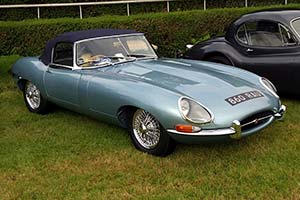
 Few cars have created a bigger shockwave in the automotive industry than Jaguar's E-Type at its 1961 Geneva Show debut. Its styling was quite a departure from Jaguar's previous sportscar range with the XK120 - 150. Its long nose was a completely new feature that spawned some subsequent automotive design trends. Technically, it shared little with other Jaguar road cars, but instead adopted details from the successful Le Mans racers.