Page 1 of 2 Next >> In the second half of the 1970s, the World Championship for sports cars was run for production based 'Group 5' racing cars. Compared to the much more tightly governed 'Group 4' cars, manufacturers were allowed to carry through major modifications compared to the road car the racer was based on. Group 5 was effectively a silhouette class. To balance the performance, the cars' minimum weight was coupled to the displacement of the engine. Since its inception in 1976, the Group 5 class had been completely dominated by the Porsche 935, which faced no serious competition. That changed halfway through 1979 when Lancia Corse deployed the striking Beta Montecarlo Turbo.
As the name suggests, Lancia's Group 5 racer was based on the Beta Montecarlo road car that was first introduced in 1975. However, other than the general layout and the engine block very little was retained for the racing car. The Italian manufacturer had called in the help of in-house racing expert Abarth for the mechanicals and designer Pininfarina for the aerodynamics. The startling end-result bore but a small resemblance to the mid-engined road car it was originally based on. The very wide body panels developed in the Pininfarina wind-tunnel formed a stark contrast to the much slimmer centre section that the rules dicated had to be carried over from the production car.
Under the composite panels the changes were numerous as well. Chassis guru Gianpaolo Dallara completely reworked the production car derived monocoque and McPherson strut suspension in every way, shape and form allowed by the regulations. The biggest 'secret' of the Group 5 Beta Montecarlo was found between the centre section and the rear suspension; the engine. While the production block was retained, Abarth engineers built a brand new 16-valve head and bolted on massive KKK-Turbo. By keeping the displacement down to 1425 cc, the car fell in the 2-litre / 780 kg class (using the 1.4 equivalency factor for Turbocharged engines). Despite its relatively small size, the engine was still good for 400 bhp and later for up to 473 bhp. Page 1 of 2 Next >>

 Ultimatecarpage.com
> Cars by brand
> Italy
> Lancia
Ultimatecarpage.com
> Cars by brand
> Italy
> Lancia
 Racing cars
> Other Sportscars
Racing cars
> Other Sportscars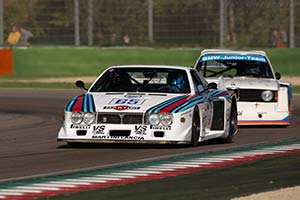
 In the second half of the 1970s, the World Championship for sports cars was run for production based 'Group 5' racing cars. Compared to the much more tightly governed 'Group 4' cars, manufacturers were allowed to carry through major modifications compared to the road car the racer was based on. Group 5 was effectively a silhouette class. To balance the performance, the cars' minimum weight was coupled to the displacement of the engine. Since its inception in 1976, the Group 5 class had been completely dominated by the Porsche 935, which faced no serious competition. That changed halfway through 1979 when Lancia Corse deployed the striking Beta Montecarlo Turbo.