Go to Ultimatecarpage.com

Car search: Quick Advanced 
 sport Ultimatecarpage.com  > Cars by brand  > Italy  > Ferrari
Racing cars  > Other Sportscars
     250 LM
Cars statistics: 5055 cars, 431 makes, 39426 images; Events statistics: 215 reports, 41349 images; Forum statistics: 85,362 members, 41,972 topics; more...


  Ferrari 250 LM
 

Ferrari 250 LM Ferrari 250 LM Ferrari 250 LM Ferrari 250 LM Ferrari 250 LM Ferrari 250 LM
Click here to save all images    Image credits: Wouter Melissen 

Click here to download printer friendly version With the introduction of the uncompromizing 250 GT, Ferrari's stronghold on GT racing was solidified exponentially. First introduced in 1954, the LWB (Long Wheel Base) 250 GT dominated, the introduction of SWB (Short Wheel Base) 250 GT late in 1959 took that domination one step further and with the 250 GTO of 1962 the domination was complete. Times were changing, the introduction of the mid-mounted engine in the 1950s changed the outlook of the sport and was set to leave many dominating models obsolete, including the 250 GT(O).

Never quick to respond to technical innovations, Ferrari built their first successful mid-engined racer in 1961, the F1 championship winning V6 engined 156. The first mid-engined sports cars were also powered by V6 engines and it was Ferrari's arch-rival Maserati (Tipo 63) that beat the Maranello based firm to building a sportscar with a mid-mounted V12. Based on the V6 engined racers, Ferrari's first V12 exploit proved an immediate success. Powered by the 250 GTO derived 300 bhp engine, the 250 P smashed the Monza track record on its 1962 debut. At the 24 Hours of Le Mans of a year later, two 250 Ps finished first and third, with a 250 GTO finishing second and the rest of the top six filled with Ferraris as well.

To continue the GT dominance, Ferrari realised that, after ten years, the successful 250 GT series had to be abandoned for a completely new car. Logical base for this new car was the all-conquering 250 P, which would be perfectly suited to GT racing with a couple of modifications. Most notable difference between the 250 P and the new 250 LM was the addition of a roof. For the chassis tubes a higher gauge of steel was used for extra rigidity.

At the 1963 Paris Motorshow the 250 LM made its official debut, but it wasn't until 1964 that the production version was ready. Main difference between the show car and all other 250 LMs was the engine displacement. The 250 LM still used the GTO derived 3 litre, in the production cars, however, a bored 3.3 litre version was used. In good Ferrari tradition it should thus have been called 275 LM, but for commercial and homologation reasons the 250 was used.

Homologation was a keyword in the LM's sporting history. With the GTO Ferrari had managed to avoid the 100 car production minimum, by claiming it was just a rebodied 250 GT SWB, which it definitely was not. In 1964 the FIA was quick to deny the homologation request for the LM, as they didn't think Ferrari would ever produce 100 LMs. Reluctant to give up, Ferrari continued development work on the LM. However, only 32 250 LMs were eventually constructed, proving the FIA's assumptions right.

With the GT homologation refusal, the 250 LM was only eligible to race in the prototype class, where it was pitched against more sophisticated rivals from its own stable. This didn't stop the 250 LM from winning and in 1964 ten victories were scored out of 35 entries. Five 250 LMs were entered in the 1965 24 Hours of Le Mans by privateers. When both Ferrari and Ford's prototype effort failed by poor reliability, the NART entered 250 LM stepped in to record its finest victory. Two of the other four finished in the top six as well, in second and sixth.

Although the 250 LM was not as successful as its predecessors, it did manage to secure Ferrari's last overall Le Mans victory and to this day it has a special spot in many Ferrari fan's hearts. With only 32 built, the 250 LM is extremely rare and valuable, for this reason a number of replicas were built. To add to the confusion original serial numbers were used for the replicas. One thing is for sure, more 250 LMs exist today than originally left the factory.

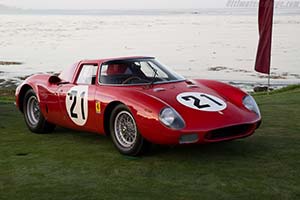
Featured is s/n 5909, which spent most of its time in the United States. After being run for a short time by Luigi Chinetti's NART, it was ownd by Bob Grossman of 'Scuderia Bear', who raced it throughout 1964. After its active career, 5909's most prominent achievement was winning the 1975 Pebble Beach Concours d'Eleganze. Fortunately the current owner is keen on taking it out racing again. It is pictured here during the 2005 Tour Auto, where it was one of the stars of the event.

Article by Wouter Melissen, last updated on May 09, 2005

Add your comments on the Ferrari 250 LM

 FAST but NASTY  
West McLaren
10-8-2002
Perhaps the best-known Ferrari street/race cars of the '60s are the 250 GTO and the 250 LM. Although they were built in similarly small numbers, the value of 250 LMs has always languished far behind that of the GTO. There are many reasons for this. The 250 GTO, equipped with a predictable solid rear axle, Watts link rear suspension, and easy-to-use, five-speed synchromesh transmission, made a bad driver look good. The 250 LM, built with a flexible chassis, tough-to-shift, non-synchro transaxle and unforgiving rear suspension geometry, made a talented driver look, at best, busy. Add in little headroom, right-hand-drive steering, a left-hand shifter, and a driving position complicated by having the gas, brake and clutch pedals offset well to the center line of the car, and the 250 LM was not favored by many Ferrari drivers. Additionally, the cockpit of the 250 LM is even noisier, more cramped and hotter than the 250 GTO, making our busy driver miserable as he tries to save his life on the race track. All 250 Le Mans were sold to privateers or to concessionaires who later sold them to privateers, and many suffered accordingly, being crashed and rebuilt repeatedly, usually on limited budgets. Several 250 Le Mans gained double identities when rebuilt, with various parts going into two separate rebuild projects, each claiming the S/N and lineage rights to the damaged car. As a result, of the thirty-two 250 Le Mans built by Ferrari, at least thirty-eight exist today, a survival rate exceeded only by the often-duplicated D-type Jaguars. Like all collectible racing Ferraris in a booming economy, the price of a 250 Le Mans has risen in the last five years. 250 Le Mans S/N 6023, a car with a good race history and provenance, sold for $2,147,500 at Christie's auction at Pebble Beach, August 28, 1999, to a California exotic car dealer. This same car was resold to an English collector in March 2000 for $2,500,000. More recently, RM sold S/N 6173 for $2,310,000 at their Amelia Island auction. While a fully documented car, 6173 had been heavily crashed and rebuilt, while 6023 was relatively pristine, accounting for the price differential. While $2,500,000 is a record price for a 250 LM in this decade, it is well below the record price of $5,500,000 paid for S/N 6313 in 1990, and is also well below the price of a comparable condition 250 GTO today, which would sell for well over $6,000,000. In general, the prices of 250 LMs have always been around 50% of those of GTOs with similar provenance, and you can expect that ratio to remain constant for the foreseeable future.
     

General specifications
Country of origin Italy
Chassis number 5909
Numbers built 32
Produced from 1963 - 1966
Introduced at 1963 Paris Motor Show
Body design Pininfarina

Major wins
1965 24 Hours of Le Mans (Masten Gregory / Jochen Rindt in 5893)

Engine
Configuration Type 211 60º V12
Location Mid, longitudinally mounted
Construction light alloy block and head
Displacement 3.286 liter / 200.5 cu in
Bore / Stroke 77.0 mm (3 in) / 58.8 mm (2.3 in)
Compression 9.7:1
Valvetrain 2 valves / cylinder, SOHC
Fuel feed 6 Weber 38 DCN Carburettors
Aspiration Naturally Aspirated
Power 320 bhp / 239 KW @ 7500 rpm
Torque 294 Nm / 217 ft lbs @ 5500 rpm
BHP/Liter 97 bhp / liter

Drivetrain
Chassis aluminium body on multi tubular space frame
Suspension (fr/r) double wishbones, coil springs, shock absorbers, anti roll bar
Steering ZF worm-and-peg
Brakes Dunlop discs, all-round, inboard at the rear
Gearbox 5 speed Manual
Drive Rear wheel drive

Dimensions
Weight 850 kilo / 1873.9 lbs
Length / Width / Height 4270 mm (168.1 in) / 1700 mm (66.9 in) / 1150 mm (45.3 in)
Wheelbase / Track (fr/r) 2400 mm (94.5 in) / 1350 mm (53.1 in) / 1340 mm (52.8 in)

Performance figures
Power to weight 0.38 bhp / kg
Top Speed 295 km/h (183 mph)
0-60 mph 6.1 s

Resources
Related cars
Related articles
Useful links