
| sport |
 Ultimatecarpage.com
> Cars by brand
> United States
> Ford
Ultimatecarpage.com
> Cars by brand
> United States
> Ford
 Racing cars
> Other Sportscars GT40 Mk I Gulf Racing cars
> Other Sportscars GT40 Mk I Gulf
|
| Ford GT40 Mk I Gulf |
| Article | Image gallery (209) | Chassis (6) | Specifications |
|
|
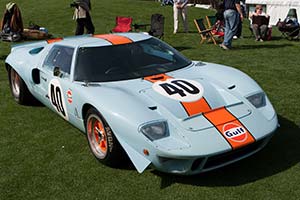
Page 1 of 1  A drastic regulation change saw a whole generation of sports prototype racers obsolete at the end of the 1967. The new rules limited the engine size of pure prototypes to just three litre, while a five-litre sports car class was added with a 50 example production limit. Having just won the 24 Hours of Le Mans two years running with GT40 variants that were now illegal, this was a convenient moment for Ford to suspend its works program. A drastic regulation change saw a whole generation of sports prototype racers obsolete at the end of the 1967. The new rules limited the engine size of pure prototypes to just three litre, while a five-litre sports car class was added with a 50 example production limit. Having just won the 24 Hours of Le Mans two years running with GT40 variants that were now illegal, this was a convenient moment for Ford to suspend its works program.The changes did in fact favour, the original, small-block GT40, which due to the large number of cars built easily met the homologation requirements. Upon their withdrawal, Ford sold their British facility to former Ford Advanced Vehicles principle John Wyer. Under the JW Automotive banner, he continued to supply parts for existing cars and thanks to the regulation revisions also received orders for new GT40s. More importantly, Wyer also switched back to racing GT40s with his Gulf-backed team after successfully fielding Mirage M1s in 1967. The Mirage M1 had not been a brand new design but instead a further development of the original GT40 with a lighter chassis and a narrower roof. Where permitted these modifications were also carried through on a batch of three new GT40s readied for the 1968 Sports Car World Championship. In fact two of these cars featured chassis previously used for two of three Mirages used in 1967. The new GT40s also used a stroked, five-litre version of the small-block V8. According to official figures this was good for around 425 bhp. Finished in the ever striking Gulf colours, the JW Automotive cars were no doubt the fastest small-block GT40s yet. Among the drivers hired to drive the Gulf GT40s were the likes of Brian Redman, David Hobbs and Jacky Ickx. They did face strong competition in the World Championship with Lola managing to get the T70 homologated as a production sports car and Porsche fielding the very quick 907 and 908 prototypes powered by eight cylinder engines of 2.2 litre and 3 litre respectively in size. Porsche got off to a stellar start in 1968, taking outright victories at Sebring and Daytona. JW Automotive hit back with wins at Brands Hatch, Monza, Spa and Watkins Glen. Scheduled late in the year due to strikes, the 24 Hours of Le Mans was the final round of the season. Keen to win their first outright win at Le Mans, Porsche fielded four 908s against three Gulf GT40s. The German manufacturer had to wait another year as Pedro Rodriguez and Lucien Bianchi came out on top in their GT40, securing the World Championship for JW Automotive in the process. For the 1969 season, Wyer hedged his bets and fielded the all new Mirage M2 prototype in the shorter distance events while relying on the tried and trusted GT40s in the long races. During the winter the homologation requirements for sports cars had been reduced from 50 to just 25 examples. This had inspired Porsche to build a five-litre prototype racer, the 917, in large numbers but for a variety of reasons, the German manufacturer relied mostly on the further developed 908. Ferrari also returned to the fray with the three-litre 312 P. The new Porsche 908/2 proved quick straight out of the box but thanks to its tenacity, the Gulf GT40 took another win in the Sebring 12 Hours, this time with Jacky Ickx and Jacky Oliver behind the wheel. Sadly, this was a rare success for the JW Automotive team in the races leading up to Le Mans. The new Mirage M2 proved to be both too fragile and underpowered to compete with the 908s. The main problem was the BRM V12, the team was forced to use as Ford had opted to supply their new Cosworth DFV engine to a rival team. For the 24 Hours of Le Mans, a pair of the tried and trusted GT40s were brought out once again. Despite the type's hat-trick of wins, the Gulf liveried machines were now outsiders. Porsche brought a small army of 908s and 917s and looked the clear favourites. There are no certainties at Le Mans however and in the final our Ickx and Oliver emerged in the lead, chased hard by Hans Herrmann and Gerard Larousse in the sole surviving works 908. A legendary drive from Ickx eventually saw him score the GT40s fourth win, with Herrmann a mere 120 metres behind, which is still the closest ever finish at Le Mans. The 1969 Le Mans would be the last hurrah for the GT40 after a career at the top that spanned over half a decade. For 1970, JW Automotive served as one of the Porsche-supported semi-works team, successfully fielding Gulf-liveried 917s. Scoring back-to-back Le Mans wins and bringing Ford a third World Championship, the Gulf GT40 was not the only the final GT40 development but also the most victorious. Page 1 of 1 |
| Article | Image gallery (209) | Chassis (6) | Specifications |
| All Cars - Contact us - Privacy Statement - Top | © 1998 - 2026 Ultimatecarpage.com |