Page 1 of 2 Next >> When Ferrari replaced the 275 GTB with the 365 GTB/4 'Daytona' in 1968 and no competition version was announced, a highly successful era came to an end. In this period, Ferraris, particularly the 250 GT derivatives, dominated GT racing. There were various reasons for the Italian manufacturer to suspend the customer racing program, like the spiralling costs of the sports car and F1 efforts and the switch of the focus to prototype racing of the potential clients.
The Ferrari 365 GBT/4 was nevertheless bestowed with the same racing DNA as its predecessors, so it was only a matter of time before one was independently prepared for racing. Not surprisingly, among the first to field a Daytona was Luigi Chinetti, who was Ferrari's American importer and long time private entrant under the North American Racing Team (NART) banner. Readied in 1969, the alloy-bodied NART Daytona was raced at Daytona and Sebring with a twelfth at the latter as the best result.
Buoyed by the performance of his Daytona, Chinetti approached Enzo Ferrari in an attempt to re-consider his decision not to make a competition version. He met his old friend halfway and offered the help of the 'Assistenza Clienti' or customer assistance department to ready a batch of five new cars for the 1971 season. Crucially, the 'Gestione Sportiva', the works racing department, was not involved. With this arrangement, Ferrari could genuinely claim they had no association with the competition Daytona, while also keeping his loyal clients happy.
Built to Group 4 regulations, the new 'Daytona Competizione' featured an all-aluminium body with plastic windows. This helped shave a massive 400 kg off the dry weight of the relatively heavy road car. Further changes to the exterior included the removal of the bumpers and the addition of small 'fences' on the the front wings to improve stability at high speed. Modification to the engine was limited to a cold air box and an open exhaust system. This raised the power with 50 bhp to 402 bhp. Page 1 of 2 Next >>

 Ultimatecarpage.com
> Cars by brand
> Italy
> Ferrari
Ultimatecarpage.com
> Cars by brand
> Italy
> Ferrari
 Racing cars
> GT Cars
Racing cars
> GT Cars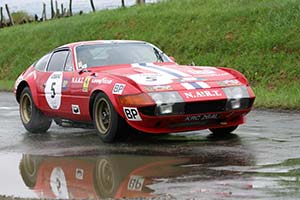
 When Ferrari replaced the 275 GTB with the 365 GTB/4 'Daytona' in 1968 and no competition version was announced, a highly successful era came to an end. In this period, Ferraris, particularly the 250 GT derivatives, dominated GT racing. There were various reasons for the Italian manufacturer to suspend the customer racing program, like the spiralling costs of the sports car and F1 efforts and the switch of the focus to prototype racing of the potential clients.