
| f1 |
 Ultimatecarpage.com
> Cars by brand
> Great Britain
> March
Ultimatecarpage.com
> Cars by brand
> Great Britain
> March
 Racing cars
> Formula 1 721X Cosworth Racing cars
> Formula 1 721X Cosworth
|
| March 721X Cosworth |
| Article | Image gallery (7) | Specifications | User Comments (1) |
|
|
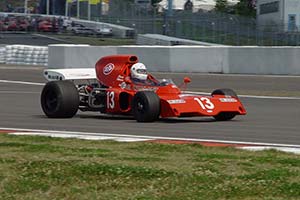
Page 1 of 1  March burst onto the Formula 1 scene in 1970, with the simple but effective March 701. The British manufacturer was formed in 1969 by four friends; Robin Herd, Max Mosley, Graham Coaker and Alan Rees. The governing body's decision to allow for sponsor-markings and the introduction of the 'cheap' Ford Cosworth DFV created a renewed market for privateers. March's goal was to build a chassis for those privateers. March burst onto the Formula 1 scene in 1970, with the simple but effective March 701. The British manufacturer was formed in 1969 by four friends; Robin Herd, Max Mosley, Graham Coaker and Alan Rees. The governing body's decision to allow for sponsor-markings and the introduction of the 'cheap' Ford Cosworth DFV created a renewed market for privateers. March's goal was to build a chassis for those privateers.Designed to be simple and easy to run, the March 701 was neither overly quick or innovative. Although its performance could not immediately match that of the top-runners, the 701 (1970 / Formula 1) was a popular customer car, with 11 cars constructed before the end of the season. One of the best known March runners was Ken Tyrrell, who purchased a 701 for World Champion Jacky Stewart to drive. March themselves also ran 701s in the 1970 Championship. Although 11 Formula 1 cars were sold in 1970, March was in big financial difficulties. A better chassis was a necessity for March' survival. With ex-Lotus employee Geoff Ferris designing the chassis and Frank Costin the body, the March 711 was set to be more competitive than its predecessor. The most characteristic feature of the 711 was the 'tea-tray' front wing. Young Swedish driver Ronnie Petterson finished second in the driver's championship and March third in the constructor's championship. For 1972, a completely new design that was intended to be a technical break-through, would hopefully bring March to the top of the field. The most striking feature of the 721X (for experimental) was the rear suspension, which featured high mounted rear springs. Inspired by Porsche and Alfa Romeo sportscar design, the gearbox was mounted between the engine and the rear axle, instead of behind the rear axle. In theory these two features would be very good for the car's overall weight distribution. After running heavily modified 711s in the first races of the season, the 721X made its debut at the Spanish GP in Jarama. The two cars entered were driven by two very talented young drivers, Niki Lauda and Ronnie Peterson. Unfortunately the customer Goodyear tires, March were running, were designed for a conventional chassis and suspension configuration. The front tires were completely overloaded and caused all kinds of trouble in corners from complete understeer to accute oversteer. After three Grands Prix, 'the experiment' was over and the 721X replaced by a more conventional 721G. In the years to come, both the rear suspension and gearbox layout was applied on most Grand Prix cars, proving that the theories behind design of the 721X were correct. March remained a leading customer-chassis constructor, but the results of the 1971 season were never matched again. Pictured is the first of the 721X's constructed. It is seen here at the 2003 Nürburgring Old Timer Grand Prix were it took part in the Force Grand Prix race and on display at the Techno Classica show in Essen earlier that year. Page 1 of 1 |
| Article | Image gallery (7) | Specifications | User Comments (1) |
| All Cars - Contact us - Privacy Statement - Top | © 1998 - 2024 Ultimatecarpage.com |