Go to Ultimatecarpage.com

Car search: Quick Advanced 
  Ultimatecarpage.com  > Cars by brand  > France  > Bugatti
EB 110 SS
Cars statistics: 4674 cars, 413 makes, 34492 images; Events statistics: 196 reports, 36409 images; Forum statistics: 83,467 members, 40,991 topics; more...


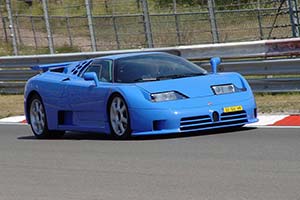
  Bugatti EB 110 SS
 

Bugatti EB 110 SS Bugatti EB 110 SS Bugatti EB 110 SS Bugatti EB 110 SS Bugatti EB 110 SS Bugatti EB 110 SS
Click here to save all images    Image credits: Wouter Melissen 

Click here to download printer friendly version Bugatti was one of the finest car manufacturers of the 1920s and 1930s, but after the death of founder Ettore Bugatti in 1947, the company ceased production. In an attempt to revive Bugatti, Italian entrepreneur Romano Artioli bought the rights to the legendary name. In 1989 he announced the return of Bugatti. A state of the art factory was constructed just north of Modena, Italy. So just like Ettore himself, Artioli's Bugatti was Italian.

No expense was spared in designing the new Bugatti and from scratch one of the most advanced vehicles of its day was designed and built. Launched on the day of Ettore's 110th birthday (09-15-1991), the new car was aptly named 'EB 110'. Scene of the launch was the Versailles Palace, the former domicile of the French royal family.

Much like its predecessors the EB 110 featured a uniquely styled body complete with the characteristic horse-shoe shaped grill. Responsible of the design was the Italian designer Marcello Gandini. Unlike his previous wedge-shaped designs like the Lamborghini Countach and Lancia Stratos, the EB 110's body is round and voluptuous. To save weight, the entire body was made of aluminium.

The aluminium body panels are bonded to a carbon fibre monocoque chassis. The EB 110 was the first road car to use a monocoque using this exotic material. Due to the difficult production process of the composite material, the tubs were constructed by French aviation company Aerospatiale. It was suspended all around by double wishbones. The front suspension features push-rod operated shock absorbers and the rear dual shock absorbers on each side.

Not just the chassis was advanced, the engine was as well; it remains as one of the most complex powerplants ever constructed. Being a 60 degree V12 engine, its configuration was very Italian, but the ancillaries are what make the 3.5 litre V12 extraordinary. The dual overhead camshafts operated five valves per cylinder, a setup only seen in the Ferrari F1 racers of the day. Four IHI Turbochargers were mated the high revving engine, giving the EB 110 an unprecedented output of over 550 bhp.

To best suit the Turbocharged engine's characteristics, a 6 speed manual gearbox was fitted. It ensured that the revs could be kept in the 3500+ rpm area after shifting up. The incredible amount of horsepower and torque were delivered to the road through all four wheels. The permanent four wheel drive delivers 27% of the power to the front wheels and the other 73% to the rears. Plenty of stopping power is provided by large ventilated Brembo discs.

Complementing the initial EB 110 GT, was the EB 110 SS, for Super Sport. The SS took the GT's performance one step further. With 650 bhp on the tap, the SS was a genuine race car for the road. Some styling cues distinguished the GT and SS, most notably the air holes behind the side windows on the SS. Seven spoke alloy wheels replaced the BBS wheels found on the GT.

All this did not come cheap, but when the project was started, money did not seem hard to come by. Unfortunately for Artioli, the world economy crashed and with it the demand for steap priced exotics. Five years after its introduction and after a production run of only 126 cars, Bugatti filed for bankruptcy. The remaining tubs were sold to Jochen Dauer, who used them to construct around a dozen more EB 110s.

This was not the final chapter in Bugatti's history. In the late 1990s the rights to the Bugatti name were snapped upped by Volkswagen. After a number of concepts were shown on motorshows around the world, production was started of a new Bugatti. Much in the EB 110's tradtion, the German Bugatti was again the most powerful car available.

Article by Wouter Melissen, last updated before 12 / 01 / 2004

Add your comments on the Bugatti EB 110 SS

     
General specifications
Country of origin France
Numbers built 95 GTs, 31 SSs
Produced from 1992 - 1995
Body design Gandini

Engine
Configuration 60º V12
Location Mid, longitudinally mounted
Construction aluminium block and head
Displacement 3.498 liter / 213.5 cu in
Bore / Stroke 81.0 mm (3.2 in) / 56.6 mm (2.2 in)
Compression 7.5:1
Valvetrain 5 valves / cylinder, DOHC
Fuel feed Multi Point Fuel Injection
Aspiration Quad Turbos
Power 650 bhp / 485 KW @ 8000 rpm
Torque 637 Nm / 470 ft lbs @ 3800 rpm
BHP/Liter 186 bhp / liter

Drivetrain
Chassis aluminium body on carbon fibre monocoque
Front suspension double wishbones, pull-rod operated shock absorbers
Rear suspension double wishbones, twin gas pressure shock absorbers, anti-roll bar
Steering rack-and-pinion, power assisted
Brakes ventilated discs, all-round
Gearbox 6 speed Manual
Drive Rear wheel drive

Dimensions
Weight 1418 kilo / 3126.2 lbs
Length / Width / Height 4400 mm (173.2 in) / 1940 mm (76.4 in) / 1114 mm (43.9 in)
Wheelbase / Track (fr/r) 2550 mm (100.4 in) / 1550 mm (61 in) / 1618 mm (63.7 in)

Performance figures
Power to weight 0.46 bhp / kg
Top Speed 350 km/h (217 mph)
0-60 mph 3.2 s

Resources
Useful links