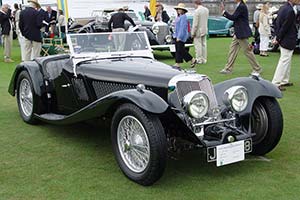
Model history: Adrian Squire was in is his early twenties when he announced his plans to design and build a car under his own name in 1931. Despite his tender age, this was an ambition he already held for many years. When he was just 16-years old he had, for example, drawn up a six-page catalog of his 'dream-machine'. A 20,000 Pound inheritance enabled him to turn his dream into reality when he turned 21. At that time he already spent brief spells at Bentley and MG.
Squire's plan was very straightforward: create a small sports car from scratch that could rival the finest machines available. He had learned valuable lessons at his previous employers and had figured where changes could be made to improve the handling. At a time when chassis were relatively flexible, Squire laid down a frame that was very rigid. The conventional main chassis rails were connected by cruciform bracings. As a result of the increased rigidity, the car could be relatively softly sprung, which benefitted the road holding considerably.
Suspension was through a beam axle at the front and a live axle at the back. The first three cars featured a conventional 'over-slung' rear axle, which was replaced by an axle running over the chassis frame to lower the car and accordingly further improve its handling. On both ends semi-elliptic leaf springs were fitted in combination with friction dampers. The hydraulic drum-brakes used were a bespoke design. At 15.5 inch were very large for the size of the car. To keep the unsprung weight at a minimum the finned drums were cast in a lightweight magnesium alloy.
Part of the initial plan was to custom build an engine as well but Squire soon realised that was one step too far. Fortunately he found a kindred spirit in Douglas Ross, who was the managing director of engine builder Anzani. Once the London factory of the Italian company, British Anzani had become a fully independent company in the late 1920s. They mostly built road car engines but Ross pushed ahead with a more advanced twin-cam racing engine. Sadly there had been no customers until Squire stepped up. An agreement for the supply of the Anzani R1 (Ross 1) engine complete with 'Squire' stampings on visible parts of the engine.
The Anzani R1 was a compact and lightweight four cylinder engine with twin overhead camshafts. These were driven by a chain fitted at the rear of the engine. Although originally designed with natural aspiration, the R1 was fitted with a David Brown design Roots-type supercharger. This enabled to produce a reliable 110 bhp, despite its modest displacement of 1496cc. It was mated to a Wilson pre-selector gearbox with four forward speeds. Squire believed that its additional weight was more than compensated by the lightning-quick gear changes and ease of use.
Almost four years in the making, the first Squire was completed early in 1935. It was clothed in an elegant four-seater roadster body by Vanden Plas. Adrian Squire had certainly achieved his goal as the small sports car proved to be hugely capable. Particularly the handling and braking set new standards. The car, however, did not come cheap; complete with the Vanden Plas body it cost a staggering 1195 Pounds, which was Alfa Romeo and Bugatti money. A less luxurious Markham body was also offered soon after, which shaved 200 Pounds off the price.
Squire nevertheless struggled to find purchasers for his car and was forced to sell his company after just seven were produced. At least one of these was a competition car, built with hopes of boosting the car's appeal. Squire's assets were acquired by one of its customers, Val Zethrin. Under his supervision, three additional examples were built. These cars were fitted with an updated version of the R1 engine that tackled the cooling and oil-feed issues, which troubled the original design. Production of the fabulous Squire ended late in 1937.
Soon after the demise of his company, Squire joined Bristol, where he was sadly killed in an air-raid in 1940. It is a big shame he was not able to display more of his undeniable talent. One could only wonder what Bristol's post-War cars would have looked like, had he lived to design them. His legacy is a lovely little sports car that with the engine tweaks certainly was one of the finest built before the War. Today, the nine surviving cars are owned by true connoisseurs and only come to market once every decade.
Chassis: X103
Serial X103 was the second of three prototypes built using the taller and longer over-slung chassis. It was fitted with a particularly attractive Vanden Plas body. The car was sold new to G.F.A. 'Jock' Manby-Colegrave, who was one of the company founders. X103 moved to the United States in the 1950s and disappeared in a locked storage twenty years later. It eventually resurfaced and was offered in the 2001 Bonhams & Brooks Quail Lodge auction. The car attracted a lot of attention and eventually sold for $145,000, which was triple the low estimate. Now part of a prominent collection, it is seen here during the 2004 Pebble Beach Concours d'Elegance.
Article by Wouter Melissen, last updated on January 01, 2005
I saw this car yesterday in the Keller Estate private collection. Its such a private collection nobody ever gets to see it unless by special invitation, photographs are not permitted, and there isn't even a book to purchase that has all the 100+ great cars documented in the collection. Was shocking to see this great car I've never seen before.
I recognize the photos above from the Carmel Concourse d'Elegance and I recognize the badging and number plate on this car. Its the same one I saw yesterday at the Keller Estate Vineyard.
What a gorgeous car. Quite smaller than the monstrous saloons that were being built in other countries in the early 30's. Even compared to the British Rolls and Bently's of the same era. Gorgeous lines, even more elegant than the Jaguar SS100 and XK120. I hear there's less than 40 of these ever produced.
Fantastic. Thanks for the photos.
Squire
ericd 10-08-2007
My father owned Squire X101, (DMP219) the prototype. He imported it from England in 1952 and I was able to enjoy many miles behind the wheel. It was a pity that the company didn't survive since the concept and execution were really delightful. Beautiful and fast (for its day.) DMP219 is now in the collection of a Dr.Simone in Philadelphia along with some other rare and beautiful classics. I hope the doctor drives it from time to time. Eric Davison
could've ( would've, should've ) been a legen
Dan Flynn 08-18-2005
What a beautiful car! Flowing lines, perfectly proportioned, fabulous looking from any angle. The Vanden Plas interpretation of a sports car almost defies improvement. Mated to a firm chassis and a high-revving engine, this Squire had to have been a very satisfying driver's car. Pity the firm never got the chance to establish themselves far better than a mere 7 cars could allow. The combination of performance and style could've made Squire a legendary prewar sports car known and enjoyed by a much greater audience.