Page 1 of 2 Next >> Adrian Squire was in is his early twenties when he announced his plans to design and build a car under his own name in 1931. Despite his tender age, this was an ambition he already held for many years. When he was just 16-years old he had, for example, drawn up a six-page catalog of his 'dream-machine'. A 20,000 Pound inheritance enabled him to turn his dream into reality when he turned 21. At that time he already spent brief spells at Bentley and MG.
Squire's plan was very straightforward: create a small sports car from scratch that could rival the finest machines available. He had learned valuable lessons at his previous employers and had figured where changes could be made to improve the handling. At a time when chassis were relatively flexible, Squire laid down a frame that was very rigid. The conventional main chassis rails were connected by cruciform bracings. As a result of the increased rigidity, the car could be relatively softly sprung, which benefitted the road holding considerably.
Suspension was through a beam axle at the front and a live axle at the back. The first three cars featured a conventional 'over-slung' rear axle, which was replaced by an axle running over the chassis frame to lower the car and accordingly further improve its handling. On both ends semi-elliptic leaf springs were fitted in combination with friction dampers. The hydraulic drum-brakes used were a bespoke design. At 15.5 inch were very large for the size of the car. To keep the unsprung weight at a minimum the finned drums were cast in a lightweight magnesium alloy.
Part of the initial plan was to custom build an engine as well but Squire soon realised that was one step too far. Fortunately he found a kindred spirit in Douglas Ross, who was the managing director of engine builder Anzani. Once the London factory of the Italian company, British Anzani had become a fully independent company in the late 1920s. They mostly built road car engines but Ross pushed ahead with a more advanced twin-cam racing engine. Sadly there had been no customers until Squire stepped up. An agreement for the supply of the Anzani R1 (Ross 1) engine complete with 'Squire' stampings on visible parts of the engine. Page 1 of 2 Next >>

 Ultimatecarpage.com
> Cars by brand
> Great Britain
> Squire
Ultimatecarpage.com
> Cars by brand
> Great Britain
> Squire
 1500 Vanden Plas Sports Tourer
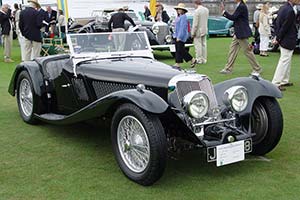
 Adrian Squire was in is his early twenties when he announced his plans to design and build a car under his own name in 1931. Despite his tender age, this was an ambition he already held for many years. When he was just 16-years old he had, for example, drawn up a six-page catalog of his 'dream-machine'. A 20,000 Pound inheritance enabled him to turn his dream into reality when he turned 21. At that time he already spent brief spells at Bentley and MG.