Page 1 of 2 Next >> In the second half of the 1930s Sydney Herbert Allard quickly made a name for himself in British Trials and Hillclimbs with his Allard Specials. Operating from the Adlards Motors garage (this is no spelling error) he bought earlier in 1929, Allard mounted an assault on international motor racing that culminated in a third place finish in the 24 Hours of Le Mans and an overall victory in the Monte Carlo rally. After racing motorcycles, he gradually moved to four wheels, driving a three wheeled Morgan in between. In 1936 the first 'Allard Special' made its debut.
Adlards Motors was an official Ford dealer, so it was only logical that Allard based his first cars on Ford products. The first Allard Special, commonly referred to as CLK 5 because of its registration number, combined a Ford Model 40 chassis and engine with a Bugatti Type 51 body. Its light weight and considerable ground clearance made it an ideal Trials racer. By moving the cockpit as far backwards as possible, the weight was concentrated over the rear wheels, a design principle found on all future Allard models. Ford's flat-head V8 provided plenty of torque to turn Allard's first Special in an immediate winner.
Allard's many successes in CLK 5 created a big interest in a production version of the Special. Up until the outbreak of the War a small number of Allard Specials were constructed, powered by either the Ford V8 or the related Lincoln V12. These could hardly be considered production cars and it was not until immediately after the War that the first Allard production cars were constructed. Nevertheless the Specials proved to be highly successful in various races. The only weak point were the overheating problems at high speeds, caused by the manifold design of the flat-head engine.
During the War Adlards Motors repaired damaged military vehicles with great care and precision. Despite 12 hour workdays, Sydney Allard found time to design a new sportscar, which he planned to produce as soon as the War would end. The first real Allard was ready in 1946 and is now commonly referred to as the J1. Ford bits and pieces again formed the basis of the Allard. A sturdy braced and boxed frame hosted a 3.6 litre V8 and 3-speed gearbox. Suspension was by a split axle at the front and live axle at the rear, both employing a transverse leaf spring. A full width body was fitted, but the wings could be quickly removed and replaced by cycle fenders to turn the J1 in a proper Trials car. Page 1 of 2 Next >>

 Ultimatecarpage.com
> Cars by brand
> Great Britain
> Allard
Ultimatecarpage.com
> Cars by brand
> Great Britain
> Allard
 Racing cars
> Other Sportscars
Racing cars
> Other Sportscars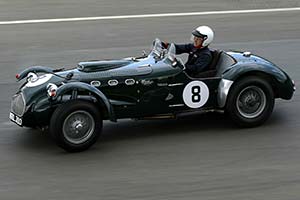
 In the second half of the 1930s Sydney Herbert Allard quickly made a name for himself in British Trials and Hillclimbs with his Allard Specials. Operating from the Adlards Motors garage (this is no spelling error) he bought earlier in 1929, Allard mounted an assault on international motor racing that culminated in a third place finish in the 24 Hours of Le Mans and an overall victory in the Monte Carlo rally. After racing motorcycles, he gradually moved to four wheels, driving a three wheeled Morgan in between. In 1936 the first 'Allard Special' made its debut.