Page 1 of 2 Next >> Rule changes at the end of the 1972 season left the Porsche 917 obsolete for the World Sportscar Championship. Building a completely new car to campaign in the prototype class, which now counted for the World Championship was not a really an option. These prototypes were basically Formula 1 racers with a two seater body and the only serious competitors were existing F1 teams like Ferrari and Matra, and British teams using the Ford Cosworth DFV engine. With no recent F1 experience, it would have been too much of an effort to build a competitive prototype racer for Porsche.
Fortunately for Porsche a new European GT Championship was created, for which Porsche's 911 model was eligible, so Porsches European motorsport activities for 1973 were focussed on the Group 4 GT class. Competition would come from Porsche's perpetual nemesis, Ferrari, in the form of the 365 GTB Daytona 'Competizione'. With a displacement which was almost twice that of the largest Porsche 911 engine at the time, the Daytona was the clear favourite. Work was started on a production 911, that could form the base for a racer quick enough to take on the Ferrari.
Chosen as base for the new car was the Porsche 911 S, that had been successful in events like the Rally Monte Carlo and the Tour de France. Main design focus was to save weight and increase the output of the flat 6 engine. The bore of the 2.4 litre engine was increased by 6 mm to 90 mm and with it the output of the now 2.7 litre engine grew with 20 bhp to 210 bhp. To get the added power on the road, Porsche fitted wider rear than front tires on a roadcar for the first time in its history. A lot of weight was saved by stripping the 911 of all luxuries and the use of fiberglass and thin gauge steel for various bodyparts. One of the most legendary Porsches, the 911 Carrera RS 2.7, was born!
To be homologated for the Group 4 class, at least 500 examples of the model had to be constructed. Production of the RS 2.7 started in 1972 and its stunning performance made it an immediate hit. More than enough cars were constructed, securing the Porsche's entry in the 1973 GT Championship. The rules allowed for some modifications to be made to the racing cars compared to the road cars. Most obvious difference between the Carrera RS 2.7 and its racing counterpart, the Carrera RSR 2.8 was the slight displacement increase. Page 1 of 2 Next >>

 Ultimatecarpage.com
> Cars by brand
> Germany
> Porsche
Ultimatecarpage.com
> Cars by brand
> Germany
> Porsche
 911 Carrera RS 3.0
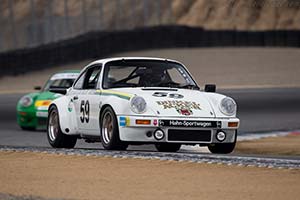
 Rule changes at the end of the 1972 season left the Porsche 917 obsolete for the World Sportscar Championship. Building a completely new car to campaign in the prototype class, which now counted for the World Championship was not a really an option. These prototypes were basically Formula 1 racers with a two seater body and the only serious competitors were existing F1 teams like Ferrari and Matra, and British teams using the Ford Cosworth DFV engine. With no recent F1 experience, it would have been too much of an effort to build a competitive prototype racer for Porsche.