Page 1 of 1 Alfa Romeo had made a successful return to motorsport with the TZ (Tubular chassis and Zagato body) model, and in 1964 explored the opportunity to make a road going version of the lightweight racer. Although the Zagato version was highly competitive, it was also very expensive, so Alfa Romeo offered a TZ chassis to both Bertone and Pininfarina to turn into a road car. At Bertone the project was headed by a young Giorgietto Giugiaro, who had penned the Giulia Sprint body for Alfa Romeo a year earlier.
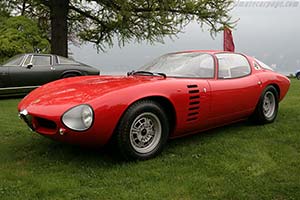
One of the TZ chassis greatest advantages was the exceptionally low construction, which allowed for a small frontal area. Giugiaro made the most of that and designed a highly aerodynamic fibreglass body, which was even lower than the aluminium Zagato body. To smooth out the airflow the car featured a glued-in front window, which was an industry first. Another interesting design element was the incorporation of the Alfa Romeo's competition cloverleaf as cockpit vents. Launched at the 1964 Paris show, the car was dubbed Canguro, Italian for kangaroo.
Giugiaro's Canguro received universal acclaim, but Alfa Romeo was not convinced and abandoned the idea of the TZ based road car. One of the reasons was the incapability of Autodelta, the marque's racing department, to build enough chassis. The project ended on a sad note when a journalist crashed the unique car in a test drive. The Canguro's remains were eventually bought in 1971 by Gary Schmidt, a German journalist. He intended to reconstruct the car, but he failed to do so, and the car was considered lost.
Fortunately this was not the end of the story; a Japanese collector tracked down the remains in the 1990s, and continued in secrecy where Schmidt had left off. It made a glorious debut at the 2005 Villa d'Este Concours d'Elegance, where it was voted best of show. For many it was quite a shock to see one of the automotive's finest designs in person, after it was believed to be lost for ever.
Although the Canguro was never produced, it has made a lasting impression on the industry. Some of the design cues were found on later Alfa Romeos, and other Bertone designed vehicles. Designed in a time when Italian design was at a peak, it is considered by many as one of the most balanced designs ever executed.
The Canguro is pictured at its second debut, the 2005 Concorso d'Eleganza Villa d'Este, where it was the centre of attention of press and public alike. Page 1 of 1

 Ultimatecarpage.com
> Cars by brand
> Italy
> Alfa Romeo
Ultimatecarpage.com
> Cars by brand
> Italy
> Alfa Romeo
 Canguro
 Alfa Romeo had made a successful return to motorsport with the TZ (Tubular chassis and Zagato body) model, and in 1964 explored the opportunity to make a road going version of the lightweight racer. Although the Zagato version was highly competitive, it was also very expensive, so Alfa Romeo offered a TZ chassis to both Bertone and Pininfarina to turn into a road car. At Bertone the project was headed by a young Giorgietto Giugiaro, who had penned the Giulia Sprint body for Alfa Romeo a year earlier.