Page 1 of 1 With a seemingly unlimited budget, Mercedes-Benz dominated Grand Prix racing in the second half of the 1930s. A few years later there was little left of the company other than a pile or rubble. In record time the factory was rebuilt and the racing car designers set about developing a brand new flagship model. Powered by a three litre six cylinder engine, the four door saloon was known as the 300. By 1950, the German company was in well enough shape again to consider racing. Two of the 1930s Grand Prix cars were refurbished and entered in a number of Formula Libre races, but with little success. In the summer of 1951 the green light was given for the development of a brand new racing car, be it on a tight budget.
For various reasons Grand Prix racing was not an option. Instead Mercedes-Benz used some parts of the production cars to build a sports racer. What was brand new, was a a ground-breaking tubular spaceframe chassis that combined a low weight with superior rigidity compared to the traditional ladder frame. Suspension was equally advanced with double wishbones and coil springs at the front, and swing axles with coil springs at the rear. The Mercedes-Benz designers decided to break with convention by fitting a coupe body to reduce drag and improve the top speed. They had to overcome the unusual high sides of the spaceframe chassis, which did not allow for normal doors. Instead they fitted doors recessed into the roof with hinges at the top, which were quickly referred to as 'gullwing' doors.
Time and most importantly money was spared by using the six cylinder engine from the 300. A first sign of things to come was the sportier 300 S production car, introduced at the 1951 Paris Auto Salon, which featured a short wheelbase chassis and a three Carburetor 150 bhp engine. In the new racing car, it was mounted in the engine bay slanted at a 50 degree angle to allow for a lower bonnet. The single overhead camshaft engine was further modified with dry sump lubrication and larger Solex downdraught Carburetors. This brought the performance up to a decent 171 bhp. This power was transferred to the rear wheels through an off the shelve four speed gearbox. The completed machine was dubbed the 300 SL for 'Sport Leicht' or Sport Light.
Three examples were readied in time for the 1952 Mille Miglia. Mercedes-Benz' racing successes had not been forgotten and the company's return to motorsport was highly anticipated. The new 'Silver Arrows' were certainly not the lightest or most powerful cars, but the slippery shape, superb reliability and highly experienced team made the 300 SL highly competitive. During its debut at the Mille Miglia, the gullwing coupe was beaten only by a Ferrari. The first victory came a few weeks later at a race in Bern, Switzerland. The new Mercedes' performance had greatly impressed Jaguar and they hastily fitted more aerodynamic bodies to the C-Type for Le Mans. It was a gross mistake as the tight air intake proved too small to cool the cars and all Works C-Types were out very early in the race. This paved the way for a one-two victory for the 300 SL; the first ever for a closed car.
To celebrate the company's and Germany's first Le Mans win, four 300 SLs were entered in a minor race at the Nürburgring. The four racing cars were distinctly different from the Le Mans winners; they sported roadster bodies. With little opposition, the result was an almost routine 1-2-3-4 victory. A bigger challenge, against much stronger opposition, came at the end of the season in the gruelling Carrera PanAmericana in Mexico. The 300 SL's durability saw the new Silver Arrow clinch another 1-2 victory. Despite the success, the 300 SL was not raced again by the factory. For 1953 a lighter, sleeker and more powerful version was developed, but this car was used in testing only.
It was far from the end for the 300 SL project, which was spun off into two directions. The best known is the 300 SL road car, introduced in 1954. While retaining the unique gullwing doors, the production car has a more elegant design. Today it remains as one of the most highly acclaimed Mercedes-Benz ever built. The spaceframe chassis was carried over to the W196 Formula 1 car and the closely related 300 SLR sports racer. Featuring a high-tech straight eight engine, the two racing cars absolutely dominated. Both the 300 SL road car and the W196 / 300 SLR are well known by most car enthusiasts, while the earlier 300 SL competition car is mostly forgotten. As father of these legendary machines and multiple major race winners, it deserves a little more credit. Page 1 of 1

 Ultimatecarpage.com
> Cars by brand
> Germany
> Mercedes-Benz
Ultimatecarpage.com
> Cars by brand
> Germany
> Mercedes-Benz
 Racing cars
> Other Sportscars
Racing cars
> Other Sportscars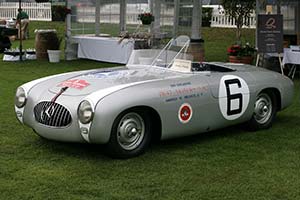
 With a seemingly unlimited budget, Mercedes-Benz dominated Grand Prix racing in the second half of the 1930s. A few years later there was little left of the company other than a pile or rubble. In record time the factory was rebuilt and the racing car designers set about developing a brand new flagship model. Powered by a three litre six cylinder engine, the four door saloon was known as the 300. By 1950, the German company was in well enough shape again to consider racing. Two of the 1930s Grand Prix cars were refurbished and entered in a number of Formula Libre races, but with little success. In the summer of 1951 the green light was given for the development of a brand new racing car, be it on a tight budget.