Page 1 of 2 Next >> Thanks to his determination Christian von Koenigsegg turned his boyhood dream into reality at a remarkable young age. Not short on ambition, he set out to construct the 'perfect sportscar'. After several years of careful planning, the Swede approached designer David Craaford in 1993 to pen a global shape following his explicit instructions. Only 22 years old he officially announced the Koenigsegg project in 1994. Throughout the 1990s his team worked on the design and engineering of the supercar. In those years the prototype car constructed received global acclaim. All this work culminated in the Koenigsegg CC that was unveiled at the 2000 Paris Motorshow. In the preceding years the car was not only developed, but numerous test was carried out to ensure the car was fully road legal and ready for production.
So what did the young Swede build to conquer the world? A highly advanced mid-engined sportscar that in concept rivalled the finest Italy and Germany has to offer. Using the latest racing technology a strong and lightweight carbon fibre and aluminium honeycomb monocoque chassis forms the car's core, while a specifically developed supercharged V8 is the heart of the Koenigsegg. The front and rear double wishbone suspension is carried on separate subframes to enable quick repairs and to simplify maintenance. The Ohlins dampers are mounted in-board and can be fully adjusted to suit the driver's preferences through the Koenigsegg Advanced Control System (KACS).
As mentioned earlier the all aluminium engine is the rapidly beating heart of the Swedish beast. It is derived from Ford's 4.6 litre quad-cam V8, but in the development process all parts were modified to the extent that it can be considered a Koenigsegg engine. A highly advanced Rotrex Supercharger system literally boosts the output of the V8 to 655 bhp in the 'base' model. Weighing in at just over 200 kg, it not only produces plenty of power, but also helps to keep the weight down. The horses are transferred to the wheel through a custom developed Crima six speed gearbox, which comes complete with a separate oil cooler and a limited slip differential. Even the specifically developed gearlever can be adjusted to suit the driver's preferences.
Many of the elements drawn by Craaford in 1993 were carried over in the final design, except for the front facia. On the Paris show car the headlights consisted of three units, but the final production version featured a more conventional single piece headlight. The high downforce and low drag combination was achieved by spending many hours in the Volvo wind tunnel. Unlike many other cars in this genre, the Koenigsegg does not feature a big rear wing, but instead relies on the advanced underbody construction. Uniquely, the doors open by sliding out first and then tilting forward; a totally different approach as the scissor doors often seen on this type of cars. Page 1 of 2 Next >>

 Ultimatecarpage.com
> Cars by brand
> Sweden
> Koenigsegg
Ultimatecarpage.com
> Cars by brand
> Sweden
> Koenigsegg
 CCX
CCX
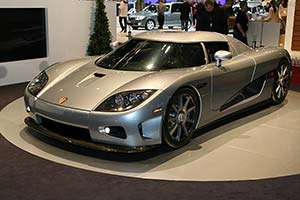
 Thanks to his determination Christian von Koenigsegg turned his boyhood dream into reality at a remarkable young age. Not short on ambition, he set out to construct the 'perfect sportscar'. After several years of careful planning, the Swede approached designer David Craaford in 1993 to pen a global shape following his explicit instructions. Only 22 years old he officially announced the Koenigsegg project in 1994. Throughout the 1990s his team worked on the design and engineering of the supercar. In those years the prototype car constructed received global acclaim. All this work culminated in the Koenigsegg CC that was unveiled at the 2000 Paris Motorshow. In the preceding years the car was not only developed, but numerous test was carried out to ensure the car was fully road legal and ready for production.