Page 1 of 1 For a very brief period, the form of racing cars was as important as the function. Yes, there were many beautiful racers before and there have been many more after, but only in the second half of the 1930s did the function not dictate the form. Particularly in France did the gentleman racers order a competition chassis and then had a coachbuilder fit a body light and slippery enough to win races and beautiful enough to win the numerous concours d'elegance. Partly responsible for this unusual trend was the rise to fame of designer/coachbuilder Joseph Figoni and the introduction of a new generation, lower chassis. The first signs of the great things to come were a Delahaye and Delage bodied in 1936 by Figoni & Falaschi with remarkable curvaceous designs. It was obvious to all that the body was no longer just there to protect the mechanical bits and the passengers. The period already hit its peak a year later when the Figoni & Falaschi design was combined with the latest Talbot Lago chassis to create some of the most evocative cars ever produced.
Joseph Figoni was born in Italy, but moved to France when he was but a few years old. After the Great War, he started a small shop in which he first only did body repair work, but soon took up improving designs, followed not long after by the design and construction of complete bodies. Compared to his later work, his first designs were very conventional, although he did already take up an interest in racing car bodies. The first major success for the young coachbuilder was the back to back win for a Figoni bodied Alfa Romeo in the 1933 and 1934 24 Hours of Le Mans races. This must have grabbed the attention of Italian businessman Ovidio Falaschi and the two joined forces in 1935 to create the coachbuilder Figoni & Falaschi; the former was responsible for the creative and the latter for the business side. It is generally assumed that the introduction to the work French artist Geo Ham inspired Figoni to take his designs into a new, bolder direction. This was particularly appreciated by Anthony Lago, who was in the process of revamping the Talbot brand. For 1937 the two companies agreed to work together exclusively.
A wild mix of a large number of brands and headquarters in both England and France did not do the Talbot company much good and the once dominant racing car manufacturer was on the brink of bankruptcy in the early 1930s. Italian born Anthony Lago still saw a future for Talbot and the desperate shareholders put him in charge of the French arm of the ailing company. Soon after taking control, he hired the talented engineer Walter Becchia to develop the first Talbot Lago. He had very big shoes to fill as he was forced to take over where legendary designer Louis Coatalen had left off. The first model was a very sensible three litre sportscar, but things got really interesting when Becchia was given carte blanche to design a four litre version of the straight six engine. Not only did he increase the engine size, he also fitted a cylinder head with hemispherical combustion chambers. Breathing through two Stromberg carburetors this engine was good for around 140 bhp while the three carb competition engine produced over 170 bhp. The new engine was mated to a preselector four speed gearbox, produced by Wilson, a company also owned by Lago. Holding it all together was a ladder frame suspended by wishbones at the front and a live axle at the rear. The independent front suspension made the chassis considerably lower than its predecessors. Dubbed the Talbot Lago T150C (for competition), the new top model was available as the Super Sport (ss) version and as the slightly longer Speciale. With a wheelbase of 265 cm and 295 cm respectively both models were still short in comparison to the competition.
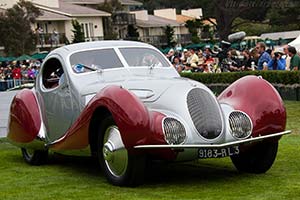
Figoni & Falaschi bodied most of the T150Cs intended for competition with a purposeful two seater roadster design, but in addition he created a coupe version for the richest of customers. Clearly continuing where he had left off with the Delahaye and Delage designs, the coupe shape did not feature a single straight line. Not only did the design look exquisite from any angle, it also helped to propel the four litre Talbot to an impressive top speed; by no means a wasted luxury on the long straights of the Le Mans track. Soon after the first completed car was shown to the public at the 1937 Paris Motorshow, it was given the nickname 'Goutte d'Eau', literally meaning water drop, but in English the name Teardrop stuck. Two different versions of the Teardrop can be distinguished; the first notchback coupe named 'Jeancart' after the commissioner of the first car and the second 'New York' style, which was first unveiled in that city in 1937. In total only five of the Jeancart style cars were built and subsequently another eleven with the New York bodystyle and every single one differed in detail as all were built to the specific demands of the customers. Regular concours winners then and now, several of the Teardrops were built specifically for racing. Among the many fine results, a third place finish behind two Delahayes in the 1938 24 Hours of Le Mans is an obvious highlight. One example was even raced successfully after the Second World War and Rob Walker used his Teardrop for practice runs before the first post-War Le Mans race and figured he was faster than any of the British cars entered. For the race he used a Delahaye similar to the 1938 winner.
Not long after custom coach building reached its peak, it was all over; simpler monocoque chassis took over after the War, leaving little for people like Joseph Figoni to work with. Some survived as independent design houses, but many 'carrossiers' including Figoni & Falashi were forced to shut down their business. Ovidio Falaschi returned to Italy to run a hotel and Joseph Figoni spent the second half of his life in charge of a successful garage business. In the short time the two men worked together, they produced some of the most desirable coachwork ever fitted to a rolling chassis. The Teardrop Talbot Lago is no doubt the duo's highlight and can be considered the fitting finale of four decades of highly individual custom designed coachwork. For the last sixty years, the curvaceous Talbots have been among the world's most desirable motor cars. A total of 17 Talbot Lago chassis have been fitted with the Teardrop body, including three examples on the slightly different T23 chassis, which features a more conventional OHV version of the six cylinder engine. The surviving cars (only two Jeancart style cars are unaccounted for) have a very big chance of scoring the much coveted 'best in show' at all the major concours d'elegance. This was underlined in 1998 when chassis 90104 was awarded 'Best in Show' at 'Pebble Beach,' Page 1 of 1

 Ultimatecarpage.com
> Cars by brand
> France
> Talbot Lago
Ultimatecarpage.com
> Cars by brand
> France
> Talbot Lago
 T150C SS Figoni & Falaschi Teardrop Coupé
 For a very brief period, the form of racing cars was as important as the function. Yes, there were many beautiful racers before and there have been many more after, but only in the second half of the 1930s did the function not dictate the form. Particularly in France did the gentleman racers order a competition chassis and then had a coachbuilder fit a body light and slippery enough to win races and beautiful enough to win the numerous concours d'elegance. Partly responsible for this unusual trend was the rise to fame of designer/coachbuilder Joseph Figoni and the introduction of a new generation, lower chassis. The first signs of the great things to come were a Delahaye and Delage bodied in 1936 by Figoni & Falaschi with remarkable curvaceous designs. It was obvious to all that the body was no longer just there to protect the mechanical bits and the passengers. The period already hit its peak a year later when the Figoni & Falaschi design was combined with the latest Talbot Lago chassis to create some of the most evocative cars ever produced.