Page 1 of 2 Next >> Although he was an avid racer himself, Vincenzo Lancia never built a racing version of the road cars bearing his name. These road cars did attract plenty of attention because of their often unconventional and pioneering designs. Lancia's trademark was the small angle V-engine that had been in use since the late teens, and the Italian company was also the first to produce a car with a unitary construction. When the company's founder passed away in 1937, his son Gianni Lancia took over and things changed dramatically in Turin.
The Second World War intervened with the ambitious young Lancia's plans, but as soon as the hostilities ceased the work continued. He had hired legendary designer Vittorio Jano firstly to design a new saloon, but also to set up a racing program. The first sign of the new direction was the Aurelia launched in 1950, which featured independent suspension all-round and a very compact V6 engine. A year later the competition version of the Aurelia debuted complete with a powerful 2.5 litre version of the V6 engine.
The Aurelia B20 GT was the very first Lancia racing car in the 45 year history of the company, but proved to be immediately successful with class wins in many major rallies and also at Le Mans between 1951 and 1954. Inspired by the success of the Aurelia, work was started on a completely new racing car that could challenge for overall wins. For this project Jano's vast experience at Alfa Romeo and Fiat proved to be vital as he designed a state of the art competition special. Dubbed the D20, the new racing cars were ready for the 1953 Mille Miglia.
With the exception of the engine there was little that the new racer shared with the Aurelia and even that was extensively revised. The displacement was increased to three litres and the central mounted camshaft was replaced by chain driven double overhead camshafts. Performance of the V6 was quoted at 245 bhp. The powerplant was installed in a tubular spaceframe chassis, which was suspended independently by wishbones at the front and back. One of the most unusual features were the inboard mounted brakes, designed to lower the unsprung weight. As with the Aurelia, coach-builder Pinin Farina was responsible for the design and construction of the lightweight coupe bodies.
Four cars were completed in time for the Mille Miglia debut and against very strong competition one of them managed to finish in third position. For the 24 Hours of Le Mans the engines were fitted with Superchargers to bridge the gap to the larger engined Jaguars and Ferraris. This proved to be a disastrous move as it turned out to be fatal for the reliability and all cars entered were forced to retire. Some drastic changes were carried out as both the Superchargers and the coupe bodywork were discarded. Now sporting open bodies also by Pinin Farina, the cars were renamed D23. Page 1 of 2 Next >>

 Ultimatecarpage.com
> Cars by brand
> Italy
> Lancia
Ultimatecarpage.com
> Cars by brand
> Italy
> Lancia
 Racing cars
> Other Sportscars
Racing cars
> Other Sportscars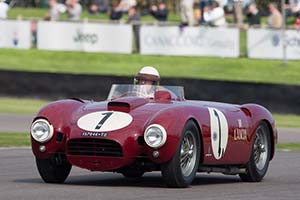
 Although he was an avid racer himself, Vincenzo Lancia never built a racing version of the road cars bearing his name. These road cars did attract plenty of attention because of their often unconventional and pioneering designs. Lancia's trademark was the small angle V-engine that had been in use since the late teens, and the Italian company was also the first to produce a car with a unitary construction. When the company's founder passed away in 1937, his son Gianni Lancia took over and things changed dramatically in Turin.