Go to Ultimatecarpage.com

Car search: Quick Advanced 
  Ultimatecarpage.com  > Cars by brand  > Italy  > Maserati
450S Costin Zagato Coupe
Never miss another Ultimatecarpage.com update, news feature or event report by subscribing to our mailing list to receive all the news in your mailbox ...


Maserati 450S Costin Zagato Coupe

Maserati 450S Costin Zagato Coupe Maserati 450S Costin Zagato Coupe Maserati 450S Costin Zagato Coupe Maserati 450S Costin Zagato Coupe Maserati 450S Costin Zagato Coupe Maserati 450S Costin Zagato Coupe
Click here to save all images    Image credits: Wouter Melissen / Rob Clements 


Click here to download printer friendly version Up to 1956, Maserati solely focussed on small-engined sportscar racing with engine sizes ranging from 1.5 litre in the 150S to the 3 litre in 300S. These were all fine racers but they were never in contention to take the overall lead against the much more powerful Ferraris, Astons and especially Jaguars. So Maserati set out to build an engine and chassis that was capable of beating the 'big-boys'.

The Maserati designers worked simultaniously on two different engines, a new 3.5 litre six cylinder and a 4.5 litre V8. A new chassis was designed to house both engines. The first engine was the six cylinder and it was taken out in a new, stronger chassis for the 1956 Mille Miglia. The 'six' proved underpowered for the heavy chassis and the combination was even outpaced by 3 litre 300S. By the fall of 1956, the V8 was ready and it was taken out at the practice of the Swedish Grand Prix.

Throughout the fall and winter of 1956, the V8 car was further developed and the engine output was raised from the initial 365 bhp to 400 bhp. With this immense figure, the quad cam, V8 engined 450S was the most powerful front engine sportscar. It was only surpassed by the Panoz prototypes in the late 1990s. The brakes were also revised to be able to cope with the enormous speeds expected from the 450S.

The 450S made its first appearance at the 1957 Argentinian 1000 km race where it was driven by the Grand Prix drivers Juan Manuel Fangio and Stirling Moss. In the early stages of the race there was no one who could keep up with the storming 450S. The all new and complicated engine was remarkably reliable, although it failed to finish. The drivers were let down by a failing clutch, which after some clutchless gearshifts, caused the transmission to seize. At Sebring in March of that same year the 450S was in top form. This time there was no mechinical failure stopping the Modena based team from scoring their first victory. With the 450S in the hands of Fangio and Jean Behra victory was had.

At the Mille Miglia two months later victory was further away than ever. Jean Behra destroyed his 450S on the open roads before the race when, travelling at 150mph, a truck pulled out in front of him, there was no room to slow down or pass the truck. The Moss driven 450S did make it to the start but he had to retire 10 miles in the race with a broken brake pedal. Moss didn't have any luck at the Nurburgring 1000km either where he retired from first place in the 10th lap as a wheel came off.
For Le Mans Maserati brought out a low drag coupe version of the 450S for Moss to race. Ironically it proved to be slower than than the roadster bodied 450S due to major design flaws. In the race Moss showcased his ability and desire to win and piloted the underperforming coupe to second place, but in 38th lap he was let down by a failing rear axle and had to retire.

Ferrari wanted to capitalize on the 450S' reliability problems and sent Mike Hawthorn out to win the Swedish Grand Prix with the new 315S. Yet it was the Maserati duo Moss and Behra that outpaced the Ferrari from the get-go. This time one of the cars actually made it to the finish to record the second victory for the 450S. The Moss / Schell driven 450S had to retire after a transmission failure. Behra was able to lap Hawthorn who was in second place and secured his second win of the season with the 450S. Maserati was still in contention for the World Championship.

The finale of the season, the Venuzuelan Grand Prix, would decide the championship. Luck had definitly run out and it turned out to be one of the worst weekends in Maserati's racing history. One day before the race Maserati's team manager died but the team persisted. Three cars were entered, two 450S and one 300S. Moss' 450S was destroyed after a collision with an AC Bristol. The second 450S caught on fire when re-fueling, the fire was extinguished and Schell took it out again. Both Moss and Behra were burned. When Schell tried to pass Jo Bonnier's 300S on a straight of the track, the 300S blew. Bonnier couldn't control his car and careened right into Schell's 450S. Both cars were destroyed. Nothing more than three wrecks remained from Maserati's entry and all hopes for the championship were gone.

The sport's governing body changed the rules for sportscar racing for the 1958 season, leaving the 450S obsolete. When it finished, it won, and in the rest of the races it was let down more by bad-luck than anything else. Most of 450Ss went to the United States where they were raced with some success. Two were fitted with enlarged 5.7 litre engines, pumping out an incredible 526bhp. In awe of its power Carol Shelby nick-named his 450S, 'Big Hawg'.

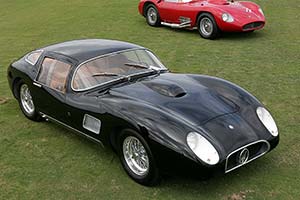
Featured is the unique low drag coupe designed by British aerodynamics specialist Frank Costin and constructed by Zagato in Italy. There was little time to complete the project before the 1957 Le Mans race and without being properly tested the car left for France. For reasons unknown at the time, the car performed very poorly and was unable to match the open topped cars' top speeds. Later it was concluded that hot air from the radiator was directed straight to the Weber carburetors, decreasing the engine's power considerably. Despite the problems, Moss managed to get the 450 S Coupe to second place before a mechanical failure put the pairing out of the race.

After the unique car's disappointing racing debut, the body was removed and left to rot in Maserati's scrapyard. An American collector traced the car down in 1958 and commissioned Maserati to reconstruct it as a road car. With the help of Fantuzzi the wheelbase was stretched 25 cm to create some additional interior space. When the job was completed the 450 S Costin Zagato Coupe was one of the fastest road cars in the world. After a spell in the United States, it was sold to prominent German collector Peter Kaus, who displayed it for many years in his Rosso Bianco museum.

In 2002 the unique racer turned road car was sold to its current owner and returned to the United States. He had it carefully restored by Faralli & Mazzanti to its original road car specification including a fresh layer of black paint. It was subsequently shown at various events including the Pebble Beach Concours d'Elegance and the Le Mans Classic. It is pictured in and around Palm Beach at the Cavallino Classic and Palm Beach, a Concours d'Elegance. In the first picture the Coupe 450 S is seen next to a 'regular' Roadster bodied example.

Article by Wouter Melissen, last updated on 04 / 12 / 2006

Add your comments on the Maserati 450S Costin Zagato Coupe

 Fell in love with this at 13  
donhaines
09-19-2007
I first saw a photo of this car at age 13. Didn't even know what it was but I fell in love with it.

I still think this is the most beautiful GT car ever built. Perhaps the most beautiful car ever built period. The E-Jag has been call the most beautiful car but probably because they were built in quantity and were available to the public. They may be as a production car but the 450S Coupe has to be the ulitmate dream car.
Someone should build a replica of it. It is unique in the world.
 450 S  
Cedric
12-24-2004
The new owner, who acquired the car in 2002, had this car painted black. It has been restaured and this 450 S is said to drive properly, in spite of the enormous interior heat produced by the big engine and the side exhausts. The Colotti 5-speed is in fact a transaxle. No-one will disagree that this is an absolutely stunning vehicle.
     

General specifications
Country of origin Italy
Chassis number 4512
Numbers built 1
Produced in 1957
Body design Frank Costin / Zagato / Fantuzzi

Engine
Configuration Twin Spark 90º V 8
Location Front, longitudinally mounted
Construction aluminum head
Displacement 4.478 liter / 273.3 cu in
Bore / Stroke 93.8 mm (3.7 in) / 81.0 mm (3.2 in)
Compression 9.6:1
Valvetrain 2 valves / cylinder, DOHC
Fuel feed 4 Weber 45 IDM Carburetors
Aspiration Naturally Aspirated

Drivetrain
Chassis/body aluminum body on steel tubular frame
Front suspension wishbones, coil springs, hydraulic Houdaille shock absorbers, anti-roll bar
Rear suspension DeDion axle, transverse semi-elliptic leaf spring, hydraulic Houdaille shock absorber, anti-roll bar
Steering worm-and-sector
Brakes hydraulic drums, all-round
Gearbox Colotti 5 speed Manual
Drive Rear wheel drive

Dimensions
Weight 1270 kilo / 2799.9 lbs
Wheelbase / Track (fr/r) 2649 mm (104.3 in) / 1333 mm (52.5 in) / 1298 mm (51.1 in)

Performance figures
Power 450 bhp / 336 KW @ 7200 rpm
Torque 488 Nm / 360 ft lbs @ 5500 rpm
BHP/Liter 100 bhp / liter
Power to weight 0.35 bhp / kg

Resources
Related articles
Useful links


Ultimatecarpage.com - All Cars - Contact us - Privacy Statement - Top © 1998 - 2009 Ultimatecarpage.com