Go to Ultimatecarpage.com

Car search: Quick Advanced 
 sport Ultimatecarpage.com  > Cars by brand  > France  > Bugatti
Racing cars  > Other Sportscars
     Type 35 'Grand Prix de Lyon'
Cars statistics: 5054 cars, 430 makes, 39392 images; Events statistics: 215 reports, 41349 images; Forum statistics: 85,353 members, 41,967 topics; more...


  Bugatti Type 35 'Grand Prix de Lyon'
 

Bugatti Type 35 'Grand Prix de Lyon' Bugatti Type 35 'Grand Prix de Lyon' Bugatti Type 35 'Grand Prix de Lyon' Bugatti Type 35 'Grand Prix de Lyon' Bugatti Type 35 'Grand Prix de Lyon' Bugatti Type 35 'Grand Prix de Lyon'
Click here to save all images    Image credits: Wouter Melissen / Pieter Melissen 

Model history:
Click here to download printer friendly version Soon after the First World War ended, Ettore Bugatti picked up production of the sophisticated Bugatti road cars. They were powered by nifty four cylinder engines with a single overhead camshaft, actuating either eight or sixteen valves. In the early twenties Bugatti's first track success was scored with the sixteen valve engine, which significantly increased Ettore Bugatti's interest in racing. For the first time he set about developing a racing car from the ground up, although many of the parts were designed to be used on future road cars as well.

To be competitive at the highest level, a little more than the 1500 cc currently available was required, so it was the first real chance for Ettore Bugatti to turn his plans for an eight cylinder engine into metal. Constructed by joining two four cylinder engine blocks and displacing just under 3 litres, the Type 28 engine was the first to sport Bugatti's familiar three valve layout. Installed vertically in the head, the two inlet valves and one exhaust valve were operated by a single overhead camshaft. Before the project could be completed, the rules were changed in favour of 2 litre engines and just one rolling Type 28 chassis was constructed.

In accordance with the new regulations, Bugatti set about developing a smaller eight cylinder engine. It was of a slightly simpler construction with just three, instead of nine ball bearings to support the crank, but the valvetrain was retained. It was also the first engine to sport the unusual, but Bugatti trademark ultra-square design. Installed in a four cylinder chassis, the Type 30 was raced with some success in 1922, particularly at Strassbourg. In 1923 the 2 litre engine powered the 'aerodynamic' Type 32 Tank, but reliability issues forced Ettore Bugatti to return to the drawing boards, with an epic result.

Many of the reliability issues were cured by adding two more ball bearings to support the crank. As before, the eight cylinder engine was mated to a four speed gearbox derived directly from the four cylinder cars. The drivetrain was installed in a simple ladder frame, suspended by rigid axles on both ends. The inverted quarter elliptic springs fitted inboard at the rear would become another Bugatti trademark. The most characteristic features on the Type 35 were the cast alloy wheels with integral drum brakes and detachable rims. The package was rounded off by a tightly wrapped aluminium body dominated by the horseshoe radiator.

At first sight the 95 bhp produced by the 2 litre engine would not make for a great racing car, but this was more than compensated by the superb handling characteristics of the nimble Bugatti. The engine was also extremely reliable, even the most difficult of circumstances. The Bugatti Type 35 was not a winner straight out of the box as its debut in the 1924 Grand Prix de Lyon was dogged with problems. In the race several of the cars shed their tires and for many years this was attributed to the new wheels, but later it was believed that this was the result of a fault during the construction of the tires.

Leaving little to chance, Bugatti fitted wider tires to his cars with a second place finish in the next Grand Prix at San Sebastian as a result. In the following five seasons a wide variety of developments based on the Type 35 would score over 2000 'successes', including dozens of major victories highlighted by four consecutive wins in the Targa Florio. The Type 35's success on the track also made it high in demand with privateers and it was the first ever racing car to be built in large numbers. This is also an explanation on how the car achieved the incredible number of successes as claimed by Bugatti.

One of the first developments was a 1.5 version of the engine to comply with the latest Grand Prix regulations. Built in very small numbers, it was known as the Type 39. For the long road races like the Targa Florio a 2.3 litre engine was created, known as the Type 35T (for Targa Florio). A major step forward was the reluctant addition of a Supercharger, which until then was considered 'cheating' by Ettore Bugatti. It became available on all versions of the engine, with the 2.3 Type 35B as the the most powerful. Not intended for racing, Bugatti introduced the Type 35A or 'Course Imitation' with a three main bearing version of the 2 litre engine for around 2/3 of the Type 35 price.

By 1930, the Type 35 and its derivatives were gradually losing competitiveness although Grands Prix were won up to 1932. Its replacement, the Type 51, used a very similar chassis design, but now with a twin overhead camshaft engine. Although the figure of 2000+ successes includes more than just victories, the Bugatti Type 35 is without a doubt the most successful racing car ever constructed. The versatility of the chassis enabled it to compete successfully in Grands Prix, long distance road races or hill climbs. It was also quintessential in establishing Bugatti as a serious manufacturer and greatly helped the company to achieve the mythical status it holds today.


Chassis: 4449
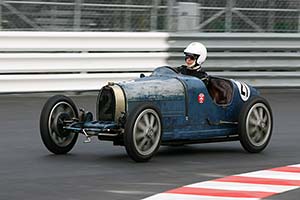
Chassis 4449 Featured is one of the first ten Bugatti Type 35s constructed late in 1924 and sports the same specification as the Grand Prix de Lyon cars. This includes the slim tires and minimal driver protection. Research to the exact competition history of this chassis is still ongoing, but it is believed that it made its competition debut at San Sebastian. It has survived in remarkable original condition and the current owner is more than happy to display every detail as can be seen above. It is pictured in action at the 2006 Monaco Historic Grand Prix; at a track that suited the Bugatti Type 35 particularly well in its day.

Article by Wouter Melissen, last updated on January 18, 2007

Add your comments on the Bugatti Type 35 'Grand Prix de Lyon'


General specifications
Country of origin France
Chassis number 4449
Numbers built 96 (Type 35)
Produced from 1924 - 1925

Major wins
1925 Targa Florio (Bartolomeo Constantini)

Engine
Configuration Straight 8
Location Front, longitudinally mounted
Construction cast-iron block and head
Displacement 1.991 liter / 121.5 cu in
Bore / Stroke 60.0 mm (2.4 in) / 88.0 mm (3.5 in)
Valvetrain 3 valves / cylinder, SOHC
Fuel feed 2 Solex Carburettors
Aspiration Naturally Aspirated
Power 95 bhp / 71 KW @ 5000 rpm
BHP/Liter 48 bhp / liter

Drivetrain
Chassis aluminium body on steel ladder frame
Front suspension live axle, semi-elliptic leaf springs, friction dampers
Rear suspension live axle, inverted quarter-elliptic leaf springs, friction dampers
Steering worm-and-wheel
Brakes drums, all-round
Gearbox 4 speed Manual
Drive Rear wheel drive

Dimensions
Weight 650 kilo / 1433 lbs
Length / Width / Height 3700 mm (145.7 in) / 1340 mm (52.8 in) / N/A
Wheelbase / Track (fr/r) 2400 mm (94.5 in) / 1200 mm (47.2 in) / 1200 mm (47.2 in)

Performance figures
Power to weight 0.15 bhp / kg
Top Speed 175 km/h (109 mph)

Resources
Suggested reading
  • Bugatti Magnum, by Hugh Conway with Maurice Sauzay
  • Bugatti - le Pur Sang des Automobiles, by Hugh Conway
  • Grand Marques Bugatti, by Hugh Conway
Related articles
Useful links