Page 1 of 2 Next >> After his arrival in Europe Bruce McLaren worked his way up from the youngest ever Grand Prix winner to a highly successful racing car manufacturer in a remarkably short time. The New Zealander also found time to score Ford's first 24 Hours of Le Mans in 1966. In the following season the 'Group 7' McLaren M6 dominated the Can-Am Challenge Series and in 1968 Denny Hulme scored McLaren's first Formula 1 victory. These successes strengthened a long lingering desire that had strongly nestled in the back of Bruce McLaren's head; a 'Group 6' McLaren production car that could double as a road car and most importantly a Le Mans contender.
Realising the dream was made increasingly difficult by new regulations that took into effect in 1968, limiting displacement for Group 6 prototype racing cars to just three litres. This forced McLaren to set his sights on Group 4, which required a homologation run of fifty cars and a displacement limit of five litre. In 1968 McLaren had established a partnership with the British Trojan company to build the production Group 7 Can-Am cars, so they could be used to build the run of cars required for homologation. The displacement limit was more worrying as the Chevrolet engines used in the Can-Am cars were really only competitive with higher displacements. The lower octane fuels available in Europe made things ever worse.
In spite of these potential problems, Bruce McLaren went ahead with the development of the Group 4 racer. He kept the cost and risk for his company down by using the existing and well proven M6 chassis for the new car. Considering the advanced design and track record of the M6 this was in no way a compromise. Designed in just eleven weeks, the M6 had been McLaren's first full length monocoque car, designed to house an American small-block V8 engine. With double wishbones, front and rear, the design was very straightforward. This made it very easy for Trojan to adapt it for (mass-) production in 1968. To distinguish the customer car from the McLaren built Works racers, it was known as the M6B.
With the chassis readily available, the work on the Group 4 car could focus on the required coupe body. Typical for McLaren a simple, but effective shape was penned. The design was reminiscent of the contemporary Group 6 car from Ferrari. Specialized Mouldings went ahead and started mass producing the fibreglass. It is believed that they produced all fifty necessary bodies in one batch. Trojan assembled the first car using a M6B chassis and it was launched in January of 1969 as the McLaren M6GT. By that time the homologation limit for Group 4 had been dropped to 25, which opened the door for the likes of Porsche. McLaren quickly realised that the M6GT would be no match for the new Porsche 917 and the plans to run the car at Le Mans later in the year were quickly shelved. Page 1 of 2 Next >>

 Ultimatecarpage.com
> Cars by brand
> Great Britain
> McLaren
Ultimatecarpage.com
> Cars by brand
> Great Britain
> McLaren
 M6GT Chevrolet
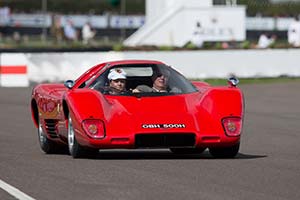
 After his arrival in Europe Bruce McLaren worked his way up from the youngest ever Grand Prix winner to a highly successful racing car manufacturer in a remarkably short time. The New Zealander also found time to score Ford's first 24 Hours of Le Mans in 1966. In the following season the 'Group 7' McLaren M6 dominated the Can-Am Challenge Series and in 1968 Denny Hulme scored McLaren's first Formula 1 victory. These successes strengthened a long lingering desire that had strongly nestled in the back of Bruce McLaren's head; a 'Group 6' McLaren production car that could double as a road car and most importantly a Le Mans contender.