
 Ultimatecarpage.com
> Cars by brand
> Spain
> Hispano Suiza
Ultimatecarpage.com
> Cars by brand
> Spain
> Hispano Suiza
 H6 Duvivier Tourer H6 Duvivier Tourer
|
| Hispano Suiza H6 Duvivier Tourer |
| Article | Image gallery (10) | Specifications |
|
|
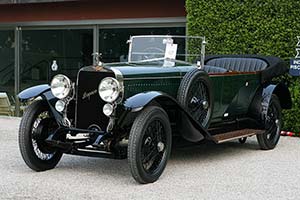
Page 1 of 1  At the first motor show after the end of the First World War, the 1919 Paris Auto Salon, Marc Birkigt launched a new luxury model, the H6. For many years the six cylinder Hispano Suiza's refinement and built quality remained unmatched. At the first motor show after the end of the First World War, the 1919 Paris Auto Salon, Marc Birkigt launched a new luxury model, the H6. For many years the six cylinder Hispano Suiza's refinement and built quality remained unmatched.In the War, Hispano Suiza had supplied over 50,000 V12 fighter plane engines. For his new top of the line model, Birkigt first intended to use a version of the well proven V12. After some tests he concluded that one bank of a V12 would be more than sufficient to propel the new car. The 'six' displaced just over 6.5 litres and featured a single overhead camshaft. Each 35 lb crankshaft was machined from a 600 lb billet, resulting in a very rigid crankshaft. This was typical for Birkigt's 'no cost spared' perfectionism. For the block and head aluminium was used, to keep the weight of the engine down. In the block a six separate steel sleeves formed the cylinders. Ignition was through two coils, with two plugs per cylinder, one on each side of the engine. The overhead camshaft was shaft driven and operated the valves, which were set vertical in the block. This was unconventional setup, which could result in tremendous damage, if a valve dropped in the cylinder. Birkigt was confident in using it, as the valves had never failed on the V12 airplane engines. Finished in black enamel and polished aluminium, the engine was mounted in a conventional ladder frame. It was suspended by a live axle and semi-elliptic leaf springs all-round. The four drum brakes were power assisted by a patented 'servobrake' system. The ingenious system used the car's momentum to slow it down. The brake assistance system took the power from the gearbox, which drove a shaft at 1/64 the speed of the engine. If all else failed, the rear brakes could be activated using a hand lever. Built in Paris and later in the Czech Republic as well, the H6 offered luxury, speed and refinement. Many of Hispano Suiza's European competitors like Rolls Royce, Bentley and Isotta Fraschini offered one or two of these ingredients, but not until the late 1920s did another manufacturer come up to par with the H6. This complete package did not come cheaply and for a while the H6 was the most expensive European car available. In 1922 the slightly more powerful H6B replaced the H6 and in 1924 the 8-litre H6C was added to the line-up. Hispano Suiza delivered the H6 as a rolling chassis for coach builders to body. To match the car's remarkable abilities, only the finest coach builders were commissioned to design and fit bodies on the H6 chassis. The featured H6 is no exception; fitted with a beautiful Tourer body by the Paris based coach builder Duvivier. It was in fact the very first H6 to be delivered to a customer, who happened to be none other than the Spanish king Alphonso XIII. He was a real enthusiast and remained one of Hispano's most loyal customers for many years. Production of the H6B ended in 1932 and of the H6C in 1933. Its replacement was the T68 or J12, which was powered by V12 engine, displacing just over 9.4 litres. Today the H6 is still one of the most highly respected models of the vintage and post vintage era. Carefully restored, the Hispano H6 Duvivier Tourer is seen here during the 2007 Concorso d'Eleganza Villa d'Este, where it received the Targa d'Argento in its class; a special Mention of Honour by the jury. Page 1 of 1 |
| Article | Image gallery (10) | Specifications |
| All Cars - Contact us - Privacy Statement - Top | © 1998 - 2026 Ultimatecarpage.com |