Page 1 of 2 Next >> In the first half of the 20th century sports and racing cars were predominantly equipped with very spartan open bodies. The driver's creature comforts and weather protection were second or third to saving weight and decreasing frontal area. At the end of the 1930s a better understanding of aerodynamics saw the introduction of fixed head racers on the grid, but only very rarely. This all changed in the early 1950s when small two door coupes, often referred to as Grand Tourers, were introduced left and right. Initially intended as road cars for the enthusiast, they quickly made it out to the track. In 1955 a Grand Turismo, or GT class was added to the international racing calendar for two and three litre production cars.
The GT moniker was first introduced to the Ferrari line-up in 1954 with the introduction of the 250 GT Europa. It replaced the 250 Europa and was primarily intended as a road car, but as it turned out it formed the basis for a long line of highly successful racers. Unlike its Lampredi big-block powered predecessor, the 250 GT Europa used Colombo's short block V12, derived from the 250 MM racing engine. The Pinin Farina designed and constructed coupe body was also similar to the 250 MM's. The chassis followed Ferrari's familiar pattern of two large tubular members with several cross braces with a wheelbase of 2600 mm. Suspension was by wishbones at the front with a single transverse leaf spring and a live axle at the rear. In good Italian fashion, large finned drum brakes took care of the braking.
With its 2953 cc V12 engine, the 250 GT Europa fitted perfectly in the new three litre class, so it was no surprise a 'Competizione' version was prepared for the 1955 season. The first competition 250 GTs were very similar to the road cars, but of course stripped of all luxuries. After the first batch of four cars was constructed, the chassis was modified with the front transverse leaf springs replaced by coil springs. Breathing through three Webers, the three litre engine produced between 230 and 260 bhp depending on the version and the state of tune. Pinin Farina bodied the first cars, but shortly after the production was allocated to the local specialist Scaglietti, while the Turin based coach-builder continued to supply the designs. With the exception of five chassis, bodied by Zagato, all subsequent 250 GT competition cars featured Scaglietti built bodies.
Internally all 250 GTs built between 1955 and 1964 were known as such, but several nicknames were used to distinguish the various types. The cars built between 1955 and 1959 are now referred to as Long Wheelbase (LWB) to distinguish them from the later 2400 mm Short Wheelbase (SWB) cars and those of 1957 through to 1959 vintage are also generally dubbed Tour de France (TdF). This was for a very good reason; from the first time a 250 GT was entered in the gruelling endurance race in 1956, it dominated the event, taking nine consecutive victories. The organizers allowed the (class-)winning manufacturers to use the event's name for the winning model. In 1955 and 1956 the 'standard' competition 250 GTs were constructed with the 250 MM inspired design, but for 1957 the first major modification was carried through. Page 1 of 2 Next >>

 Ultimatecarpage.com
> Cars by brand
> Italy
> Ferrari
Ultimatecarpage.com
> Cars by brand
> Italy
> Ferrari
 Racing cars
> GT Cars
Racing cars
> GT Cars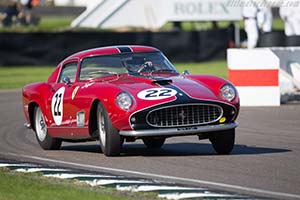
 In the first half of the 20th century sports and racing cars were predominantly equipped with very spartan open bodies. The driver's creature comforts and weather protection were second or third to saving weight and decreasing frontal area. At the end of the 1930s a better understanding of aerodynamics saw the introduction of fixed head racers on the grid, but only very rarely. This all changed in the early 1950s when small two door coupes, often referred to as Grand Tourers, were introduced left and right. Initially intended as road cars for the enthusiast, they quickly made it out to the track. In 1955 a Grand Turismo, or GT class was added to the international racing calendar for two and three litre production cars.