Page 1 of 1 In motoring's formative years the most luxurious machines were generally produced in France. The young entrepreneur and racer Charles Rolls recognized this and started importing cars from mainland Europe into England. Although his well setup business was quickly growing, he started considering the production of a British equivalent of the excellent European cars. At this time he learnt of a mechanical and electrical engineer Henry Royce, who was looking at expanding his business. His engineering ability and obsession with quality made him the right person for Rolls to team up with. In 1904 Rolls secured the exclusive deal to market the Royce built and designed cars and two years later the two separate companies merged to form Rolls-Royce Limited.
At the time he first thought of constructing, Henry Royce was a Manchester based crane manufacturer. His interest in cars was spiked by a DeDion Quadricycle, but his real inspiration was a 1902 Decauville. That very advanced French machine set the pattern for the conventional car with a front mounted engine and a prop shaft driving the rear wheels with gears. This eliminated the need for the noisy chain drive. Even though the little Decauville was a formidable machine, Royce was convinced he could do better and set about designing his first car.
Like the French car, the first Rolls-Royce featured a two cylinder engine of around 2 litre. At the time, it was the norm to have a camshaft operating the exhaust valve and use the suction of the piston moving down to open the intake valve. Needless to say this was not the most accurate method and certainly not good enough for Royce's standards, so he fitted a second camshaft to actuate the intake valves through pushrods. He also broke with convention by having the pistons move up and down separately, to make the engine run more smoothly. Royce also spent much time reworking existing Carburetors to improve the engine response.
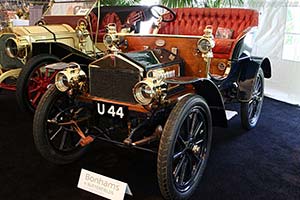
Producing around 12 bhp at 1000 rpm, the engine was installed in a ladder frame chassis. This was suspended by live axles on both ends. The power was transferred to the rear wheels through a three speed gearbox. Stopping power was provided by a footbrake that acted on the gearbox and a hand brake that operated a small drum on the rear axle. All this was not quite as advanced as the engine, the superb build quality and use of lightweight materials did make the first Rolls-Royce chassis stand out. Fitted with a comparable body, the British car was around 100 kg lighter than the Decauville. Simply dubbed the '10hp', the first Rolls-Royce was completed in April of 1904.
Alongside the 10hp, Royce had also developed three, four and six cylinder engined machines using the same basic design and many common parts. These were built to the request of Rolls, who understood that his clientele was most interested in these largest engined machines. At the December 1904 Paris Salon, the Rolls-Royce range was officially unveiled with a display, which included finished 10hp and 20hp cars, an engineless 15hp chassis and a 30 hp engine. Available in a variety of wheelbases, the range was usually clothed by Barker or Cann. Although intended as luxurious road cars, several of the new owners campaigned their Rolls-Royces in hill climbs and races. In 1906 Charles Rolls piloted a 20hp to victory in the second Tourist Trophy.
Thanks to Royce's high quality standards and Rolls' sporting success, the Rolls-Royce was a big hit with wealthy Brits and by 1906 the fledging company was set to conquer the rest of Europe and the United States. In the fall of that year a completely new model, known initially as the 40/50hp, was unveiled to replace the entire four-car range. The company moved to new premises in London to expand production. Between 1906 and 1922, the 40/50hp, or Silver Ghost was the only Rolls-Royce model available. By 1906, the company had produced around 60 rolling chassis at Royce's Cooke Street factory. The demand had been so high that they could have easily sold three times the number of cars. Although not as well known as the subsequent models, these very first Rolls-Royces set new standards and established the company as the manufacturer of the world's finest cars. Page 1 of 1

 Ultimatecarpage.com
> Cars by brand
> Great Britain
> Rolls-Royce
Ultimatecarpage.com
> Cars by brand
> Great Britain
> Rolls-Royce
 10hp Barker Two Seater
 In motoring's formative years the most luxurious machines were generally produced in France. The young entrepreneur and racer Charles Rolls recognized this and started importing cars from mainland Europe into England. Although his well setup business was quickly growing, he started considering the production of a British equivalent of the excellent European cars. At this time he learnt of a mechanical and electrical engineer Henry Royce, who was looking at expanding his business. His engineering ability and obsession with quality made him the right person for Rolls to team up with. In 1904 Rolls secured the exclusive deal to market the Royce built and designed cars and two years later the two separate companies merged to form Rolls-Royce Limited.