Page 1 of 2 Next >> Despite the dismal results achieved with the low-line Brabham BT55 in 1986, designer Gordon Murray found a willing ear at McLaren to give it another go a year later. This time round the results were a complete mirror image. Drivers Ayrton Senna and Alain Prost together won 15 of the 16 races in the 1988 season, making the ultra-low MP4/4 one of the most successful racing cars ever built.
In theory Murray's objective of placing all of the car's weight as low as possible in the chassis made perfect sense. With the Brabham that meant placing the BMW four-cylinder engine at a sharp angle, which created all sorts of problems. The very compact Honda V6 used by McLaren was much more suited to this purpose. The ultra-low chassis meant that the drivers had to lie almost flat in the car, which was something Alain Prost initially objected to.
Although the packaging and execution was very different, the specifications of the chassis, penned by Murray together with chief designer Steve Nichols, very much followed convention. At the core was a carbon fiber / honeycomb monocoque suspended by double wishbones on both ends. At the front push-rods actuated the springs/damper units while at the rear rocker-arms were used. Carbon ceramic disc brakes were used on all four wheels.
In addition to the obvious handling benefits, the low line also provided aerodynamic advantages. The frontal area was reduced by 10% and air could flow more cleanly to the rear wing, greatly improving its efficiency. Murray's only compromise concerned the ride-height, which was not quite as low as it could have been. This did make the MP4/4 more forgiving to drive and easier to setup.
The TAG/Porsche V6 that had brought three World Championships was replaced by the superior twin-turbo Honda V6, which had been used to great effect by the Williams and Lotus teams. Even with the latest boost-restrictions, it was the most powerful engine on the grid. The V6 was mated to a three-shaft six-speed gearbox that was specifically developed for the MP4/4 in conjunction with Weisman in the USA. Page 1 of 2 Next >>

 Ultimatecarpage.com
> Cars by brand
> Great Britain
> McLaren
Ultimatecarpage.com
> Cars by brand
> Great Britain
> McLaren
 Racing cars
> Formula 1
Racing cars
> Formula 1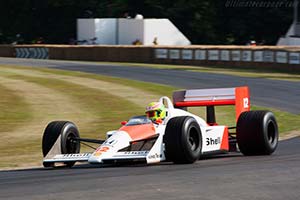
 Despite the dismal results achieved with the low-line Brabham BT55 in 1986, designer Gordon Murray found a willing ear at McLaren to give it another go a year later. This time round the results were a complete mirror image. Drivers Ayrton Senna and Alain Prost together won 15 of the 16 races in the 1988 season, making the ultra-low MP4/4 one of the most successful racing cars ever built.