Go to Ultimatecarpage.com

Car search: Quick Advanced 
  Ultimatecarpage.com  > Cars by brand  > United States  > Duesenberg
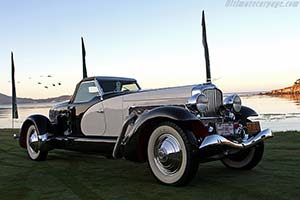
SJ Weymann 'Fishtail' Speedster
Cars statistics: 3249 cars, 324 makes, 21848 images; Events statistics: 122 reports, 20499 images; Forum statistics: 57,336 members, 34,385 topics; more...


Duesenberg SJ Weymann 'Fishtail' Speedster

Duesenberg SJ Weymann 'Fishtail' Speedster Duesenberg SJ Weymann 'Fishtail' Speedster Duesenberg SJ Weymann 'Fishtail' Speedster Duesenberg SJ Weymann 'Fishtail' Speedster Duesenberg SJ Weymann 'Fishtail' Speedster Duesenberg SJ Weymann 'Fishtail' Speedster
Click here to save all images    Image credits: Wouter Melissen 


Click here to download printer friendly version Launched at the 1928 New York Auto Show, the Duesenberg Model J was the result of a design process influenced by both Duesenberg's rich racing heritage and owner Errett Lobban Cord's demands. Cord envisioned the new Duesenberg to be the greatest American car ever. No expense was spared and a legend was created by the design team led by Fred Duesenberg. Today the name Duesenberg alone makes many automotive enthusiasts' hearts beat faster.

Duesenberg first stunned the world in 1921 by winning the French Grand Prix, the first and only American manufacturer to ever win the event. The three litre racer featured a state of the art eight cylinder engine and hydraulic drum brakes all-round. In the same year Duesenberg entered the passenger car market with the Model A. Many of the features that made the Grand Prix racer successful were found on the road car as well. The Model A was the first road car ever to be fitted with hydraulically operated drum brakes all-round.

Unlike the racing Duesenbergs, the road cars were not an immediate success. The Duesenberg brothers were great designers and engineeers, but their business and marketing talents were limited. Poor sales results pushed Duesenberg on the verge of bankruptcy. E.L. Cord stepped in and bought the company in 1926. Cord decided to abandon the nimble Model A and requested Fred Duesenberg to design a large, luxurious and powerful chassis to be bodied by various coach-builders.

Dubbed Model J, the new Duesenberg was equipped with a wide variety of technical novelties. In its design the chassis was very simple with a ladder frame and solid axles front and rear. Six cross-members made sure the chassis was twist-free and could accomodate all body-types regardless of the body's rigidity. An ingenious lubrication system was installed, which automatically started lubricating various parts of the chassis after sixty to eighty miles. Two lights on the dashboard indicated the lubrication progress and two others lit up at 750 and 1500 miles indicating the need for an oil change and battery check respectively.

It's the engine that really made the Model J stand out from its competition. With 32 valves, double overhead camshafts and a detachable head the eight cylinder engine was the most advanced engine ever designed in the United States. Displacing just under 6.9 litres, the engine produced an earthmoving 265 bhp, more than could be tested on any contemporary dynometer. Although the engine was designed by Fred Duesenberg, it was constructed by specialised engine-builder Lycoming, which was also recently acquired by E.L. Cord.

Officially Duesenberg constructed rolling-chassis for coach-builders to body. A rolling chassis usually included all mechanical parts, the dashboard, front fenders, radiator grille, running boards, bumpers and optional swiveling spotlights. The chassis were shipped to coach-builders to be fitted with a body or the other way around. To make sure a wide variety of bodies was available at the launch, a blue-print of the upcoming car was sent to all major coach-builders six months before the New York show. From 1930 Duesenberg ordered bodies in small batches and offered complete cars.

Despite the enthusiastic public response at the New York launch, sales were disappointing. The estimated production figure of 500 cars per year was never matched and eventually only 481 Model Js were constructed. Being extremely expensive, the Model J was popular with the rich and famous. Among the owners were many greats from the showbizz industry like Gary Cooper, Clark Gable, James Cagney and Greta Garbo. Various kings and queens were Model J owners as well. Part of the Duesenberg legend is based on the many famous owners.

A series of minor modifications were carried out during the production life, but most of the design remained the same up until the factory closed in 1937. First to go was the four-speed gearbox, which proved unable to handle the engine's power. It was replaced by a unsynchronised 3-speed gearbox, which was fitted to all Duesenbergs to come. Unlike almost all American manufacturers Duesenberg did not switch to a fully synchronised gearbox in the mid-1930s, which made the Model J difficult to drive and outdated compared to its competitors.

Throughout the production run, the engine dimensions stayed the same. An increase of 55 bhp was achieved by adding a supercharger. Only a handful of supercharged Model Js were constructed and they are today commonly known as the Model SJ, a name never used by Duesenberg themselves. A final evolution was the addition of ram-horn intakes on the last supercharged models. Fitted in two short wheelbase chassis, this engine reportedly produced up to 400 bhp, a stunning figure even today. Two of these 'super-Duesenbergs' were constructed and are reffered to as SSJs, again a designation never used by the factory.

Production ceased in 1937 because of the depression and for a number of specific reasons. The Model J's development grounded to a halt in 1932, when Fred Duesenberg died from the results of a car crash. By 1937 the chassis and gearbox were ancient compared to the competition and a thorough redesign was needed to bring Duesenberg back on top once more. The Cord company had lost interest in Duesenberg, which from a business perspective never lived up to the expectations. E.L. Cord had left the company and with him the enthusiasm required to keep a brand like Duesenberg alive.

Today the Model J is considered to be one of the most legendary cars ever constructed. The combination of state-of-the-art racing inspired engineering, the era's finest coach-building and the cars' many famous owners have all contributed to that legend. One of the most told stories about the Model J underlined the engine's incredible power; the Model J could smoothly accelerate from 10 mph to 89 mph in second gear. The SSJ's top-speed is estimated to be close to 160 mph, faster than any other pre-War road car.

One of America's premier designers, Gordon Buehrig penned two Speedster designs for the Weymann Body Company. The first was for short wheelbase chassis and known as the 'Tapertail' Speedster, and the second for a supercharged long wheelbase chassis, dubbed the 'Fishtail' Speedster. The latter was commisioned by Capt. George Whittell, who was an honorary fire marshall. Probably one of the largest two seater cars ever built, the 'Fishtail' Speedster came equipped from the factory with a siren and an emergency light.

Whittell barely used his Duesenberg and when the car was acquired by the famous Harrah Collection in the 1960s, it only had 1342 miles on the counter. Still in absolute original condition, the massive 'Fishtail' Speedster was shown at the 2007 Pebble Beach Concours d'Elegance, where Duesenberg was the featured marque. It was lined up alongside the 'Tapertail' Speedster.

Article by Wouter Melissen, last updated on 02 / 04 / 2008

Add your comments on the Duesenberg SJ Weymann 'Fishtail' Speedster

 Duesy Fishtail @ Pebble  
bdowns
02-05-2008
I am proud to say I was at PB last year and witnessed the Duesenbergs lined up like soldiers. What a mind blowing event, anybody who can get there, GO! This year will feature Lancia and Lamborghini. Ultimatecarpage.com, you guys ROCK.
Bruce
     

General specifications
Country of origin United States
Chassis number 2537 / J-508
Numbers built one-off
Produced in 1933
Body design Gordon Buehrig for Weymann

Engine
Configuration Lycoming / Duesenberg Straight 8
Location Front, longitudinally mounted
Construction cast-iron block and head
Displacement 6.876 liter / 419.6 cu in
Bore / Stroke 95.3 mm (3.8 in) / 120.7 mm (4.8 in)
Compression 5.2:1
Valvetrain 4 valves / cylinder, DOHC
Fuel feed Schebler Carburetor
Aspiration Supercharger

Drivetrain
Chassis/body steel ladder frame
Front suspension beam axle, semi-elliptic leaf springs, friction dampers
Rear suspension live axle, semi-elliptic leaf springs, friction dampers
Steering Ross cam-and-lever
Brakes hydraulic drums, all-round
Gearbox Warner Gear 3 speed Manual
Drive Rear wheel drive

Dimensions
Weight 2400 kilo / 5291.1 lbs
Wheelbase / Track (fr/r) 3899 mm (153.5 in) / 1422 mm (56 in) / 1422 mm (56 in)

Performance figures
Power 320 bhp / 239 KW @ 4200 rpm
BHP/Liter 47 bhp / liter
Power to weight 0.13 bhp / kg

Resources
Suggested reading Duesenberg, the Pursuit of Perfection by Fred Roe
Road & Track, February 1966
Related articles
Useful links


Ultimatecarpage.com - All Cars - Contact us - Privacy Statement - Top © 1998 - 2008 Ultimatecarpage.com