Page 1 of 1 Ettore Bugatti was already busy with creating a new eight cylinder engine as early as 1913. The First World War postponed the plans and the existing four cylinder models remained in production well into the 1920s. After the peace had returned to Europe, development work continued and a three litre eight cylinder engine was displayed at motor shows in France and England. This 'Type 28' engine did not leave the prototype phase as shortly after the governing bodies announced that for the 1922 season, the Grand Prix engines would be limited to just two litres.
Along the same lines as the three litre engine, Bugatti constructed an eight cylinder engine that did meet the new regulations. The 'Type 29/30' was built up of two blocks of four cylinders and featured three valves per cylinder (two intake and one exhaust). Mounted vertically in the head, the valves were actuated by one overhead camshaft. Whereas the original three litre engine used nine bearings to support the crankshaft, the new two litre had just three. This would become one of the weak spots of the design, particularly in racing. Depending on the state of tune, the engine produced between 75 and 100 bhp.
Bugatti originally intended to mount the new engine in an existing four cylinder engine chassis, which proved to be not capable of taking the load of the larger and more powerful 'eight'. The new, strengthened 'Type 30' chassis followed Bugatti fashion with live axles front and rear. What was unusual was the use of hydraulic front brakes, which had been used very successfully by the 1921 French Grand Prix winning Duesenberg. Instead of using the Lockheed produced brakes of the Duesenberg, Bugatti set about developing his own. There were some fundamental flaws in the design and in 1925 they were discarded and replaced with conventional cable operated drums.
The first few chassis were prepared for the 1922 racing season and known was the Type 29/30. A team of four cars was entered for the French Grand Prix at Strasbourg. Clothed in an aerodynamic body, the new Bugatti quickly earned the nickname 'Le Cigar'. It was a successful debut with the three surviving examples finishing second, third and fourth behind the winning Fiat. A single car with a more conventional bodywork was raced to third at Monza. No fewer than five Type 29/30s, equipped with single seater bodies, were entered in the 1923 Indy 500. Here the bearing problems became painfully obvious and all but one car retired. A radical streamlined version of the Type 30, known as the 'Tank', was constructed for the 1923 French Grand Prix, but it could do no better than 3rd. Bugatti recognised the problems and fixed all of them for the (nine bearing) Type 35, and the rest, so they say, is history.
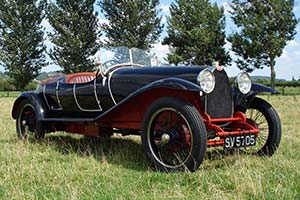
After the first batch of racing cars was completed, the focus was turned to the road going Type 30. It was virtually identical to the racing cars, with the exception of the slightly longer wheelbase. Although the Type 29/30 had not been a success on the track, the prospect of buying a Grand Prix Bugatti for the road most certainly appealed to customers. The motoring press was also universal in their acclaim. Series production began in all earnest in 1923 and in the first year about 140 examples were produced. By the time the last Type 30 rolled off the production line, around 600 had left the factory. Most of these were equipped by a variety of coachbuilders with open two or four seater bodies. Little known today, Bugatti's first eight cylinder engined machine was an economic success and on the track paved the way for the all-conquering Type 35. Page 1 of 1

 Ultimatecarpage.com
> Cars by brand
> France
> Bugatti
Ultimatecarpage.com
> Cars by brand
> France
> Bugatti
 Type 30 Lavocat & Marsaud Torpedo
 Ettore Bugatti was already busy with creating a new eight cylinder engine as early as 1913. The First World War postponed the plans and the existing four cylinder models remained in production well into the 1920s. After the peace had returned to Europe, development work continued and a three litre eight cylinder engine was displayed at motor shows in France and England. This 'Type 28' engine did not leave the prototype phase as shortly after the governing bodies announced that for the 1922 season, the Grand Prix engines would be limited to just two litres.