Page 1 of 1 Ever since he started building cars under his own name, Ettore Bugatti dreamed of creating the ultimate, no compromise luxury car. To that end, he started the development of an eight cylinder engine in 1913 and wrote in great detail about his ambitions in a letter to his friend Espanet. The project was cut short by the outbreak of war throughout Europe. Bugatti redesigned the engine and was used in the war to power airplanes. With peace returned to Europe, Bugatti continued to produce the four cylinder engined cars that had proven so popular before the war.
A first sign of things to come was an experimental eight cylinder engined chassis shown at various motor shows in 1921. The displacement of the production version was just two litres, which was far short of what would be required to build Bugatti's dream machine. In both road (Type 30) and competition (Type 35), the new eight cylinder engine was very successful, freeing up resources for what was referred to as the 'Golden Bug'. In 1926 Ettore Bugatti revealed his plans for a fifteen litre engined luxury car. It would eclipse the best the likes of Rolls-Royce had to offer and was targeted at the very richest of customers and in particular royals, giving the Golden Bug its more familiar 'Royale' nickname.
Although displacing well over seven times more than the Type 30/35 eight cylinder engines, the engine in the Type 41 followed the same design, just at a completely different scale. The in-line engine had a block cast in one piece with an integral cylinder, measuring a staggering 1.4 metres in length. Actuated by a single overhead, each cylinder featured three vertically mounted valves; two intake and exhaust. The dry-sump engine was fed by just one Bugatti designed Carburetor and sported two plugs per cylinder. The prototype engine had the promised displacement of around 15 litres, but for the subsequent production cars a slightly smaller displacement of 12.8 litre was chosen.
To allow room for the absolutely massive engine, Bugatti constructed a chassis with a wheelbase of 4.3 metres. Like most Bugatti's chassis, the Type 41's was a highly conventional ladder frame, suspended by live axles front a rear. At the front semi-elliptic leaf springs were fitted while the rear suspension featured the traditional Bugatti reversed quarter elliptic leaf springs. Operated by cables, the drum brakes followed the cars massive dimensions with a diameter of 18 inches. As with the successful racing cars, the one-piece aluminium wheels doubled as brake drums. While the Type 41 chassis was not the most advanced available, the meticulous finish was absolutely fantastic.
Equipped with a place-holder Packard body, the first chassis was completed in 1927. Despite its exceptional dimensions, the Royale impressed by its road holding capabilities and fabulously quiet ride. Ettore Bugatti had certainly succeeded in building the ultimate luxury car, but now came the difficult part; finding customers. The biggest obstruction was the high price Bugatti asked for the car. At the 1932 Olympia Show in London one of the chassis was offered for a staggering £6,500, which was twice as much as a the most expensive Rolls Royce.
Eventually only five additional Royales were constructed, which was well short of the 25 car run Bugatti had quietly hoped for. Only four of these found an owner; the first and last car produced remained in the hands of the Bugatti family for many years. Ironically none of the Royale's owners were royals and to this date none of the six Type 41s has ever been owned by a royal. Bugatti did manage to turn a profit out of the project by selling Type 41 engines to a train manufacturer. With the subsequent Type 46, 50 and 57 models, Bugatti did manage to conquer the luxury market. Page 1 of 1

 Ultimatecarpage.com
> Cars by brand
> France
> Bugatti
Ultimatecarpage.com
> Cars by brand
> France
> Bugatti
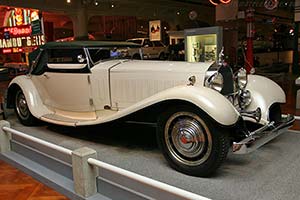
 Type 41 Royale Weinberger Cabriolet
 Ever since he started building cars under his own name, Ettore Bugatti dreamed of creating the ultimate, no compromise luxury car. To that end, he started the development of an eight cylinder engine in 1913 and wrote in great detail about his ambitions in a letter to his friend Espanet. The project was cut short by the outbreak of war throughout Europe. Bugatti redesigned the engine and was used in the war to power airplanes. With peace returned to Europe, Bugatti continued to produce the four cylinder engined cars that had proven so popular before the war.