Page 1 of 1 It is a cruel twist of fate that the most famous Bentley built under W.O. Bentley's reign was the one he did not approve of and by far the least successful. The Naturally Aspirated four and six cylinder engined Bentleys dominated endurance racing, yet it is the supercharged 'Blower' Bentley that is best known today. W.O. Bentley's thoughts on the car were quite straightforward: "To supercharge a Bentley engine was to pervert its design and corrupt its performance." History proved him quite right as the Blower Bentley never won a major race. So why was the supercharged Bentley built in the first place?
The Blower Bentley was the brainchild of 'Bentley Boy' Henry 'Tim' Birkin, who was always looking for more power and speed. W.O.'s solution was to simply increase the size of the engine to improve performance, but that was not sufficient for Birkin. He convinced racing enthusiast the Hon Dorothy Paget to bankroll this conversion with his great charm. Birkin also received the blessing for fellow Bentley Boy, multiple Le Mans winner, diamant magnate and part owner of Bentley Woolf Barnato. Early in 1929 a small shop was set up in Welwyn by Birkin and production of the first supercharged Bentleys commenced.
Birkin got the ball rolling by commissioning Amherst Villiers to build him a Supercharger to bolt onto a completed 4.5 Litre Bentley. This followed the design of all Bentleys of the day that really only differed by the type of engine fitted and even these were built along the same lines. All of them had a single overhead camshaft with a beautiful four-valve per cylinder head. Birkin might have picked the smaller four cylinder engine, so he would not fall in the same class as the Works Bentleys, which used 6.6 Litre 'six'. The 'blower' was bolted to the crankshaft and was prominently visible on the nose of the car. Birkin's conversion certainly made a difference as the power was up from 100 bhp to a healthy 175 bhp, which was still down on the 200 bhp of the Speed Six used by the factory team.
The first Blowers were ready in the summer of 1929 and were entered by the Hon. Dorothy Paget in various races. It quickly became clear that the finely tuned internals of the Bentley engine were no match for the force of the Superchargers and the engines blew more often than not. When they did hold together, the Blower Bentleys were quite competitive with a number of second place finishes as the best result. Despite the mechanical problems, Barnato allowed Birkin to enter a team in the 1930 24 Hours of Le Mans. Their effort, not surprisingly, ended early with two 'blown' engines. The Le Mans entry came back to bite Bentley as they now had to build the agreed fifty examples needed for homologation. Page 1 of 1

 Ultimatecarpage.com
> Cars by brand
> Great Britain
> Bentley
Ultimatecarpage.com
> Cars by brand
> Great Britain
> Bentley
 Racing cars
> Other Sportscars
Racing cars
> Other Sportscars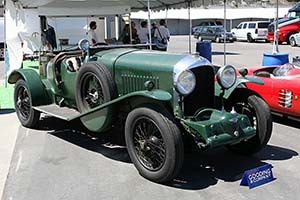
 It is a cruel twist of fate that the most famous Bentley built under W.O. Bentley's reign was the one he did not approve of and by far the least successful. The Naturally Aspirated four and six cylinder engined Bentleys dominated endurance racing, yet it is the supercharged 'Blower' Bentley that is best known today. W.O. Bentley's thoughts on the car were quite straightforward: "To supercharge a Bentley engine was to pervert its design and corrupt its performance." History proved him quite right as the Blower Bentley never won a major race. So why was the supercharged Bentley built in the first place?