Page 1 of 1 Few cars have served as inspiration or basis for concept cars as often as the Corvette has. This tradition dates back to the second half of the 1950s and served to show future design directions and General Motors' latest technology. At the 1990 North American International Auto Show in Detroit the finest and one of the last of the great concepts was launched; the CERV III. The name is a reference to the first two 'Corporate Experimental Racing Vehicles' designed by the great Zora Arkus-Duntov many years before to explore the possibility of a Corvette entry at Le Mans. Even though the CERV III was not intended to go racing, it packed technology found only in the most advanced racing cars of the day.
The world got a first glimpse at what was to come in 1986 when the Corvette Indy Concept was launched. At the time it was considered to serve principally as a show-case for the newly developed Ilmor/Chevrolet Indy racing engine. In fact it was the first result of a partnership between Chevrolet engineers and the British F1 team and sportscar manufacturer Lotus. Even though the mid-engined Indy Concept shown to the public was nothing more than a full scale mock-up, work was under way to build the first fully functioning car back in England. It was completed late in 1986 and a second example in January of 1987. Although they resembled the Indy Concept, they were mainly built to test all the advanced mechanicals that would go into the third and final car.
In good Corvette tradition the CERV III featured a separate body and chassis, but that is about where the similarities stopped. Especially the chassis and suspension were heavily influenced by Lotus. The British company's familiar backbone chassis was used with the engine as a fully stressed member. Constructed from the then very exotic carbon fibre, the backbone weighed a mere 17kg. Suspension was by double wishbones all-round with fully adaptable hydraulic dampers; the titanium springs only served to maintain ride-height when the car was stationary. Vented discs were used with a form of anti-lock braking system, which the driver could override by hitting the brake-paddle even harder. The steering was also state of the art as it featured a second rack for the rear wheels.
Mounted transversely behind the passenger compartment was a twin Turbo-charged and strengthened version of the LT5 engine developed jointly by Lotus and General Motors. This quad-cam engine appeared in Naturally Aspirated form in the Corvette ZR1 introduced in 1989. In the back of the CERV III, it produced a staggering 650 bhp. The power was transferred to all four wheels through a three and two speed automatic gearbox working in sync. It was a somewhat unusual, but effective way to create a six speed gearbox. The carbon fibre propshaft for the front wheels actually ran through the centre section of the backbone chassis. All of the car's highly advanced systems were constantly monitored and adjusted by a computer mounted in the nose.
What was most obviously carried over from the 1986 Indy Concept was the exterior styling. A closer comparison will reveal that many details were changed to make the design suitable for a fully functioning car. What remained was the elegant and very smooth shape, which was considerably more civilized than the designs of contemporary Italian supercars. With a highly impressive drag coefficient of 0.277, the claimed top speed of 362 km/h does not sound completely unfeasible. Naturally carbon fibre was used for the body, but the designers had a few more tricks up their sleeves. To make the CERV III more easily serviceable than the regular mid-engined cars, they placed the body on four hydraulic struts and fitted quick releases for all electric wires and fluid hoses; the entire body could be lifted off for maintenance.
Needless to say the Corvette CERV III Concept was the star of the 1990 Detroit Show. Between its four wheel drive, four wheel steering, adaptable suspension, carbon fibre body and chassis, and 650 bhp engine, it was the most advanced and fastest street legal car ever produced. It was also no surprise that it remained a one-off and only a limited amount of the technology was ever used on production cars. Sadly, it was one of the very last in a long line of 'Corvette' concept cars. Today it resides in the General Motors Heritage Center, where it is treated with great care and commonly referred to as the $1 million Corvette. Page 1 of 1

 Ultimatecarpage.com
> Cars by brand
> United States
> Chevrolet
Ultimatecarpage.com
> Cars by brand
> United States
> Chevrolet
 Corvette CERV III Concept
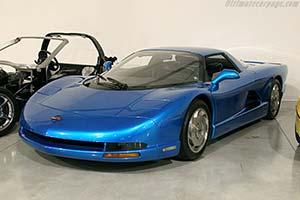
 Few cars have served as inspiration or basis for concept cars as often as the Corvette has. This tradition dates back to the second half of the 1950s and served to show future design directions and General Motors' latest technology. At the 1990 North American International Auto Show in Detroit the finest and one of the last of the great concepts was launched; the CERV III. The name is a reference to the first two 'Corporate Experimental Racing Vehicles' designed by the great Zora Arkus-Duntov many years before to explore the possibility of a Corvette entry at Le Mans. Even though the CERV III was not intended to go racing, it packed technology found only in the most advanced racing cars of the day.