Go to Ultimatecarpage.com

Car search: Quick Advanced 
  Ultimatecarpage.com  > Cars by brand  > Spain  > Pegaso
Z102 B 2.8 Saoutchik Coupe
Cars statistics: 4674 cars, 413 makes, 34492 images; Events statistics: 196 reports, 36409 images; Forum statistics: 83,467 members, 40,991 topics; more...


  Pegaso Z102 B 2.8 Saoutchik Coupe
 

Pegaso Z102 B 2.8 Saoutchik Coupe Pegaso Z102 B 2.8 Saoutchik Coupe Pegaso Z102 B 2.8 Saoutchik Coupe Pegaso Z102 B 2.8 Saoutchik Coupe Pegaso Z102 B 2.8 Saoutchik Coupe Pegaso Z102 B 2.8 Saoutchik Coupe
Click here to save all images    Image credits: Wouter Melissen 

Model history:
Click here to download printer friendly version Today it is hard to fathom that in the early 1950s the most advanced and fastest road car was built not in Italy, Germany or England but in Spain. It gets a little easier to imagine when we learn that this 'supercar' was the brainchild of former Alfa Romeo designer Wilfredo Ricart and built by ENASA in the remnants of the Hispano Suiza factory. On the other hand it must be noted that none of Ricart's designs were particularly successful and that ENASA specialised in buses and trucks. Regardless they got it absolutely right when they launched the Pegaso Z102 at the 1951 Paris Auto Salon. Well actually not quite but more about that later.

Before joining Alfa Romeo in 1936, Ricart had successfully built and raced cars under his own name in Spain. He and his family were forced to flee the country because of the civil war. During his time at the Italian manufacturer, he quickly climbed the ranks and was soon appointed head of design of 'Alfa Corse'; the newly established racing department, which was headed by one Enzo Ferrari. It is commonly believed that the two men did not get along very well, ultimately resulting in Ferrari's famous departure. At Alfa Romeo Ricart designed several inspiring road and racing car, which for various reasons never got beyond the prototype phase. The most famous of these was the 512 'voiturette' racer, powered by a supercharged, mid-mounted flat 12 engine.

With peace returned to Europe, Ricart returned to his native Spain. Here he joined the government backed ENASA, short for Empresa Nacional de Autocamiones SA. Business was booming and towards the end of the 1940s he approached company executives with the idea of developing a Spanish supercar. The nationalistic government was very interested in this unique opportunity to do one better on the traditional automobile manufacturing countries in Europe. Ricart received the green light and started drawing up designs immediately. Perhaps as a gesture to Enzo Ferrari and his legendary emblem, the name Pegaso was picked. This was derived from the Greek mythical creature Pegasus; a flying horse.

Ricart's speciality was engines and he did not waste any of his talents on the Pegaso. He penned a V8 equipped with two camshafts for each bank of cylinders. Included in the design were many typical Alfa Romeo inspired elements like the beautiful valve covers and hemispherical combustion chambers. Initial displacement was a modest 2.5 litre but Ricart left enough room to increase the swept volume to 2.8 and even 3.2 litre. Breathing was through a choice of Weber Carburetors (among the few non Spanish parts on the car) and supercharging was also offered. The smallest of the engine variants was good for an impressive 165 bhp while a whopping 360 bhp was claimed for the blown 3.2.

Although never raced, the Alfa Romeo 512 did underline that Ricart had a fine understanding of chassis design as well and again he used all of it for the Z102. Instead of bolting the five speed gearbox directly to the engine as was common practice, he mounted it in unit with the final drive. With more weight towards the rear of the car, the balance was much more neutral. Also directly derived from racing was the DeDion axle complete with transverse torsion bars used for the rear suspension. At the front double wishbones and longitudinal torsion bars were used. Massive finned drums provided the stopping power. This high-tech running gear was fitted to a steel platform chassis with an unusually short wheelbase.

Up to here there were no flaws but unfortunately all of these beautiful mechanicals were covered by a rather ungainly and awkward ENASA built coachwork. So visitors of the 1951 Paris Auto Salon can be excused if they were not impressed at first sight by the new manufacturer from Barcelona. The situation was soon rectified as Pegaso brought an example with a see through body to the next major shows. Additionally specialist coach builders Touring of Milan and Saoutchik of Paris were commissioned to work their 'magic' on the Z102 chassis. The two specialists complemented each other's work with Touring providing elegant coupe bodies while Jacques Saoutchik penned strangely attractively baroque coupe and cabriolet bodies.

Considering the Pegaso's specification, it came as no surprise that Ricart readied a racing version of the Z102. The road going chassis was already drilled for lightness so other than an engine little was needed. Touring fitted the racing cars with roadster bodies using their light weight 'superleggera' construction. In full running order the cars weighed less than 1000 kg. Two were ready in time for the 1952 Monaco Grand Prix, which was run for sports cars that year. Problems in practice with wheel flap forced the team to withdraw from the race. Next on the agenda was the 24 Hours of Le Mans but the proposed two car entry was not ready in time to take part. Eventually racing in 1952 was limited to local hillclimbs where the cars proved moderately successful.

Preparations for the 1953 Le Mans began well in advance. Ricart had developed a highly unusual catamaran shaped or 'bisiluro' bodywork. The two strange machines were fitted with a two-stage supercharged version of the 2.5 litre engine. Fortune did not smile on Pegaso's racing effort as both racers were severely damaged in a factory fire. Ricart was now forced to revert to the Touring barchettas for Le Mans. During the practice sessions works driver 'Jover' crashed fatally and the team withdrew from the racing. The only notable performance of a Pegaso in an international event came during the Carrera PanAmericana late in 1953. The company's test driver Palacio ran as high as third behind the leading Ferraris. But again the race ended in tragedy as the Touring Barchetta crashed heavily. Fortunately Palacio survived.

Amidst the racing effort the production of road cars was a slow and tedious process. There were only few employees skilled enough to make these supercars. To make matters worse almost every part of the car had to be made in-house as there were no suppliers of high performance parts in Spain. Pegaso did claim a spot in the history books; in September of 1953 a supercharged roadster was timed at 152 mph, a road car record. It lasted only a few weeks as Jaguar crushed the record with a 'mildly' modified version of the XK140 road car. It is believed only 87 Z102s were built when Ricart launched the Z103 in 1956. This used a far less complex OHV V8 engine. It did not turn Pegaso's fortunes and production ceased in 1958. ENASA needed all the space available to make the much more profitable trucks and buses.


Chassis: 0161
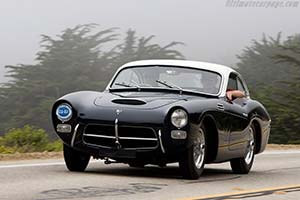
Chassis 0161 Saoutchik's bodies fitted can be separated in two series. Featured is a Coupe of the second series. It is powered by the 2.8 litre version of the engine. Originally sold to a local customer, the car eventually ended up in the United States. Towards the end of the 1990s it returned to Europe but in recent years has been sold to North America once more. In superb condition, it is pictured above during the 2008 Pebble Beach Concours d'Elegance.

Article by Wouter Melissen, last updated on December 29, 2008

Add your comments on the Pegaso Z102 B 2.8 Saoutchik Coupe

     
General specifications
Country of origin Spain
Chassis number 0161
Numbers built 6 (Second Series Saoutchik Coupes)
Produced from 1951 - 1956
Body design Jacques Saoutchik

Engine
Configuration 90º V8
Location Front, longitudinally mounted
Construction light alloy block and head
Displacement 2.815 liter / 171.8 cu in
Bore / Stroke 80.0 mm (3.1 in) / 70.0 mm (2.8 in)
Compression 8.8:1
Valvetrain 2 valves / cylinder, DOHC
Fuel feed 4 Weber 36 DCF3 Carburettors
Aspiration Naturally Aspirated
Power 170 bhp / 127 KW @ 6500 rpm
Torque 221 Nm / 163 ft lbs @ 3400 rpm
BHP/Liter 60 bhp / liter

Drivetrain
Chassis body on steel platform chassis
Front suspension double wishbones, longitudinal torsion bars, telescopic shock absorbers
Rear suspension De DeDion axle, transverse torsion bars, telescopic shock absorbers
Steering worm-and-nut
Brakes drums, all-round
Gearbox 5 speed Manual
Drive Rear wheel drive

Dimensions
Weight 1280 kilo / 2821.9 lbs
Length / Width / Height 4100 mm (161.4 in) / N/A / N/A
Wheelbase / Track (fr/r) 2340 mm (92.1 in) / 1320 mm (52 in) / 1290 mm (50.8 in)

Performance figures
Top Speed 225 km/h (140 mph)

Resources
Related articles
Useful links