Page 1 of 2 Next >> Ever the conservative, Enzo Ferrari rarely produced an experimental or ground-breaking racing car. He much rather followed a path of gradual evolution, which resulted in fast but above all reliable racing cars. By the early 1960s most manufacturers had switched to the mid-engine configuration, including Ferrari for the Formula 1 cars and the smaller engined sports racers. It would, however, take until 1963 before Ferrari built the first sports racer with a mid-mounted V12 engine. Considering that the Italian team had won the 24 Hours of Le Mans for the 3rd year running in 1962, it was certainly not too late.
Using the lessons learned with the six and eight cylinder sports racers of previous seasons, a simple but effective steel tubular spaceframe was drawn up. Suspension was also very straightforward with double wishbones and coil springs being used front and rear. Stopping power was provided by Dunlop discs brakes, which were mounted inboard at the rear to lower the suspension's unsprung weight and improve handling. The space that was traditionally reserved for the screaming V12 engine was now used for the radiator and the fuel tanks.
Mounted longitudinally behind the driver was the familiar 'short block' V12 engine. A hallmark of Ferrari's design philosophy, it was a direct development of the engine originally penned by Gioachino Colombo back in 1946. Particularly in three liter guise, it had been hugely successful, scoring wins in almost all major races including Le Mans and the Mille Miglia. For the new mid-engined racer, the latest specification of the '250' engine was used. Breathing through six Weber Carburetors, it produced just over 300 bhp.
Dubbed the 250 P, the rolling chassis was sent to Fantuzzi, who clothed it in a curvaceous, slippery aluminium body penned by Pininfarina. It featured an airfoil behind the open cockpit and a cut-down rear-end to reduce drag. These 'aero' features were reminiscent of the front engined 330 TRI/LM that won the 24 Hours of Le Mans a year earlier. A large opening in the nose fed air to the front mounted radiator. In the rear-deck two large scoops allowed the V12 engine to breath. Completed the 250 P had a dry weight of just 760 kg, which was considerably lighter than the comparable front-engined 250 TR. Page 1 of 2 Next >>

 Ultimatecarpage.com
> Cars by brand
> Italy
> Ferrari
Ultimatecarpage.com
> Cars by brand
> Italy
> Ferrari
 Racing cars
> Other Sportscars
Racing cars
> Other Sportscars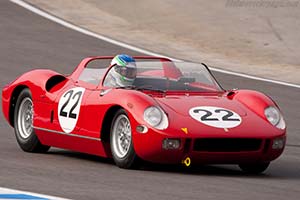
 Ever the conservative, Enzo Ferrari rarely produced an experimental or ground-breaking racing car. He much rather followed a path of gradual evolution, which resulted in fast but above all reliable racing cars. By the early 1960s most manufacturers had switched to the mid-engine configuration, including Ferrari for the Formula 1 cars and the smaller engined sports racers. It would, however, take until 1963 before Ferrari built the first sports racer with a mid-mounted V12 engine. Considering that the Italian team had won the 24 Hours of Le Mans for the 3rd year running in 1962, it was certainly not too late.