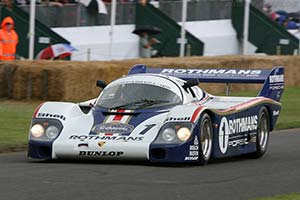
Model history: With the 935 and 936 Porsche dominated international sportscar and prototype racing in the second half of the 1970s. Racing in the Group 5 and Group 6 classes respectively, the two cars shared a Turbocharged six cylinder engine. Installed in the 936 for the 1981 24 Hours of Le Mans, the engine displaced 2.65 litres and was equipped with water-cooled heads and four valves per cylinder. Designated 935/76, this engine powered the 936 to a third victory at Le Mans.
At the end of the 1981 season drastic rule changes left Porsches prototype racer obsolete. A new system of Group A, B and C classes were setup for 1982. Group A and B cars required a limited production run to be eligible. Group C cars on the other hand were prototypes and restricted only by a number of set dimensions. Another important aspect of Group C racing was the fact that only a limited amount of fuel was available per car per race, effectively restricting the engines' performance.
Two weeks after the 1981 Le Mans victory, Porsche started work on a prototype racer to suit the Group C regulations. It was the first all new racer Porsche constructed in over a decade and was quite a departure from the 936, which shared many components with Porsche's prototypes of the late 1960s. The only proven part of the new '956' was the aluminium flat 6 engine, which had powered the 936.
For many years Porsche had relied on a triangular spaceframe structure for their products, but to keep up with the competition a completely new aluminium monocoque chassis was designed for the 956. The monocoque supported the front suspension and a rear subframe. The engine and rear suspension were mounted on the subframe. Suspension was by wishbones all-round with the rear coil-spring / shock absorber unit mounted on top of the gearbox to keep them out of the airflow.
The regulations stated that the section of the bottom right behind the front suspension was completely flat, to prevent that the cars would have extreme ground effects bottoms. Porsche fitted the 956 with large Venturis, starting right behind the mandatory flat section, making it the first the ground-effects Porsche. Because of its width, a flat engine is not ideally suited for ground-effects, but this was somewhat fixed by tilting the engine upwards. Combining the ground-effects bottom with a simple but effective body, the 956 generated over 3 times more downforce than the 917.
To suit the fuel economy regulations best, the engine management of the already efficient flat 6 engine was revised with the help of Bosch. The mechanical Fuel Injection system was replaced by a digital unit, resulting in a similar output as the 936 engine, but with better fuel efficiency and more torque. Bolted onto the engine was a new five speed gearbox with a syncromesh on all gears. It replaced the sturdy four speed unit used on the 936, which was originally designed for the hugely powerful Can-Am cars.
After nine months of hard work, the 956 made its debut, two races into the season. Its main competition consisted of underfinanced or badly supported cars from Lola and Ford. At its debut in the Silverstone Six Hours race, the 956 finished second overall behind an old Group 6 Lancia and first in the Group C class. A sign of things to come! In the following four years, the Porsche 956 dominated international sportscar racing and secured four consecutive Le Mans 24 Hours victory.
The only factory team taking Porsche on was Lancia, but they never seemed to get the reliability right. In qualification sessions, the Lancias often proved their pace, but they rarely managed to finish a race. In the three years the Lancia works team took part in the championship, they managed to beat the 956 only once. Key to the success of the 956 was the large fleet of customer entered example, backing up the works entries. A total of 10 works and 17 customer cars were constructed.
Porsche had also set its sights on the IMSA GTP championship in the USA, which almost identical to the Group C championship. One big difference was the stricter pedal-box regulations in the USA, which stated that the pedal-box had to be mounted behind the front axle line for driver safety. The 956 did not comply with that, so Porsche started work on a revised model, the 962, specifically intended as a GTP contender. In 1984 the 962 made its debut and was as immediately dominant in GTP as the 956 was in Group C.
Anticipating a pedal-box rule change for Group C after the 1985 season, Porsche developed the 962C as the works Group C racer for 1985. At Le Mans the works 962Cs were beaten by customer 956s. At the end of the season the 956 was left obsolete after the FIA had copied the IMSA's stricter pedal-box regulations. Porsche continued their stronghold in the Group C championship and secured another two Le Mans victories in 1986 and 1987. Eventually they were beaten in 1988 by newer and more advanced Jaguars, prepared by TWR.
Despite their age, the Porsches remained compoetitive throughout the Group C / GTP era. In slightly revised Dauer-Porsche form the 962 took another Le Mans win in 1994; a dozen years after it was first conceived. Needless to say the Porsche 956/962 has gone into history as one of the finest racing cars ever constructed.
Chassis: 956/001
The very first Porsche 956. It made its racing debut at the Silverstone 6 Hour race in May of 1982 and was driven to class victory by Jackie Ickx and Derek Bell. During Le Mans, chassis 001 served as a T-car. Subsequently it was raced only once more, to victory at the Norisring by Jochen Mass. In the Summer of 1986, it was given to Ickx to thank him for many services for Porsches. After a lengthy stay in the United States, it recently ended up in the hands of a great Porsche and Group C racing enthusiast in Great Britain. Derek Bell is seen here back in one of 'his' old 956s during the 2007 Goodwood Festival of Speed, where the 25th anniversary of Group C was celebrated.(Source: Golden Era, the History of Group C & IMSA GTP, Ian Briggs and John Starkey)
Chassis: 956/007
Chassis 007 was built up new for 1983 and can be distinguished from its precessors by its slightly different Rothmans livery. It was driven to victory in the 1983 Silverstone 1000 km by Stefan Bellof and Derek Bell. It later crashed during a race at the Nurburgring. Some surviving parts were used on the rebuild of chassis 008 that had also been crashed. The 'new car' was was subsequently renumbered 007. It was eventually bought by Derek Bell and eventually ended up in the hands of a British Group C and Porsche racing enthusiast. It is pictured here in action during the 2008 Goodwood Festival of Speed.(Source: Golden Era, the History of Group C & IMSA GTP, Ian Briggs and John Starkey)
Chassis: 956/114
Chassis 114 was the second of five customer cars built in 1984, are officially referred to as 956Bs. They were virtually identical to the 1983 Works and featured many minor changes compared to the earlier cars. This car was owned by John Fitzpatrick and campaigned in the evocative Skoal Bandit colours. The best result was a second place at Mosport with David Hobbs behind the wheel. It was raced for two more seasons in different liveries before it was retired from contemporary racing. In recent years it was regularly raced in Historic Group C events. It is seen here during the 2007 Goodwood Festival of Speed where the 25th anniversary of Group C was celebrated.(Source: Golden Era, the History of Group C & IMSA GTP, Ian Briggs and John Starkey)
Article by Wouter Melissen, last updated on February 13, 2009
The concept of having detailed info on individual examples of a model takes UCP a step further in what comes to usefulness and accuracy. It's a great idea to those who really like to know their stuff.