Go to Ultimatecarpage.com

Car search: Quick Advanced 
 sport Ultimatecarpage.com  > Cars by brand  > Italy  > Nardi-Danese
Racing cars  > Other Sportscars
     Alfa Romeo Roadster
Cars statistics: 4674 cars, 413 makes, 34492 images; Events statistics: 196 reports, 36409 images; Forum statistics: 83,467 members, 40,991 topics; more...


  Nardi-Danese Alfa Romeo Roadster
 

Nardi-Danese Alfa Romeo Roadster Nardi-Danese Alfa Romeo Roadster Nardi-Danese Alfa Romeo Roadster Nardi-Danese Alfa Romeo Roadster Nardi-Danese Alfa Romeo Roadster Nardi-Danese Alfa Romeo Roadster
Click here to save all images    Image credits: Wouter Melissen 

Model history:
Click here to download printer friendly version Best known today for his wood-rimmed steering wheels, Enrico Nardi was responsible for a wide variety of exciting projects. He worked for Enzo Ferrari in the late 1930s and helped develop the Auto Avia 815, which can be considered the first ever Ferrari sports car. After the War, he established his own shop with the help of Renato Danese. Under the Nardi-Danese banner, they produced various sports cars. The most potent of these were powered by an Alfa Romeo sourced six cylinder engine.

The chassis Nardi designed for the new sports car consisted of two side-members with considerable cross-bracing. Each side-member was constructed from two tubes running from the front to the back of the car with vertical and diagonal tubes added for further strength. At the front the chassis was suspended by double wishbones and a transverse leaf-spring that ran under the chassis rails. A live-axle with Bugatti-style reversed quarter-elliptic leaf springs served as the rear end. Massive drum brakes were fitted on each corner.

A dry-sump version of Alfa Romeo's 6C 2500 was mounted low and well back in the chassis. This resulted in a better weight balance than on the 6C engine competition Alfas of the period. Nardi was an engine tuning wizard; his skills were in high demand of both the criminals and law enforcement. After he worked his magic on the 2.5 litre straight six, it produced around 150 bhp. That was quite an improvement over the (most definitely conservative) 105 bhp Alfa Romeo claimed as the engine's output. The four-speed gearbox found in the 6C 2500 was also used for the Nardi-Danese.

It is obvious that Nardi gave considerable thought to the car's weight distribution. As stated earlier the engine was installed towards the centre of the car. He left enough space in front of the engine for the water and oil radiators to also be fitted within the car's wheelbase. To balance out the mass of the engine, the sizeable fuel tank was mounted on top of the rear suspension. The smaller tank for the dry-sump system was mounted alongside the engine. While most of the components were custom built, Nardi did try to use much cheaper Fiat bits where possible.

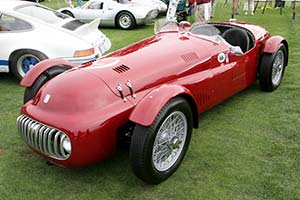
Nardi used various local coach-builders for his projects but entrusted the clothing of the Alfa Romeo engined Nardi-Daneses to Rocco Motto. Although not nearly as famous today as some of his contemporaries, Motto had a good reputation for building lightweight bodies in period. He tightly wrapped the Nardi-Danese chassis in an aluminium skin with cycle fenders on all four wheels. The tall engine was mounted so low in the body that the bonnet was barely taller than the front fenders. The headlights were mounted behind the deep grille.

It is believed that at least four and possibly five chassis were built along these lines early in 1948. Three of these were fitted with the big Alfa Romeo engine and Motto's cycle fender body. A fourth used the same Fiat derived straight eight fitted in the Auto Avia while a fifth may have been finished with a fixed head body and the 6C 2500 unit. The Alfa Romeo powered roadsters were fielded in major events like the Mille Miglia and Targa Florio. Unfortunately they did not prove to be very reliable and no notable result was scored.

Never one to settle, Nardi broke his ties with Danese shortly after these cars were built. A few years later he launched the range of beautiful steering wheels that secured his place in automotive history. He spent his final years before his untimely death in 1966 mostly with Lancia related products. The Nardi-Danese sports cars were scattered around the globe and were raced for many more years. Today the surviving examples are regarded as the finest machines that wore the Nardi name not just on the steering wheel but also on the nose.


Chassis: 948-05
Chassis 948-05 Chassis 948-5 was one of two Nardi-Daneses used in the Mille Miglia and Targa Florio in 1948 and 1949 with little success. After its brief Italian racing career, it was sold in 1950 to Perry Fina in New York. Together with Jim Pauley and Harry Grey, he raced the car at various events along the east coast of the United States. To keep the car competitive, he eventually replaced the Alfa Romeo engine with a more powerful Cadillac V8.

After Fina sold the car, it was not seen until 1969 when it was acquired by Homer Tsakis. He recognised the historical importance of the rare Nardi-Danese and had the car fully restored to its original condition. For this purpose he had tracked down a correct dry-sump Alfa Romeo engine. The body and chassis had survived the long racing career remarkably well. In 1997, the car passed in the hands of the current owner, who submitted chassis 948-5 to a fresh, ground-up restoration. The work took over 2,700 man-hours to complete.

The car has since participated in all the major events, including the Mille Miglia retrospective and the Goodwood Festival of Speed. The Nardi-Danese was also awarded 'best in class' at Pebble Beach. It is seen here at the 2006 Quail, a Motorsports Gathering.

Chassis: 948-11
Chassis 948-11 Ordered new by Count Felice Trossi, this Nardi-Danese Alfa Romeo was raced by Francesco Beneventano in the Targa Florio and Mille Miglia in 1948 and again in 1949. He managed to finish only once; during the 1949 Mille Miglia with Renato Danese in the passenger seat. It is believed that the car was sold to Argentina shortly after from Count Trossi's estate. Here Juan Manuel Fangio himself tested the car but deemed it too slow.

In 1954 it reappears in the hands of Californian racer Gordon Cooper. He extensively raced the car, now named the Cooper Special after its owner. Cooper slightly enlarged the engine, lifting power to 200 bhp, fitted larger wheels and added two extra grilles in the nose ahead of the oil cooler. Motor Trend tested the car and found that it was capable of speeds well in excess of 200 km/h. During the 1960s the cars passed into the collection of triple Le Mans winner and Ferrari's man in North America, Luigi Chinetti.

Chinetti cherished the Alfa Romeo machine and displayed it prominently in his showroom. He held on to it for over two decades before selling it to Ali Lugo, who had had his eyes on the rare machine for quite sometime. He carefully restored the car to its original configuration and even managed to acquire the original grille from Cooper. After showing the car at numerous concours and racing it extensively he sold the Nardi-Danese to its current owner. The prominent American collector ranks it among his favourite cars and thoroughly enjoys driving it.

Article by Wouter Melissen, last updated on March 19, 2010

Add your comments on the Nardi-Danese Alfa Romeo Roadster

 Namesake  
danese
06-24-2010
Thanks for the wonderful article about the Nardi-Danese Alfa Romeo Roadster.

My name is Danese Cooper and my Dad was Gordon Cooper who you referenced in the last section. His car was the 948-11, and he actually named me (his first child) after the car (Danese, not 948-11). As you can imagine, it has always held a special place in my heart.

I remember it in our garage when I was a little girl, but in the early 60s he sold it to Mr. Chinetti to buy the land his business sat on. I got to see it again at Laguna Seca 25 years later when Mr. Lugo was restoring it for the Mille Miglia and asked Dad if he still had the original grille (and steering wheel), both of which had hung in our garage forever. I have a picture of me sitting one of the bicycle fenders and one of Dad smiling next to "the Alfa" (as we called it). When my Dad passed away, we used one of the lovely pictures Motor Trend shot of him at the wheel on the switchbacks by our house for his memorial.

There are quite a few pictures of Dad and Mom and the Alfa on my Flickr account at http://www.flickr.com/photos/danesecooper/sets/72157603664214719/
     
General specifications
Country of origin Italy
Chassis number 948-05 / 948-11
Numbers built 3
Produced in 1948
Body design Motto

Engine
Configuration Alfa Romeo Straight 6
Location Front, longitudinally mounted
Construction cast-iron block, light alloy head
Displacement 2.443 liter / 149.1 cu in
Bore / Stroke 72.0 mm (2.8 in) / 100.0 mm (3.9 in)
Compression 8.0:1
Valvetrain 2 valves / cylinder, DOHC
Fuel feed 3 Weber 33 DCO Carburettors
Aspiration Naturally Aspirated
Power 150 bhp / 112 KW
BHP/Liter 61 bhp / liter

Drivetrain
Chassis aluminium body steel tubular frame
Front suspension double wishbones, transverse semi-elliptic leaf spring, friction dampers
Rear suspension live axle, reversed quarter-elliptic leaf springs
Brakes hydraulic drums, all-round
Gearbox 4 speed Manual
Drive Rear wheel drive

Dimensions
Weight 850 kilo / 1873.9 lbs

Performance figures

Resources
Related articles
Useful links