Go to Ultimatecarpage.com

Car search: Quick Advanced 
 lmp Ultimatecarpage.com  > Cars by brand  > Japan  > Toyota
Racing cars  > LMP
     TS030 Hybrid
Cars statistics: 5053 cars, 430 makes, 39380 images; Events statistics: 215 reports, 41349 images; Forum statistics: 85,352 members, 41,966 topics; more...


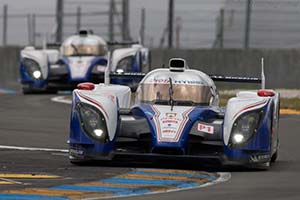
  Toyota TS030 Hybrid
 

Toyota TS030 Hybrid Toyota TS030 Hybrid Toyota TS030 Hybrid Toyota TS030 Hybrid Toyota TS030 Hybrid Toyota TS030 Hybrid
Click here to save all images    Image credits: Wouter Melissen 

Click here to download printer friendly version When Toyota switched from endurance racing to Formula 1 at the end of the 1999 season, the 24 Hours of Le Mans was still very much unfinished business for the Japanese manufacturer. In their final outing in the legendary event with the GT-One TS020, victory was literally within grasps until a puncture in the dying minutes allowed one of the BMWs to get ahead. Throughout Toyota's tenure in F1, there was talk of an imminent return but it eventually took until late in 2011 before the comeback was finally announced.

One of the deciding factors for Toyota to return to sports car racing was the accommodation made in the regulations for hybrid power-trains. Pioneering the technology on road cars, this would allow the Japanese manufacturer to showcase its potential on the race track as well. Back in Japan, a competition version of the hybrid system was already under development. Its first application was for the Supra HV-R that won the Tokashi 24-Hour Race in 2007. In the following years, much of the development work focused on shedding excess weight to make the system viable for use on a potential Le Mans car.

While similar in concept, Toyota Motorsport's hybrid system does not use conventional batteries to store the energy but ultra- or supercapacitors. Among the racing-specific advantages of using these supercapacitors is that they can be charged and de-charged very quickly and can also sustain a large number of charge cycles without any noticeable degradation. Among the reasons why they are not quite as practical for road applications (yet) are the relatively low storage capacity/weight ratio, the high self-discharge rate and the more complicated electronics required to make the most of the supercapacitors.

For the conventional engine, the regulations offered several choices of which Toyota picked the naturally aspirated petrol option. Used by the Rebellion team, a suitable 3.4-litre V8 was already available, but Toyota's engineers nevertheless decided to develop a new engine from the ground up. Like the Formula Nippon / SuperGT derived unit made available to customers, Toyota's new engine was once again a 3.4 litre V8. No further details have been released at this time, so we can not say to what extent the two V8s differ but it is safe to assume the new engine has been optimised for endurance racing.

No longer occupied with F1, Toyota's Cologne-based motorsport division was tasked to design and construct the new car. Under the leadership of Pascal Vasselon, a conventional carbon-fibre monocoque chassis was developed. Suspension was by double wishbones with push-rod actuated springs and dampers. As was the new norm, the front suspension was designed to accommodate wide tyres, previously only used for the rear wheels. The new V8-engine was mated to a transversely mounted six-speed gearbox. Like its rivals, the new Toyota featured efficient coupe-bodywork.

Known as the 'TS030 Hybrid', the new Toyota was launched early in 2012. At that time, the engineers were assessing two distinct versions of the hybrid system; one with a front-mounted electric motor and the other with the electric motor mounted in unit with the engine. The former offered the advantage of all-wheel drive but a late adjustment to the regulations, reportedly on the insistence of Peugeot, limited the use of the front motor to speeds of over 120 km/h. As a result most of the advantages of driven front wheels were eliminated, so it was decided to use the rear-mounted option.

To help run the program, Toyota called in the services of the French Oreca team, who are constructors in their own right and had also built up considerable experience running a diesel-powered Peugeot in the 2010 and 2011 seasons. Making the most of Peugeot's withdrawal from the sport early in 2012, Toyota recruited drivers Alexander Wurz and Anthony Davidson, who joined Oreca's Nicolas Lapierre, and ex-Formula 1 racers Kazuki Nakajima and Sebastien Buemi. One of Toyota's SuperGT drivers, Hiroaki Ishiura was also slated to drive but he had to step down due to back-problems. His place was taken by another ex-Peugeot man, Stephane Sarrazin.

Originally, Toyota had planned to run the first car in the 6 Hours of Spa-Francorchamps but an accident in testing forced the team to postpone the public debut until the official Le Mans Test Day. By that time, the car sported a heavily revised front-end and a new colour-scheme; gone were the traditional red and white Toyota colours, replaced by a lightning-inspired blue and white livery to emphasise the use of a hybrid drivetrain. Setting the fourth and fifth fastest times, hot on the heels of defending champions Audi, the performance during the first outing was certainly encouraging.

During the race weekend, pace was again not an issue but the cars did suffer some technical issues in practice and qualifying. The two TS030s started the race in third and fifth with the faster of the pair beaten only by the hybrid Audis. After a careful start of the race, Lapierre in the quickest of the Toyotas briefly grabbed the lead early in the evening. Sadly it all went horribly wrong for the Japanese team soon after as Davidson had a massive crash in the sister car while trying to pass a slower car. The surviving car, which had lead briefly, soon started to develop problems and eventually retired before nightfall.

Undeterred, Toyota Motorsport GmbH soldiered on and readied a single TS030 for the five remaining FIA WEC rounds. They grafted ingenious but also controversial extensions to the wings, which were nevertheless declared legal. The gremlins were also ironed out, and the TS030 scored its maiden victory at Sao Paulo. Later in the year, two more wins were added to the tally. With three wins out of six attempts in its first season, the TS030 has already lived up to expectations. Planning to run two cars for the complete FIA WEC season, TMG is now certainly one of the two joint favourites for the big trophies in 2013.

Article by Wouter Melissen, last updated on December 31, 2012

Add your comments on the Toyota TS030 Hybrid


General specifications
Country of origin Japan
Numbers built N/A
Produced in 2012
Predecessor
Body design Toyota Motorsport GmbH

Major wins
2012 6 Hours of Sao Paulo (Alexander Wurz / Nicolas Lapierre in 02)
2012 6 Hours of Fuji (Alexander Wurz / Nicolas Lapierre / Kazuki Nakajima in 02)
2012 6 Hours of Shanghai (Alexander Wurz / Nicolas Lapierre in 02)

Engine
Configuration 90º V8
Location Mid, longitudinally mounted
Construction aluminium block and head
Displacement 3.4 liter / 207.5 cu in
Valvetrain 4 valves / cylinder, DOHC
Fuel Petrol
Lubrication Dry sump
Aspiration Naturally Aspirated
Power 530 bhp / 395 KW
BHP/Liter 156 bhp / liter

Engine
Configuration Denso Electric Motor
Location Mid, longitudinally mounted
Fuel Capacitor
Power 300 bhp / 224 KW

Drivetrain
Body carbon composite panels
Chassis carbon fibre monocoque
Suspension (fr/r) double wishbones, push-rod actuated torsion bar springs and dampers
Steering rack-and-pinion, hydraulic power assistance
Brakes ventilated carbon ceramic discs, all-round
Gearbox 6 speed Sequential
Drive Rear wheel drive

Dimensions
Weight 900 kilo / 1984.2 lbs
Length / Width / Height 4650 mm (183.1 in) / 2000 mm (78.7 in) / 1030 mm (40.6 in)

Performance figures
Combined Power 830 bhp / 619 KW
Power to weight 0.92 bhp / kg

Resources
Related cars
Related articles
Useful links