Page 1 of 3 Next >> A significant reduction of the displacement limits put additional emphasis on (aerodynamic) efficiency ahead of the 2011 season and prompted Audi to develop the first closed cockpit sports racer for over a decade. Dubbed the R18 TDI, the new machine featured an equally new engine with an innovative single turbo layout. The engineers left room in the design for future developments, including the adoption of a hybrid drive system.
While the R18 TDI proved a winner at Le Mans first time out, it was deemed too heavy and for 2012 a lighter version was developed. One of the main reasons additional weight had to be shed was for the additional mechanicals required for the hybrid system. Hedging their bets, two versions of the evolution were readied; the 'conventional' R18 Ultra and the R18 e-tron quattro, equipped with two additional electric motors and a flywheel to store and distribute the generated energy.
Both versions sport a gearbox that features a complete carbon-fibre casing and has been the source of much of the weight saving. This is mated to the same wide-angle V6 with the turbo-charger wedged between the cylinder banks. The single turbo featured variable turbine geometry to ensure it is effective throughout the rev-band. In an effort to increase the parity between the diesel and petrol powered machines, further restrictions were imposed on the diesel engines, lowering the V6's output to a claimed 510 bhp.
Changes have also been made to the front of the chassis to accommodate two electric motors, which also double as generators. The energy is stored in an electric flywheel that is mounted alongside the driver. Supplied by Williams Hybrid Power, the flywheel spins in a vacuum at speeds of up to 45,000 rpm. Compared to conventional batteries, a flywheel can be charged and de-charged quickly and also does not suffer from degradation. As per the regulations, the storage capacity is restricted to just 500 kJ.
The kinetic energy is generated and used by two MGUs or Motor Generator Units, connected to the front wheels. Following protests from a rivalling team, it was decided that front motors could only be used at speeds of over 120 km/h. This removes most of the all-wheel drive benefits provided by the driven front wheels. To cool the motors and the flywheel an additional cooling system is fitted, which is responsible for a slight increase in weight and drag compared to the conventional R18 Ultra.
The modifications made to the front crash-structure in order to accommodate for the MGUs are also incorporated in the Ultra, and Audi have stated that if needed one could be converted in the other version without much effort. Suspension is more conventional with double wishbones all around. Push-rods are used at the front while the new rear-end features pull-rod actuated springs and dampers. Another novelty is a rear-view camera that is connected to a small screen in the cockpit and improves the drivers' rearward visibility. Page 1 of 3 Next >>

 Ultimatecarpage.com
> Cars by brand
> Germany
> Audi
Ultimatecarpage.com
> Cars by brand
> Germany
> Audi
 Racing cars
> LMP
Racing cars
> LMP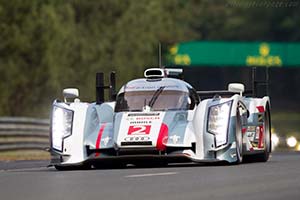
 A significant reduction of the displacement limits put additional emphasis on (aerodynamic) efficiency ahead of the 2011 season and prompted Audi to develop the first closed cockpit sports racer for over a decade. Dubbed the R18 TDI, the new machine featured an equally new engine with an innovative single turbo layout. The engineers left room in the design for future developments, including the adoption of a hybrid drive system.